
Level:
Correct: 0
Incorrect: 0
Marks: 0/0
Exam Practice
Course:
Topics:
AQA GCSE Music Smart practice A mixed round aimed at your weak spots
Unit 1
The language of music
Unit 2
Area of study 1: Western classical tradition 1650-1910
Unit 3
Area of study 2: Popular music
Unit 4
Area of study 3: Traditional music
Unit 5
Area of study 4: Western classical tradition since 1910
Avg
score:
–
Topics
done:
0/44

Rock music of the 1960s and 1970s

Practise 11 exam-style questions on Rock music of the 1960s and 1970s for AQA GCSE Music. Write your answer as you would in the exam and get it marked in seconds against the mark scheme, point by point, with the Study Helper on hand if you get stuck.

  • 11 questions
  • 1–3 marks each
  • Instant marking
  • No sign-up needed
11 questions, marked as you go

Sample questions with model answers

Here are 4 of the questions in this topic, each with a model answer, an explanation of why it earns the marks and the mark scheme an examiner would use.

Question 1

1 mark

Which keyboard instrument, used on many rock records of the late 1960s and the 1970s, plays back a strip of tape recorded from a real instrument, such as a flute, strings or a choir, while each key is held down?

Choose your answer.

  • Hammond organ
  • Mellotron
  • Moog synthesiser
  • electric piano

Model answer

Mellotron.

Explanation

The Mellotron was developed in Birmingham in 1963: pressing a key pushes a length of magnetic tape against a playback head, and the tape springs back when the key is released. The Beatles used its flute sound for the introduction of Strawberry Fields Forever (1967), and it became a key instrument of 1970s progressive rock bands such as King Crimson, Genesis and Yes. Students often confuse it with the synthesiser, which generates its sounds electronically rather than playing back recordings.

Mark scheme
  1. 1 mark

    Mellotron

    Accept close spellings (for example 'Melotron'). Do not accept Hammond organ (an electric organ whose tone comes from spinning tonewheels), Moog synthesiser (which creates sounds electronically with oscillators, not from recordings) or electric piano. If more than one option is given, award 0.
Question 2

2 marks

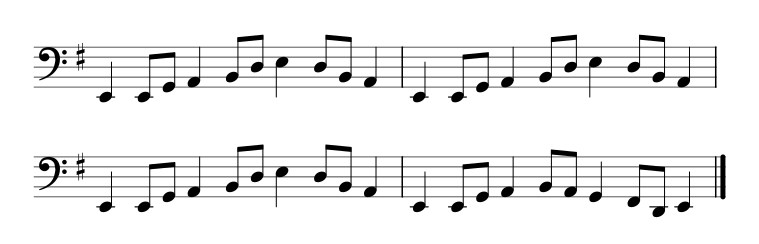
The figure shows a bass riff written for this course in the style of 1970s progressive rock. The time signature has been left out. Every bar has the same total length, and each pair of beamed quavers fills one beat.

Give the time signature that fits these bars, and name the type of scale used in the first three bars.

Four bars of a bass riff on a bass clef stave, with a key signature of one sharp and no time signature, printed as two lines of two bars. The bars use crotchets and pairs of beamed quavers; the first three bars are the same.

Model answer

Each bar contains seven crotchet beats, so the time signature is 7/4. The first three bars use only E, G, A, B and D, so they are based on the minor pentatonic scale on E.

Explanation

Count the beats: in each bar the crotchets and pairs of quavers add up to seven crotchet beats, and the riff climbs for four beats and falls back over three. Most rock is in 4/4, so an irregular metre like 7/4 is a mark of progressive rock: most of Pink Floyd's Money (1973) is in 7/4, with its guitar solo in 4/4. The pentatonic scale, a five-note scale often used in rock riffs and solos, is one of the tonality terms AQA lists for this area of study; the F# in the last bar adds a sixth note.

Mark scheme
  1. 1 mark

    7/4

    Accept 'seven crotchet beats in a bar' or 'seven four', and 7/4 with its grouping added (for example '7/4, grouped 4 + 3'). Each bar adds up to seven crotchets (fourteen quavers); the quavers are beamed in pairs, one crotchet beat each, as the question states. Do not accept 7/8 (each bar is twice that length), 14/8 (the same length, but it has a quaver beat, while the question gives a crotchet beat), 4/4, 3/4, 'alternating 4/4 and 3/4' (every bar is the same length) or 'irregular' without a time signature.

  2. 1 mark

    pentatonic / minor pentatonic / E minor pentatonic

    Bars 1 to 3 use only the five notes E, G, A, B and D. Accept any answer that names the pentatonic scale (G major pentatonic contains the same five notes, so accept it). Do not accept 'blues scale' (there is no flattened fifth), 'major', 'whole tone', 'chromatic' or 'E minor' alone (the minor scale has seven notes).

Question 3

2 marks

Punk rock spread through Britain in 1976 and 1977, with bands such as the Sex Pistols and the Clash, who rejected what they saw as the excesses of mainstream 1970s rock.

Give two musical differences between a typical punk rock song and a typical progressive rock track of the 1970s.

Model answer

A punk song is short, often about two or three minutes, whereas a progressive rock track can last over ten minutes in several sections. Punk uses a few simple, distorted power chords and has few or no guitar solos, while progressive rock uses more complex harmony and long, virtuosic solos, often on keyboards and synthesisers.

Explanation

A comparison question needs both styles in each answer, or a clear comparative. Punk grew up between 1974 and 1976 in New York (the Ramones) and London (the Sex Pistols); it kept rock's verse-chorus form and 4/4 time, viewed virtuosity with suspicion and favoured short, stripped-down songs. Its do-it-yourself attitude made the expensive equipment and long training behind progressive rock seem unnecessary.

Mark scheme
  1. 2 marks

    Any two different contrasts: punk songs are short (about 2-3 minutes), progressive rock tracks long and extended; punk uses a few simple chords (often distorted power chords), progressive rock more complex harmony; punk has few or no guitar solos, progressive rock long, virtuosic solos; punk is fast with a regular 4/4 beat, progressive rock often uses unusual or changing time signatures; punk uses a stripped-down line-up (guitars, bass, drums, voice), progressive rock adds keyboards, synthesisers, Mellotron or orchestral instruments; punk vocals are often shouted or snarled, progressive rock vocals sung; punk production is raw and minimal (sometimes do-it-yourself), progressive rock production elaborate, with studio effects; punk uses simple verse-chorus structures, progressive rock multi-section suites and concept albums; punk prizes energy over technique (amateur, DIY approach), progressive rock prizes technical virtuosity

    1 mark for each different contrast, max 2. Each answer must make a comparison: either both sides, or a clear comparative such as 'punk songs are much shorter'. A feature of only one style with no comparison (for example 'punk is loud') earns nothing. Do not accept contrasts the wrong way round (for example 'punk has longer solos').

Question 4

3 marks

George Harrison's song Within You Without You, from the Beatles' album Sgt. Pepper's Lonely Hearts Club Band (1967), is written in the style of Indian classical music.

Name two Indian instruments used in the song, and give one feature of Indian classical music, other than its instruments, that the song uses.

Model answer

The song uses the sitar and the tabla, and also the dilruba, tambura and swarmandal. Like Indian classical music, it is built over a constant drone on the keynote and fifth, and its melody uses a mode similar to the Mixolydian.

Explanation

Two marks are for named Indian instruments and one for another Indian feature. Harrison recorded the song with Indian musicians from London's Asian Music Circle; the tabla follows Indian rhythmic cycles (tala) and the tambura provides the drone. AQA's specification names the sitar and dilruba among the specific instrument types for popular music, and the Beatles helped to bring the sitar into 1960s psychedelic rock. Vague answers such as 'Indian drums' do not earn a mark.

Mark scheme
  1. 2 marks

    Any two of: sitar; dilruba; tabla; tambura (tanpura); swarmandal

    1 mark for each different instrument, max 2. Accept close spellings (for example tamboura, tampura, svarmandal, swaramandal). Accept only instruments named here. Do not accept violins or cellos (George Martin added a Western string section of eight violins and three cellos), acoustic guitar, or 'Indian drums' without the name tabla.

  2. 1 mark

    Any one of: a drone (a constant drone on the keynote and fifth, C and G as the song was written); a mode or raga-like scale (Khamaj thaat, similar to the Mixolydian mode); tala: long rhythmic cycles played on the tabla (16-beat tintal, and 10-beat jhaptal in the instrumental section, which is in 5/4); pitch bends / slides decorating the melody; a change of metre for the instrumental section

    Accept 'drone', 'pedal', 'modal', 'raga', 'tala' or 'rhythmic cycle', 'pitch bends', 'changes time signature'. Do not accept a further instrument name for this mark, 'twelve-bar blues', 'power chords' or 'major key'.

Ready to try the rest? Every answer you write is marked against the mark scheme, so you can see exactly where the marks are.

Study Helper Hints first, answers after you try

Stuck on this one? Ask for a hint and I’ll point you in the right direction, without giving the answer away. Once you’ve checked your answer, I’ll show you how the marks are awarded.