Practise 15 exam-style questions on Reading staff notation for AQA GCSE Music. Write your answer as you would in the exam and get it marked in seconds against the mark scheme, point by point, with the Study Helper on hand if you get stuck.
15 questions
1–3 marks each
Instant marking
No sign-up needed
15 questions, marked as you go
Sample questions with model answers
Here are 4 of the questions in this topic, each with a model answer, an explanation of why it earns the marks and the mark scheme an examiner would use.
Question 1
1 mark
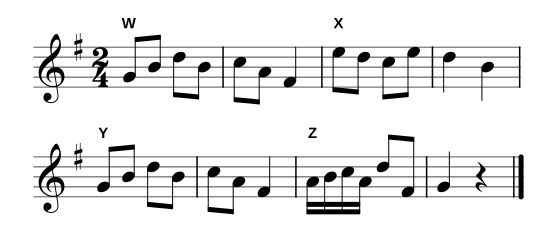
The melody below is made of four two-bar phrases, beginning at the notes labelled W, X, Y and Z.
Which one of these describes its phrase structure?
Choose your answer.
AABA
ABAB
ABAC
AABB
Model answer
ABAC: the phrase at Y repeats the phrase at W exactly, while the phrases at X and Z are new.
Explanation
Compare the phrases note by note: W and Y are identical (A), X is different (B), and Z, with its semiquavers and its ending on the tonic, is different again (C). A new phrase always takes the next unused letter, and a phrase that is only slightly changed would be marked A1.
Mark scheme
1 mark
ABAC
Do not accept more than one option. The phrase beginning at Y is an exact repeat of the phrase beginning at W; the phrases beginning at X and Z are different from W and from each other.
Question 2
2 marks
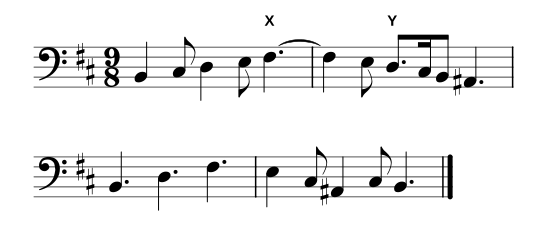
Look at the bass line below, which is in 9/8.
The note labelled X is tied to the first note of the next bar. For how many quavers does the tied sound last altogether? Then give the note value of the note labelled Y.
Model answer
X is a dotted crotchet (3 quavers) and it is tied to a crotchet (2 quavers), so the sound lasts 3 + 2 = 5 quavers. Y is a dotted quaver.
Explanation
A tie joins two notes of the same pitch into one sound, so add their values. In 9/8 the beat is a dotted crotchet (three beats of three quavers), which is why X fills the last beat of its bar. Y is followed by a semiquaver and a quaver, making a dotted rhythm inside one dotted-crotchet beat.
Mark scheme
1 mark
5 quavers
Accept 5, 'five quavers', 'two and a half crotchets'. Working: X is a dotted crotchet (3 quavers) tied to a crotchet (2 quavers): 3 + 2 = 5. Correct answer with no working scores the mark. Do not accept 3 (X alone) or 6.
1 mark
Y: dotted quaver
Accept 'dotted quaver', 'dotted eighth note'. Do not accept 'quaver' or 'dotted crotchet'.
Question 3
2 marks
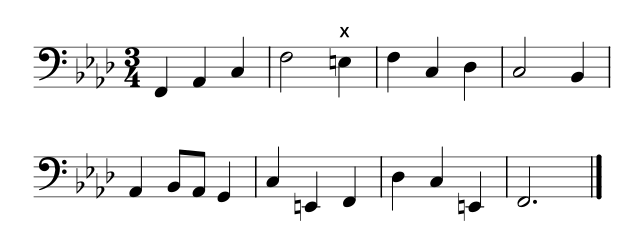
The bass line below is in F minor.
Name the note labelled X, including any sharp, flat or natural that applies to it. Then explain why this note needs a natural sign in F minor.
Model answer
X is E natural. F minor shares its key signature (four flats, including E flat) with its relative major, A flat major, but in the minor key the 7th note is raised to make a leading note a semitone below the tonic. The natural sign raises E flat to E natural, which leads up to F, as it does in the next bar.
Explanation
A minor key uses the key signature of its relative major, so its raised 7th (leading note) must be written as an accidental each time: E natural in F minor, just as B natural in C minor or G sharp in A minor. Here the natural sign raises the note; it does not lower it. These accidentals are also the best evidence that a passage is in the minor key rather than its relative major.
Mark scheme
1 mark
X: E natural
Accept naturals, sharps and flats typed as symbols or words: E natural, E♮, E or E3. Do not accept E flat (the natural sign cancels the E flat of the key signature), C (the third space read as if it were the treble clef) or F.
1 mark
it is the leading note / raised 7th of F minor: the natural raises the E flat of the key signature by a semitone, so that it lies a semitone below the tonic F and leads up to it
Accept 'leading note', 'raised 7th', 'sharpened 7th', 'the 7th note of the (harmonic) minor scale is raised', 'it makes a semitone step up to F, the tonic'. This mark does not depend on the first. Do not accept 'to cancel the E flat' alone (that says what the sign does, not why F minor needs it), 'because the music modulates' or 'to make the key major'.
Question 4
3 marks
The bass line below is for cello.
Name the notes labelled X, Y and Z, including any sharp, flat or natural that applies to them.
Model answer
X is E, on the first ledger line below the bass stave. Y is D natural: the natural sign on the first D of the bar lasts to the end of the bar. Z is C sharp, on the first ledger line above the stave (where middle C is written), sharpened by the key signature.
Explanation
In the bass clef the first ledger line below the stave is E and the first ledger line above is middle C. The key signature of four sharps (F#, C#, G#, D#) sharpens every C, including ledger-line Cs, unless an accidental cancels it, and a natural sign cancels the key signature only until the bar line. A common error is to read the bass clef as if it were the treble clef.
Mark scheme
1 mark
X: E
Each note must be matched to the right label. Accept sharps, flats and naturals typed as symbols or words (C#, C sharp, C♯; D natural). Accept E, E natural, E2. Do not accept C (the first ledger line below the treble stave) or G.
1 mark
Y: D natural
Accept 'D natural', 'D♮' or 'D': the natural sign on the first D of the bar still applies. Do not accept D sharp.
1 mark
Z: C sharp
Accept C#, C sharp, C♯, C#4, 'middle C sharp'. Do not accept C or 'middle C' without the sharp: the key signature of four sharps includes C sharp. Do not accept A (the first ledger line above the treble stave).
Ready to try the rest? Every answer you write is marked against the mark scheme, so you can see exactly where the marks are.
Ctrl + Enter to check
Study HelperHints first, answers after you try
Stuck on this one? Ask for a hint and I’ll point you in the right direction, without giving the answer away. Once you’ve checked your answer, I’ll show you how the marks are awarded.