
Level:
Correct: 0
Incorrect: 0
Marks: 0/0
Exam Practice
Course:
Topics:
AQA GCSE Music Smart practice A mixed round aimed at your weak spots
Unit 1
The language of music
Unit 2
Area of study 1: Western classical tradition 1650-1910
Unit 3
Area of study 2: Popular music
Unit 4
Area of study 3: Traditional music
Unit 5
Area of study 4: Western classical tradition since 1910
Avg
score:
–
Topics
done:
0/44

Structure and form

Practise 15 exam-style questions on Structure and form for AQA GCSE Music. Write your answer as you would in the exam and get it marked in seconds against the mark scheme, point by point, with the Study Helper on hand if you get stuck.

  • 15 questions
  • 1–3 marks each
  • Instant marking
  • No sign-up needed
15 questions, marked as you go

Sample questions with model answers

Here are 4 of the questions in this topic, each with a model answer, an explanation of why it earns the marks and the mark scheme an examiner would use.

Question 1

2 marks

Look at the melody in the figure. It is made of three four-bar phrases, which begin at the notes labelled X, Y and Z.

Using letters, describe the structure of the melody, and name the form.
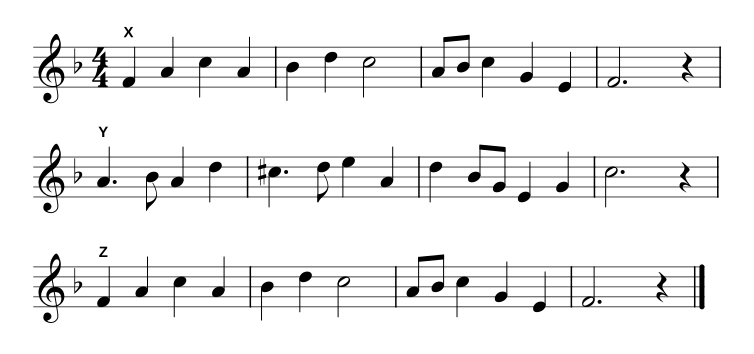
A twelve-bar melody in the treble clef with a key signature of one flat, in 4/4 time, on three lines of four bars. The first notes of bars 1, 5 and 9 are labelled X, Y and Z.

Model answer

A B A: the phrase at Z is the same as the phrase at X, and the phrase at Y is different. This is ternary form.

Explanation

Bars 9-12 repeat bars 1-4 exactly, while bars 5-8 bring a contrast: a new dotted rhythm and a C sharp suggesting D minor, then a long C (the dominant of F) that prepares the return. Three sections with the first coming back after a contrast is ternary form (A B A). Students who label the third phrase C have not compared it note by note with the first.

Mark scheme
  1. 1 mark

    A B A

    Accept ABA / A-B-A, or any wording that makes clear that the phrase at Z is the same as the phrase at X and the phrase at Y is different. Accept A B A1 (the last phrase is in fact an exact repeat, but the shape is right). Do not accept A B C (the third phrase is the same as the first) or A A B.

  2. 1 mark

    ternary (form)

    Accept close spellings (e.g. 'turnary'); ignore capital letters. Do not accept binary (two sections, A B), rondo (needs at least two different episodes, e.g. A B A C A) or arch shape.
Question 2

2 marks

The third movement of a symphony is often either a minuet and trio or a scherzo and trio.

Give one similarity and one difference between a minuet and trio and a scherzo and trio.

Model answer

Both are in ternary form, the main section, then a contrasting trio, then the main section again, in triple time. The difference is that a scherzo is much faster and more playful than a minuet, often felt as one beat in a bar.

Explanation

The minuet and trio, a dance in triple time, was the usual third movement of Classical symphonies (AQA's AoS 1 guide). The scherzo, Italian for 'joke', keeps the triple time and A B A shape but is much quicker; Haydn used scherzos in his Op. 33 string quartets, and they gradually replaced the minuet, especially in Beethoven's works.

Mark scheme
  1. 1 mark

    Similarity, any one of: both are in ternary form overall (main section, then trio, then main section again: A B A); both are in triple time; both have a contrasting trio as the middle section; both are used as a movement (often the third) of symphonies, string quartets or sonatas

    Any one similarity. Accept 'both are in 3/4'. Accept close spellings of terms; ignore capital letters.

  2. 1 mark

    Difference, any one of: a scherzo is faster or livelier (often felt as one beat in a bar) than a minuet, which is a more moderate dance; a scherzo is more playful, humorous or energetic ('scherzo' means joke); the minuet comes from a courtly dance; the scherzo became common later, replacing the minuet in many works from Beethoven's time

    Any one difference. Do not accept 'a scherzo has no trio' or 'a scherzo is in duple time'.

Question 3

2 marks

Some traditional music, such as West African drumming, uses call and response and has a cyclic structure.

Explain what is meant by call and response and by a cyclic structure.

Model answer

In call and response, a leader plays or sings a phrase (the call) and a group, or another instrument, answers it (the response). A cyclic structure is built on a pattern of a fixed number of beats that repeats over and over, with the other parts changing or improvising above it.

Explanation

Both features are common in African music and in styles influenced by it: in West African drumming a master drummer often leads the calls, while a repeating bell pattern keeps the cycle going. Call and response is also heard in blues, where an instrument answers the singer. Each term needs its own explanation for its mark.

Mark scheme
  1. 1 mark

    Call and response: a phrase played or sung by one performer (the leader) is answered by another phrase from a group or another performer

    Accept 'question and answer between a soloist and a group' when the answering is clear. The idea of a phrase being answered is needed. Do not accept 'two groups playing at the same time'.

  2. 1 mark

    Cyclic: the music is built on a pattern of fixed length (a set number of beats, a rhythm, a melody or a chord sequence) that repeats again and again in a cycle, while other parts vary over it

    Accept 'built on repeating cycles of beats, rhythms or chords', 'a repeated pattern (such as a bell pattern, riff or chord sequence) that loops round'. The idea that other parts vary over the cycle is not required. 'It repeats' or 'repetition' alone is too vague: the answer needs the idea of a repeating pattern or cycle that the music is built on. Do not accept 'themes from one movement come back in later movements': that is cyclic form in Western classical music, not the meaning for traditional music asked here.

Question 4

3 marks

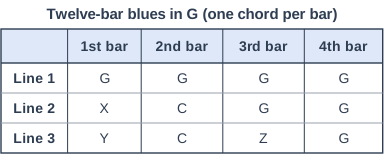
The table shows the chords of a twelve-bar blues in G, with one chord in each bar, set out in three lines of four bars.

Name the chords X, Y and Z.

Twelve-bar blues in G (one chord per bar). Table with columns (row headings), "1st bar", "2nd bar", "3rd bar", "4th bar". Line 1; 1st bar: G; 2nd bar: G; 3rd bar: G; 4th bar: G | Line 2; 1st bar: X; 2nd bar: C; 3rd bar: G; 4th bar: G | Line 3; 1st bar: Y; 2nd bar: C; 3rd bar: Z; 4th bar: G.

Model answer

X is C (chord IV), Y is D (chord V) and Z is G (chord I).

Explanation

The standard twelve-bar blues uses the three primary chords: I I I I, IV IV I I, V IV I I. In G these are G, C and D, often played as seventh chords (G7, C7, D7). There are variations, such as IV in bar 2 or V in bar 12 as a turnaround, but bars 5, 9 and 11 are IV, V and I.

Mark scheme
  1. 1 mark

    X: C (chord IV)

    Accept C / C major / C7 / IV / IV7; ignore capital letters. Answers must be matched to X, Y and Z. Do not accept D or G.

  2. 1 mark

    Y: D (chord V)

    Accept D / D major / D7 / V / V7. Do not accept C or G.

  3. 1 mark

    Z: G (chord I)

    Accept G / G major / G7 / I / I7. Do not accept D (some versions put V in the last bar as a turnaround, but Z is the third bar of the line, which is I).

Ready to try the rest? Every answer you write is marked against the mark scheme, so you can see exactly where the marks are.

Study Helper Hints first, answers after you try

Stuck on this one? Ask for a hint and I’ll point you in the right direction, without giving the answer away. Once you’ve checked your answer, I’ll show you how the marks are awarded.