
Level:
Correct: 0
Incorrect: 0
Marks: 0/0
Exam Practice
Course:
Topics:
AQA GCSE Music Smart practice A mixed round aimed at your weak spots
Unit 1
The language of music
Unit 2
Area of study 1: Western classical tradition 1650-1910
Unit 3
Area of study 2: Popular music
Unit 4
Area of study 3: Traditional music
Unit 5
Area of study 4: Western classical tradition since 1910
Avg
score:
–
Topics
done:
0/44

The orchestral music of Kodály and Bartók

Practise 11 exam-style questions on The orchestral music of Kodály and Bartók for AQA GCSE Music. Write your answer as you would in the exam and get it marked in seconds against the mark scheme, point by point, with the Study Helper on hand if you get stuck.

  • 11 questions
  • 1–3 marks each
  • Instant marking
  • No sign-up needed
11 questions, marked as you go

Sample questions with model answers

Here are 4 of the questions in this topic, each with a model answer, an explanation of why it earns the marks and the mark scheme an examiner would use.

Question 1

1 mark

Bartók often asked string players for a special kind of pizzicato, now called the Bartók pizzicato or snap pizzicato. What does the player do?

Choose your answer.

  • pulls the string up so it snaps back against the fingerboard
  • plucks the string with the left hand
  • bounces the bow off the string
  • taps the string with the wood of the bow

Model answer

The player pulls the string up away from the fingerboard and lets go, so it snaps back against the wood.

Explanation

The snap pizzicato gives a hard, percussive crack, one of many ways Bartók extended the sound of string instruments; he also used glissandi, pizzicato glissandi, col legno and sul ponticello. It is named after Bartók because he used it so often, for example in his String Quartet No. 4 (1928). The other options are real techniques with different names: left-hand pizzicato, spiccato and col legno.

Mark scheme
  1. 1 mark

    pulls the string up so it snaps back against the fingerboard

    Accept close wording of this option. Do not accept 'plucks the string with the left hand' (left-hand pizzicato), 'bounces the bow off the string' (spiccato) or 'taps the string with the wood of the bow' (col legno). If more than one option is given, award 0.
Question 2

2 marks

Bartók wrote his Concerto for Orchestra in 1943, while living in the USA. It has no single soloist.

Explain why Bartók called it a concerto, and name the conductor or the orchestra for whom it was written.

Model answer

Bartók explained that the title comes from the way it treats single instruments and groups of instruments in a soloistic, virtuoso manner, like soloists in a concerto. It was commissioned by the conductor Serge Koussevitzky for the Boston Symphony Orchestra.

Explanation

Bartók, in exile in the USA from 1940, ill and short of money, received the commission from Koussevitzky's foundation in 1943; the Boston Symphony Orchestra gave the premiere on 1 December 1944. The work has five movements, including the Game of the Pairs, the Elegia and the Interrupted Intermezzo, whose interruption is usually described as a parody of a march tune from Shostakovich's Seventh Symphony (the tune also resembles a song from Lehar's The Merry Widow, and which one Bartók was mocking is disputed). Bartók died in New York in 1945.

Mark scheme
  1. 1 mark

    Because individual instruments and sections of the orchestra are treated like soloists / have virtuosic, exposed solo passages (a 'concertante' or soloistic style)

    Accept 'every section gets a turn to show off', 'the whole orchestra is the soloist' or 'it is written for a virtuoso orchestra'. Do not accept 'it has three movements' (it has five) or 'it has a cadenza for the conductor'.

  2. 1 mark

    (Serge) Koussevitzky / the Boston Symphony Orchestra

    Accept close spellings, 'the Koussevitzky Foundation' or 'Boston Symphony'. Do not accept the New York Philharmonic, Paul Sacher or a Hungarian orchestra.

Question 3

2 marks

Give two features of rhythm or metre typical of Bartók's orchestral music.

Model answer

Bartók often changes the time signature, so the metre is irregular: the first movement of Music for Strings, Percussion and Celesta changes time signature constantly. He also uses driving ostinato rhythms with strong accents, taken from folk dances.

Explanation

Bartók's rhythm grows from the folk music he collected: lively dances with strong accents, uneven 'Bulgarian' groupings and speech-like free rhythms in slow songs. The fugue that opens Music for Strings, Percussion and Celesta has a constantly changing time signature, and the main tune of the Interrupted Intermezzo in the Concerto for Orchestra also keeps changing metre. Name the device rather than writing 'the rhythm is complicated'.

Mark scheme
  1. 2 marks

    Any two different features: irregular metre / frequently changing time signatures; asymmetric ('Bulgarian') rhythms, with uneven groups of beats such as 2+2+3; driving, repeated (ostinato) rhythms; strong accents, often on unexpected beats / syncopation; rhythms from folk dances; free, speech-like rhythm in slow folk-style melodies (parlando rubato); short-long (Scotch snap) and dotted rhythms from Hungarian folk song; cross-rhythms or polyrhythms; repeated notes that speed up or slow down

    1 mark for each different feature, max 2. Accept close spellings of terms. 'Irregular metre' and 'changing time signatures' are the same feature; 'syncopation' and 'off-beat accents' are the same feature. Any other valid feature of rhythm or metre may be credited. Do not accept 'swing rhythm', 'always in 4/4' or features of melody or harmony.

Question 4

3 marks

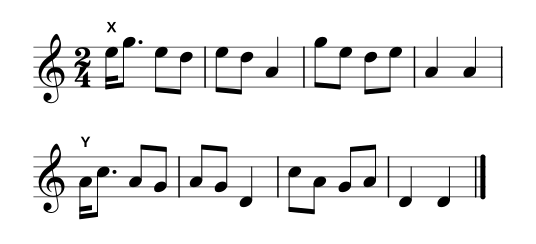
The melody below was written for this course in the style of an old Hungarian folk song, of the kind Bartók and Kodály collected.

Name the rhythm that begins at X (and again at Y), describe how bars 5-8 are related to bars 1-4, and name the scale the melody uses.

A melody of eight bars on a treble clef stave, with no key signature and the time signature 2/4, printed as two lines of four bars. The letter X is printed above the first note of bar 1 and the letter Y above the first note of bar 5.

Model answer

The rhythm at X and Y is a Scotch snap: a short note on the beat followed by a longer one. Bars 5-8 are the same as bars 1-4 but a perfect fifth lower. The melody uses a pentatonic scale.

Explanation

X is a semiquaver followed by a dotted quaver, a short-long Scotch snap with the stress on its first, short note; Hungarian words are always stressed on the first syllable, and writers link this to the strongly accented rhythms of Hungarian folk music. Every note of bars 5-8 is a perfect 5th below the matching note of bars 1-4 (E becomes A, G becomes C), the 'fifth-shifting' plan of old Hungarian songs, whose last two lines repeat the first two a fifth lower. The melody uses only A, C, D, E and G: a pentatonic scale, typical of the oldest layer of Hungarian folk song.

Mark scheme
  1. 1 mark

    Scotch snap / Lombardic rhythm / reversed (reverse, short-long) dotted rhythm

    Accept close spellings of terms in this question (e.g. 'scots snap'). Accept 'snap rhythm'. Accept 'dotted rhythm' only if the answer makes clear that the short note comes first. The question asks for the name of the rhythm: listing the note values alone ('a semiquaver then a dotted quaver') does not earn the mark. Do not accept 'dotted rhythm' alone (usually long-short), 'triplet' or 'syncopation'.

  2. 1 mark

    Bars 5-8 repeat bars 1-4 a (perfect) 5th lower / transposed down a 5th

    Accept 'the same melody a fifth lower', 'a sequence a fifth lower' or 'transposed down a perfect fifth'. The interval is needed: do not accept 'repeated lower' or 'a sequence' without the 5th, or a wrong interval (such as a 4th or an octave lower).

  3. 1 mark

    pentatonic (scale)

    Accept 'minor pentatonic' or 'anhemitonic pentatonic'. Do not accept major, minor, whole tone, chromatic, blues, or a mode name such as Aeolian or Dorian (these are seven-note scales).

Ready to try the rest? Every answer you write is marked against the mark scheme, so you can see exactly where the marks are.

Study Helper Hints first, answers after you try

Stuck on this one? Ask for a hint and I’ll point you in the right direction, without giving the answer away. Once you’ve checked your answer, I’ll show you how the marks are awarded.