Practise 11 exam-style questions on The orchestral music of Copland for AQA GCSE Music. Write your answer as you would in the exam and get it marked in seconds against the mark scheme, point by point, with the Study Helper on hand if you get stuck.
11 questions
1–3 marks each
Instant marking
No sign-up needed
11 questions, marked as you go
Sample questions with model answers
Here are 4 of the questions in this topic, each with a model answer, an explanation of why it earns the marks and the mark scheme an examiner would use.
Question 1
1 mark
Copland's Lincoln Portrait (1942) was written in the early years of the Second World War. Besides the orchestra, which performer does it need?
Choose your answer.
narrator
soprano soloist
chorus
solo pianist
Model answer
A narrator.
Explanation
Lincoln Portrait, commissioned by the conductor Andre Kostelanetz and first performed in Cincinnati in May 1942, is for narrator and orchestra: the narrator speaks words from Abraham Lincoln's speeches and writings, chosen by Copland. Like Fanfare for the Common Man, it belongs to Copland's patriotic wartime works, and it quotes the American songs Springfield Mountain and Camptown Races.
Mark scheme
1 mark
narrator
Accept 'speaker' or 'a reader'. Do not accept soprano soloist, chorus or solo pianist. If more than one option is given, award 0.
Question 2
2 marks
In the 1930s Copland deliberately changed to a simpler, more approachable style.
Explain two reasons for this change.
Model answer
Copland wanted to reach the huge new audience who enjoyed music on the radio, on records and in films, and he felt that his dissonant 1920s style had not reached them. The Great Depression also made him want to write music for ordinary people, so he used American folk tunes and subjects to make his music approachable and recognisably American.
Explanation
Copland wrote that a new public had grown up around the radio and the phonograph, and that he wanted to say what he had to say in the simplest possible terms, a style he called an 'imposed simplicity'. The Depression and then the Second World War encouraged music for 'the common man': ballets on American subjects, film scores (such as Of Mice and Men, 1939) and patriotic works such as Lincoln Portrait. Each reason earns a mark only if it explains why, not just what, he changed.
Mark scheme
2 marks
Any two different reasons: to reach a new, wider audience who knew music through radio, records (the gramophone/phonograph) and films; he felt that his dissonant, modernist music of the 1920s did not reach ordinary audiences; the Great Depression made composers want to write music with a social purpose, for ordinary people ('the common man'); commissions for ballets, film scores, radio and school music needed music that a general audience could follow; he wanted to create a recognisably American (patriotic) kind of concert music, using American folk tunes and subjects
1 mark for each different correct reason, max 2. Each reason must be explained, not just named: 'money' or 'to be popular' alone is not enough, but 'to reach the wider public who listened to the radio' earns the mark. 'A wider audience' and 'ordinary people' count as one reason unless the second answer adds a different cause (such as the Depression or radio). Do not accept 'because he had studied in Paris' (his Paris training led to his 1920s modernist style) or 'because he began to use twelve-tone methods' (that came later, from 1950). Do not credit the Second World War as the cause on its own: the USA entered the war in December 1941, after the change, although wartime works such as Fanfare for the Common Man and Lincoln Portrait (1942) continued the style; a wish to write patriotic, American music is credited under the point above.
Question 3
2 marks
Give two features of the way Copland uses the instruments of the orchestra (sonority) in works such as Rodeo, Appalachian Spring and his Third Symphony.
Model answer
Copland gives important melodies to woodwind and brass, such as the solo clarinet in Appalachian Spring or the French horn in his Third Symphony, and he uses a large percussion section with xylophone, woodblock and snare drum. His chords are often widely spaced, with flutes and violins high above the bass instruments.
Explanation
Copland's orchestration is clear and colourful: brass fanfares and solos, expressive woodwind solos, a large percussion section (Rodeo's score includes xylophone, glockenspiel, woodblock, whip, snare drum and bass drum, plus harp and piano) and wide spacing between high and low instruments. Name instruments precisely: AQA's June 2025 report said it was disappointing that very few students recognised a French horn in a passage from Copland's Third Symphony.
Mark scheme
2 marks
Any two different features: prominent brass, including fanfare-like passages; solo melodies for brass such as the trumpet or French horn; solo melodies for woodwind such as the clarinet, flute or oboe; a large percussion section, including tuned percussion such as timpani, xylophone or glockenspiel and untuned percussion such as woodblock, snare drum, bass drum and cymbals; piano (or celesta) and harp used as orchestral instruments; widely spaced scoring, with high instruments (such as flute and violins) far above the bass; contrasting blocks of instrumental colour, such as brass against strings; violins imitating country fiddling in fast dances; pizzicato or sustained chords in the strings
1 mark for each different correct feature, max 2. Any other valid feature of sonority may be credited. Accept close spellings of instrument names and terms. Naming a specific instrument in a specific role earns the mark (for example 'a solo clarinet melody'); 'uses an orchestra' or 'uses lots of instruments' does not. 'Large percussion section' and 'xylophone and woodblock' count as one feature. Do not accept synthesisers or electronic sounds, harpsichord continuo, electric guitar or drum kit.
Question 4
3 marks
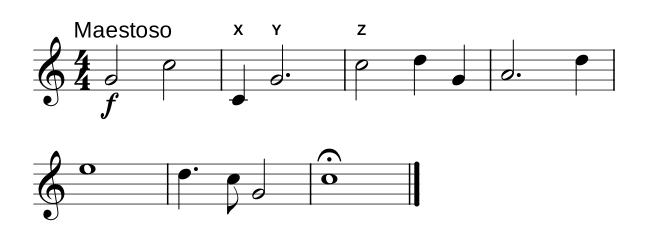
The melody below was written for this course in the style of a Copland fanfare.
Name the interval between the notes labelled X and Y, and the interval between the notes labelled Y and Z. Then give the meaning of the tempo marking at the start.
Model answer
From X to Y is a perfect 5th, and from Y to Z is a perfect 4th. Maestoso means majestically, in a stately way.
Explanation
X is C and Y is the G above it: counting C, D, E, F, G gives a 5th of 7 semitones, a perfect 5th. Y to Z, G up to C, is a 4th of 5 semitones, a perfect 4th. Fanfare-like melodies built on rising 4ths and 5ths are typical of Copland: the theme of his Fanfare for the Common Man is built mainly on perfect 4ths and 5ths. Italian terms were among the weaker answers in AQA's June 2025 report, so learn maestoso alongside the tempo terms.
Mark scheme
1 mark
X to Y: (perfect) 5th / fifth
Accept close spellings of terms and Italian words in this question. Accept '5th', 'fifth', 'P5' or 'perfect fifth'. Do not accept a wrong quality (major, minor, augmented or diminished 5th) or a wrong number.
1 mark
Y to Z: (perfect) 4th / fourth
Accept '4th', 'fourth', 'P4' or 'perfect fourth'. Do not accept a wrong quality (major, minor, augmented or diminished 4th) or a wrong number.
1 mark
Maestoso: majestically / in a majestic, stately way
Accept 'grand', 'dignified', 'stately', 'majestic'. Do not accept 'slowly' alone or 'fast' (maestoso describes character, often with a moderate or slow tempo), or 'loud' (that is shown by the f).
Ready to try the rest? Every answer you write is marked against the mark scheme, so you can see exactly where the marks are.
Ctrl + Enter to check
Study HelperHints first, answers after you try
Stuck on this one? Ask for a hint and I’ll point you in the right direction, without giving the answer away. Once you’ve checked your answer, I’ll show you how the marks are awarded.