Practise 15 exam-style questions on Harmony: chords and cadences for AQA GCSE Music. Write your answer as you would in the exam and get it marked in seconds against the mark scheme, point by point, with the Study Helper on hand if you get stuck.
15 questions
1–3 marks each
Instant marking
No sign-up needed
15 questions, marked as you go
Sample questions with model answers
Here are 4 of the questions in this topic, each with a model answer, an explanation of why it earns the marks and the mark scheme an examiner would use.
Question 1
2 marks
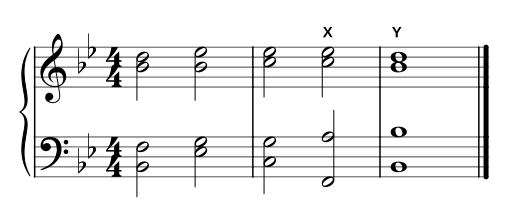
The passage below is in B flat major.
Give the chord symbol (for example Gm or C7) of the chord at X. Then name the cadence formed by the chords at X and Y.
Model answer
X is F7, the dominant 7th (V7) of B flat major. X to Y is a perfect cadence (V7-I).
Explanation
At X the notes are F, A, C and E flat: a major chord on F with a minor 7th added, so the chord symbol is F7 (V7 in B flat major). Y is the tonic chord of B flat (I), so X to Y is V7-I, a perfect cadence. A common error is to write only 'F': the 7th (E flat, given by the key signature) must be shown in the symbol.
Mark scheme
1 mark
F7
Accept 'F7', 'F dominant 7th', 'F dominant seventh'. Accept keyboard spellings of note names anywhere in the answer (Bb / B flat / B♭, Eb / E flat / E♭) and close spellings of terms. Do not accept 'F' or 'F major' alone (the E flat makes it a dominant 7th chord), 'V7' alone (the question asks for the chord symbol) or 'Fmaj7' (that would need E natural).
1 mark
perfect
Accept 'V7-I', 'V-I', 'full close' or 'authentic'. Do not accept 'plagal', 'imperfect' or 'interrupted'.
Question 2
2 marks
A pop song in D major repeats the stock chord progression I VI IV V.
Give the chord symbol for each of the four chords, in order.
Model answer
D, Bm, G, A.
Explanation
The scale of D major is D, E, F sharp, G, A, B, C sharp. Chord I is D major, VI is built on B (B, D, F sharp: B minor, Bm), IV is G major and V is A major. This I-VI-IV-V pattern is often called the '50s' or doo-wop progression; the common slip is to make chord VI major.
Mark scheme
2 marks
D, Bm, G, A (in this order)
2 marks for all four correct in order; 1 mark for any three correct in their correct places; max 2. Accept 'B minor' or 'Bmin' for Bm, and 'D major', 'G major', 'A major' for the others. Accept keyboard spellings of note names (F# / F sharp / F♯) and close spellings of terms. Do not credit 'B' or 'B major' for chord VI (in a major key chord VI is minor).
Question 3
2 marks
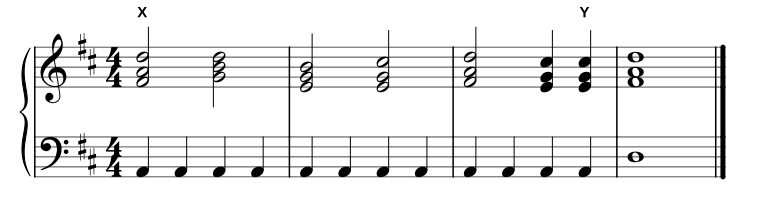
The passage below is in D major. Look at the bass part from the beat labelled X to the beat labelled Y.
Name the harmonic device used there, and state which degree of the scale the bass note is.
Model answer
It is a pedal: the bass repeats A, the dominant (5th degree) of D major, while the chords above it change. It is a dominant pedal.
Explanation
A pedal is a note held or repeated, usually in the bass, while the harmony above it changes, so some chords clash with it. In D major the scale is D, E, F sharp, G, A, so A is the 5th degree, the dominant. A dominant pedal builds tension before the music settles on the tonic, as here when the bass finally moves to D.
Mark scheme
1 mark
pedal / pedal note / pedal point / dominant pedal
Accept close spellings of terms when the meaning is clear. Allow 'drone' (AQA's June 2025 mark scheme allowed 'drone' for a pedal). Do not accept 'ostinato' or 'repeated notes' alone (the name of the device is pedal).
1 mark
dominant / 5th (fifth) degree / V
'Dominant pedal' earns both marks. Accept '5th', 'V' or 'soh'. Do not accept 'tonic', or the letter name A alone (the question asks for the degree of the scale).
Question 4
3 marks
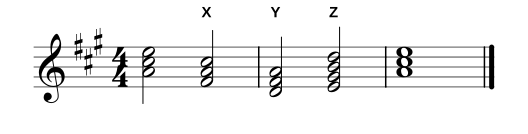
The chords below are written on one treble clef stave.
Give the chord symbol (for example Bb, Gm or C7) for each of the chords labelled X, Y and Z.
Model answer
X is F#m, Y is D and Z is E7.
Explanation
Read each chord from the bottom note upwards and apply the key signature of three sharps (F, C and G sharp). X is F sharp, A, C sharp: F sharp minor (F#m). Y is D, F sharp, A: D major (D). Z is E, G sharp, B, D: a major chord with a minor 7th added, E7, the dominant 7th of A major. A common slip is to forget the key signature, which would make X F major (F, A, C), Y D minor and Z E minor 7th (E, G, B, D).
Mark scheme
1 mark
X: F#m
Accept F#m, F sharp minor, F♯m, F#min. Accept keyboard spellings of note names (F# / F sharp / F♯) and close spellings of terms. Do not accept 'F#' or 'F sharp major' (the A is natural, so the chord is minor) or 'Fm' (the key signature makes the F and C sharp).
1 mark
Y: D / D major
Accept 'D', 'D major' or 'Dmaj'. Do not accept 'Dm' (the F is sharp from the key signature).
1 mark
Z: E7
Accept 'E7', 'E dominant 7th', 'E dominant seventh'. Do not accept 'E' or 'E major' alone (the D on top makes it a 7th chord) or 'Emaj7' (that would need D sharp).
Ready to try the rest? Every answer you write is marked against the mark scheme, so you can see exactly where the marks are.
Ctrl + Enter to check
Study HelperHints first, answers after you try
Stuck on this one? Ask for a hint and I’ll point you in the right direction, without giving the answer away. Once you’ve checked your answer, I’ll show you how the marks are awarded.