
Level:
Correct: 0
Incorrect: 0
Marks: 0/0
Exam Practice
Course:
Topics:
AQA GCSE Music Smart practice A mixed round aimed at your weak spots
Unit 1
The language of music
Unit 2
Area of study 1: Western classical tradition 1650-1910
Unit 3
Area of study 2: Popular music
Unit 4
Area of study 3: Traditional music
Unit 5
Area of study 4: Western classical tradition since 1910
Avg
score:
–
Topics
done:
0/44

Handel: Coronation Anthems and oratorios

Practise 11 exam-style questions on Handel: Coronation Anthems and oratorios for AQA GCSE Music. Write your answer as you would in the exam and get it marked in seconds against the mark scheme, point by point, with the Study Helper on hand if you get stuck.

  • 11 questions
  • 1–3 marks each
  • Instant marking
  • No sign-up needed
11 questions, marked as you go

Sample questions with model answers

Here are 4 of the questions in this topic, each with a model answer, an explanation of why it earns the marks and the mark scheme an examiner would use.

Question 1

1 mark

Which one of these works by Handel is an oratorio?

Choose your answer.

  • Zadok the Priest
  • Rinaldo
  • Solomon
  • Water Music

Model answer

Solomon.

Explanation

Solomon is an English oratorio, first performed at Covent Garden Theatre in 1749; its third act opens with the well-known instrumental piece 'The Arrival of the Queen of Sheba'. Other Handel oratorios include Saul, Israel in Egypt, Messiah, Samson, Judas Maccabaeus and Jephtha. Zadok the Priest is an anthem (a shorter choral piece for a church service or ceremony), Rinaldo is one of his Italian operas and Water Music is a set of orchestral pieces.

Mark scheme
  1. 1 mark

    Solomon

    Do not accept Zadok the Priest (a Coronation Anthem), Rinaldo (an Italian opera, first performed in London in 1711) or Water Music (an orchestral suite). If more than one option is given, award 0.
Question 2

2 marks

Give two features of harmony or tonality typical of the choruses in Handel's oratorios.

Model answer

Handel's choruses use mainly diatonic harmony based on chords I, IV and V, with strong perfect cadences marking the ends of sections. They are usually in a major key and modulate to related keys, such as the dominant, before returning to the tonic.

Explanation

Credit goes to two different features of harmony or tonality: diatonic chords, clear cadences, pedals, suspensions, sequences, or modulation to closely related keys. AQA's June 2025 report listed harmony answers among the less well-answered questions, so learn the precise terms. Chromatic harmony does appear in Handel's sadder choruses, but it is not the main feature of his style, so it needs to be linked to the words.

Mark scheme
  1. 2 marks

    Any two different features. Harmony: mainly diatonic harmony built on the primary chords (I, IV, V); clear cadences, especially perfect cadences at the ends of sections; a plagal cadence on a final 'Amen' or 'Alleluia'; pedal notes (a held or repeated bass note, often the tonic or dominant, under changing chords); suspensions (a dissonance that resolves, often at a cadence); harmonic sequences / circle-of-fifths progressions; chords filled in by the continuo from a figured bass; chromatic chords (such as diminished sevenths) to express sad or painful words; a minor-key movement ending on a major chord (tierce de Picardie). Tonality: major keys for joyful or festive choruses; minor keys for sad or penitential texts; modulation to related keys (dominant, subdominant, relative minor or major) before returning to the tonic

    1 mark for each different feature, max 2. Accept close spellings of terms (for example 'tierce de Picardie' with or without the accent). 'Perfect cadence' and 'V-I at the end' are the same feature. 'Major key' and 'minor key' together earn only 1 mark unless each is linked to the mood of the words. Do not accept 'atonal', 'modal' or 'dissonant throughout', and do not accept 'chromatic' on its own with no link to expressive words (the harmony is mainly diatonic).

Question 3

3 marks

Handel's Zadok the Priest has been sung at every British coronation since 1727.

Give three features of its music that make it suitable for a coronation.

Model answer

Zadok the Priest begins with a quiet string introduction that builds up tension, so that the sudden forte entry of the whole choir and orchestra has a majestic, dramatic effect. Trumpets and timpani and the bright key of D major give a festive, royal sound. The choir sings mainly in chords, so the acclamation 'God save the King' is clear and powerful, and near the end joyful semiquaver runs on 'Amen' pass from one voice part to another.

Explanation

Each mark needs a different musical feature; the best answers also say why it suits a grand royal ceremony. The famous moment is the contrast between the long, quiet string introduction and the sudden blaze of choir, trumpets and drums; the middle section is a dance-like passage in triple time for the people's rejoicing. When AQA's June 2025 mark scheme asked about a Handel excerpt (from the oratorio Solomon), it credited specific instruments such as trumpets, timpani, oboes and bassoons and an SATB choir, so name instruments precisely rather than writing 'lots of instruments'.

Mark scheme
  1. 3 marks

    Any three different features: a quiet introduction for the strings that builds up gradually / creates suspense or anticipation; a sudden loud (forte) entry of the full choir and orchestra (tutti) after the introduction, for dramatic or majestic effect; trumpets and timpani (drums), which give a festive, royal or ceremonial sound; large forces: a big choir (divided into more than four parts) with a full orchestra; a bright major key (D major); homophonic / chordal choral writing, so that the words (such as 'God save the King') are clear and powerful; a dance-like middle section in triple time (3/4) with dotted rhythms, expressing the people's rejoicing; long joyful runs (melismas) of semiquavers on 'Amen' passed between the voice parts; a slow, grand final cadence on 'Alleluia' (a slow plagal cadence); mainly loud (forte) dynamics in the choral sections

    1 mark for each different feature, max 3. Accept close spellings of terms when the meaning is clear. A feature earns the mark with or without an explanation of its effect. The size of the choir and orchestra counts once, however it is worded; trumpets and timpani are a separate feature. 'It is loud' and 'it is grand' count once between them. The biblical text (Zadok anointing King Solomon) is not a feature of the music and does not earn a mark on its own. Do not accept 'minor key', 'a cappella' or 'slow throughout'.

Question 4

3 marks

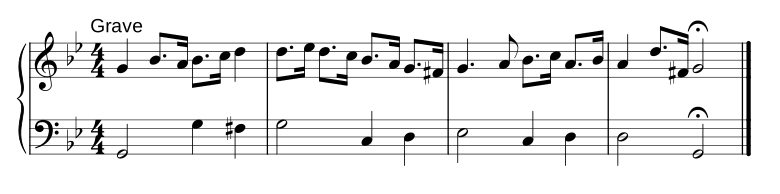
The music below was written for this course in the style of the slow opening section of a French overture, the type of overture with which Handel began his oratorio Messiah.

Name the key of the passage, name the rhythmic feature used throughout the treble part, and describe the music that usually follows this slow opening in a French overture.

Four bars of music on two staves joined by a brace, treble clef above and bass clef below, with a key signature of two flats, the time signature 4/4 and the tempo marking Grave. The last chord has a pause sign on both staves.

Model answer

The passage is in G minor. The treble part uses dotted rhythms (a dotted quaver followed by a semiquaver) throughout. In a French overture this slow, majestic opening is usually followed by a faster section in fugal (imitative) style.

Explanation

Two flats is the key signature of B flat major or G minor; the F sharps (the raised seventh, the leading note of G minor) and the final bass note G show that the key is G minor. A French overture opens with a slow, stately section full of dotted rhythms and then moves into a faster fugal section; Handel's Messiah begins with an overture of this kind. Do not confuse dotted rhythms (long-short) with the scotch snap (short-long).

Mark scheme
  1. 1 mark

    G minor

    Accept 'g minor', 'G min' or 'Gm'. Accept close spellings of terms when the meaning is clear. Do not accept B flat / Bb major (the relative major, which has the same key signature: the F sharps and the ending on G show G minor) or 'minor' without the key note.

  2. 1 mark

    Dotted rhythms / dotted quaver followed by a semiquaver

    Accept 'dotted notes', 'long-short rhythms' or 'double-dotted style'. Do not accept 'scotch snap' (short-long, the reverse pattern), 'triplets' or 'syncopation'.

  3. 1 mark

    A fast(er) section / a fugal or imitative section (voices or instruments entering one after another with the same theme)

    Either quality earns the mark: faster tempo, or fugal / imitative / contrapuntal texture. Do not accept 'the choir enters' or 'a recitative' on their own (these describe the oratorio, not the second section of the overture), or 'a slow minuet'.

Ready to try the rest? Every answer you write is marked against the mark scheme, so you can see exactly where the marks are.

Study Helper Hints first, answers after you try

Stuck on this one? Ask for a hint and I’ll point you in the right direction, without giving the answer away. Once you’ve checked your answer, I’ll show you how the marks are awarded.