Level:
Correct: 0
Incorrect: 0
Marks: 0/0
Exam Practice
Course:
Topics:
AQA GCSE Combined Science (Foundation Chemistry Paper 1) Smart practice A mixed round aimed at your weak spots
Unit 8
Atomic structure and the periodic table
Unit 9
Bonding, structure, and the properties of matter
Chemical bonds, ionic, covalent and metallic
How bonding and structure are related to the properties of substances
The three states of matter and state symbols
Properties of ionic, covalent and metallic substances
Structure and bonding of carbon
Unit 10
Quantitative chemistry
Chemical measurements, conservation of mass and the quantitative interpretation of chemical equations
Conservation of mass and relative formula mass
Mass changes, chemical measurements and concentration
Unit 11
Chemical changes
Unit 12
Energy changes
Exothermic and endothermic reactions
Avg
score:
–
Topics
done:
0/19

The three states of matter and state symbols

Practise 20 exam-style questions on The three states of matter and state symbols for AQA GCSE Combined Science (Foundation Chemistry Paper 1). Write your answer as you would in the exam and get it marked in seconds against the mark scheme, point by point, with the Study Helper on hand if you get stuck.

  • 20 questions
  • 1–6 marks each
  • Instant marking
  • No sign-up needed
20 questions, marked as you go

Sample questions with model answers

Here are 4 of the questions in this topic, each with a model answer, an explanation of why it earns the marks and the mark scheme an examiner would use.

Question 1

1 mark

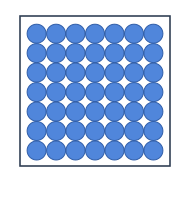
Figure 1 shows a simple model of the particles in a substance at room temperature. In the model, each particle is shown as a small solid sphere.

How do the particles in Figure 1 move?

Choose your answer.

  • They do not move at all
  • They move around each other
  • They move quickly in all directions
  • They vibrate about fixed positions
Particle diagram: single atoms of one element (all the same colour) in a regular, closely packed arrangement (solid).

Model answer

They vibrate about fixed positions

Explanation

The diagram shows a solid: the particles are close together in a regular pattern. In a solid the particles vibrate about fixed positions, held in place by the forces between the particles. The most common mistake is to think that particles in a solid do not move at all.

Mark scheme
  1. 1 mark

    They vibrate about fixed positions

    If more than one option is given, 0 marks. The particles are in a regular, closely packed arrangement, so the substance is a solid. Particles in a solid still move (they vibrate), so 'They do not move at all' is wrong. Moving around each other describes a liquid, and moving quickly in all directions describes a gas.
Question 2

2 marks

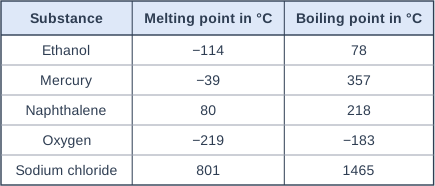
The table shows data for five substances.

Which substance in the table has the strongest forces between its particles?

Give a reason for your answer.

Table with columns "Substance", "Melting point in °C", "Boiling point in °C". Substance: Ethanol; Melting point in °C: −114; Boiling point in °C: 78 | Substance: Mercury; Melting point in °C: −39; Boiling point in °C: 357 | Substance: Naphthalene; Melting point in °C: 80; Boiling point in °C: 218 | Substance: Oxygen; Melting point in °C: −219; Boiling point in °C: −183 | Substance: Sodium chloride; Melting point in °C: 801; Boiling point in °C: 1465.

Model answer

Sodium chloride. It has the highest melting point and the highest boiling point, so the most energy is needed to overcome the forces between its particles.

Explanation

The stronger the forces between the particles, the more energy is needed to overcome them, so the higher the melting point and boiling point. Sodium chloride melts at 801 °C and boils at 1465 °C, far higher than any other substance in the table. The reason must use the data: 'it is ionic' or 'it is a solid' on its own does not answer the question.

Mark scheme
  1. 1 mark

    sodium chloride

    allow NaCl

  2. 1 mark

    (it has) the highest melting point / the highest boiling point

    MP2 is dependent on MP1; allow most energy is needed to melt / boil it; allow it has a melting point of 801 °C / a boiling point of 1465 °C; ignore it is a solid at room temperature (naphthalene is also a solid at room temperature); ignore it is ionic / it has strong bonds unless linked to the melting or boiling point

Question 3

2 marks

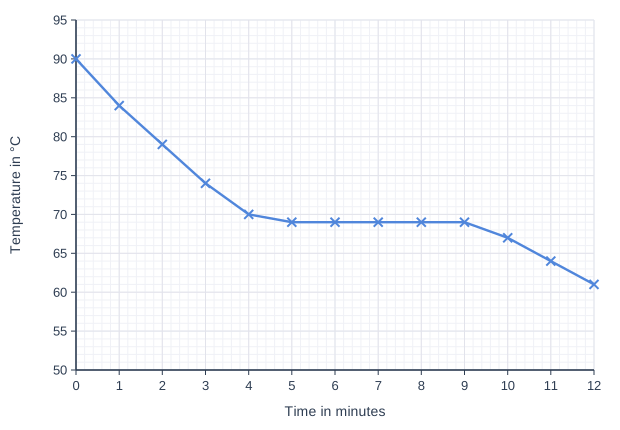
A student let some liquid stearic acid cool in a boiling tube. The graph shows the temperature of the stearic acid every minute.

Use the equation:
mean rate of cooling = fall in temperature ÷ time taken

Calculate the mean rate of cooling of the stearic acid between 0 minutes and 4 minutes.

Give your answer in °C per minute.

Line graph of temperature in °C (y-axis, 50 to 95) against time in minutes (x-axis, 0 to 12). The line joins the points (0, 90), (1, 84), (2, 79), (3, 74), (4, 70), (5, 69), (6, 69), (7, 69), (8, 69), (9, 69), (10, 67), (11, 64), (12, 61).

Model answer

fall in temperature = 90 − 70 = 20 °C
mean rate of cooling = 20 ÷ 4
= 5 °C per minute

Explanation

Read the temperatures at 0 minutes (90 °C) and at 4 minutes (70 °C) and subtract to find the fall in temperature, 20 °C. Then divide by the time taken, 4 minutes, to get 5 °C per minute. Dividing a single temperature reading by the time is a common mistake.

Mark scheme
  1. 1 mark

    (fall in temperature =) 90 − 70 = 20 (°C)

    a correct answer with no working scores full marks

  2. 1 mark

    (mean rate of cooling =) 20 ÷ 4 = 5 (°C per minute)

    allow ecf from an incorrectly read fall in temperature divided by 4; full marks are not awarded for a correct final answer from incorrect working; 22.5 (90 ÷ 4) and 17.5 (70 ÷ 4) score 0; 0.2 (4 ÷ 20) scores 1 mark

Question 4

3 marks

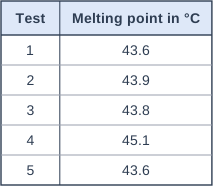
A student measured the melting point of a sample of lauric acid five times.

The table shows the results.

One of the results is anomalous.

Calculate the mean melting point of the lauric acid. Leave out the anomalous result.

Give your answer to 3 significant figures.

Table with columns "Test", "Melting point in °C". Test: 1; Melting point in °C: 43.6 | Test: 2; Melting point in °C: 43.9 | Test: 3; Melting point in °C: 43.8 | Test: 4; Melting point in °C: 45.1 | Test: 5; Melting point in °C: 43.6.

Model answer

anomalous result = 45.1 °C
mean = (43.6 + 43.9 + 43.8 + 43.6) ÷ 4
= 174.9 ÷ 4
= 43.725
= 43.7 °C (3 significant figures)

Explanation

The anomalous result is 45.1 °C, which is much higher than the other four results (43.6 to 43.9 °C). Add the other four and divide by 4 to get 43.725 °C, then round to 3 significant figures: 43.7 °C. Including the anomalous result gives 44.0 °C, and leaving the answer as 43.725 or 43.73 loses the rounding mark.

Mark scheme
  1. 1 mark

    (43.6 + 43.9 + 43.8 + 43.6) ÷ 4 / 174.9 ÷ 4

    a correct answer with no working scores full marks; the mean of all five results (220.0 ÷ 5 = 44.0) scores 1 mark in total

  2. 1 mark

    = 43.725 (°C)

    allow 43.73 / 43.72

  3. 1 mark

    = 43.7 (°C)

    allow ecf: their mean of four values from the table correctly rounded to 3 significant figures; full marks are not awarded for a correct final answer from incorrect working; 43.725 or 43.73 alone does not gain this mark

Ready to try the rest? Every answer you write is marked against the mark scheme, so you can see exactly where the marks are.

Study Helper Hints first, answers after you try

Stuck on this one? Ask for a hint and I’ll point you in the right direction, without giving the answer away. Once you’ve checked your answer, I’ll show you how the marks are awarded.