Level:
Correct: 0
Incorrect: 0
Marks: 0/0
Exam Practice
Course:
Topics:
AQA GCSE Combined Science (Foundation Chemistry Paper 1) Smart practice A mixed round aimed at your weak spots
Unit 8
Atomic structure and the periodic table
Unit 9
Bonding, structure, and the properties of matter
Chemical bonds, ionic, covalent and metallic
How bonding and structure are related to the properties of substances
The three states of matter and state symbols
Properties of ionic, covalent and metallic substances
Structure and bonding of carbon
Unit 10
Quantitative chemistry
Chemical measurements, conservation of mass and the quantitative interpretation of chemical equations
Conservation of mass and relative formula mass
Mass changes, chemical measurements and concentration
Unit 11
Chemical changes
Unit 12
Energy changes
Exothermic and endothermic reactions
Avg
score:
–
Topics
done:
0/19

Size and mass of atoms and relative atomic mass

Practise 20 exam-style questions on Size and mass of atoms and relative atomic mass for AQA GCSE Combined Science (Foundation Chemistry Paper 1). Write your answer as you would in the exam and get it marked in seconds against the mark scheme, point by point, with the Study Helper on hand if you get stuck.

  • 20 questions
  • 1–6 marks each
  • Instant marking
  • No sign-up needed
20 questions, marked as you go

Sample questions with model answers

Here are 4 of the questions in this topic, each with a model answer, an explanation of why it earns the marks and the mark scheme an examiner would use.

Question 1

1 mark

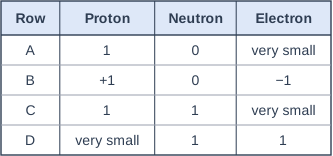
The table shows four sets of values, A, B, C and D.

Which row shows the relative masses of a proton, a neutron and an electron?

Choose your answer.

  • A
  • B
  • C
  • D
Table with columns "Row", "Proton", "Neutron", "Electron". Row: A; Proton: 1; Neutron: 0; Electron: very small | Row: B; Proton: +1; Neutron: 0; Electron: −1 | Row: C; Proton: 1; Neutron: 1; Electron: very small | Row: D; Proton: very small; Neutron: 1; Electron: 1.

Model answer

C

Explanation

The relative masses are proton 1, neutron 1 and electron very small. Students often mix up relative mass with relative charge (+1, 0, -1): a neutron has no charge, but it does have mass, about the same as a proton.

Mark scheme
  1. 1 mark

    C

    If more than one option is given, 0 marks. A gives a neutron a mass of 0 (confusing mass with charge). B shows the relative charges (+1, 0, -1), not the relative masses. D swaps the proton and the electron.
Question 2

1 mark

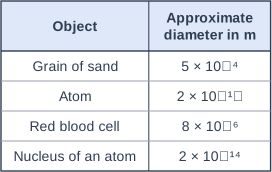
The table shows the approximate sizes of four objects.

Write the four objects in order of size, starting with the smallest.

Table with columns "Object", "Approximate diameter in m". Object: Grain of sand; Approximate diameter in m: 5 × 10⁻⁴ | Object: Atom; Approximate diameter in m: 2 × 10⁻¹⁰ | Object: Red blood cell; Approximate diameter in m: 8 × 10⁻⁶ | Object: Nucleus of an atom; Approximate diameter in m: 2 × 10⁻¹⁴.

Model answer

Nucleus of an atom, atom, red blood cell, grain of sand

Explanation

Compare the powers of ten first: the more negative the power, the smaller the object. 2 × 10⁻¹⁴ m is smaller than 2 × 10⁻¹⁰ m, which is smaller than 8 × 10⁻⁶ m, which is smaller than 5 × 10⁻⁴ m. A common mistake is to compare only the first numbers (8 and 5) and put the red blood cell last.

Mark scheme
  1. 1 mark

    nucleus of an atom, atom, red blood cell, grain of sand

    All four must be in the correct order, starting with the smallest, for the mark. do not accept the reverse order. allow 'nucleus' for nucleus of an atom and 'blood cell' for red blood cell.

Question 3

2 marks

An atom of potassium-39 has 19 protons and 20 neutrons.

An atom of calcium-40 has 20 protons and 20 neutrons.

A student says: 'These two atoms are isotopes because they have the same number of neutrons.'

Explain why the student is wrong.

Model answer

The atoms have different numbers of protons (19 and 20), so they are atoms of different elements. Isotopes are atoms of the same element, with the same number of protons but different numbers of neutrons.

Explanation

What makes an atom a particular element is its number of protons (its atomic number). Isotopes have the same number of protons but different numbers of neutrons. Having the same number of neutrons does not matter: potassium-39 and calcium-40 are different elements.

Mark scheme
  1. 1 mark

    the atoms have different numbers of protons / different atomic numbers, so they are (atoms of) different elements

    allow potassium and calcium are different elements.

  2. 1 mark

    isotopes are atoms of the same element / with the same number of protons but different numbers of neutrons

    allow isotopes have the same atomic number but different mass numbers. ignore same number of electrons. do not accept isotopes have different numbers of protons.

Question 4

4 marks

mass of a proton = 1.67 × 10⁻²⁷ kg
mass of an electron = 9.11 × 10⁻³¹ kg
A neutron has almost the same mass as a proton.

Calculate how many times greater the mass of a proton is than the mass of an electron. Give your answer to 2 significant figures.

Use your answer to explain why almost all of the mass of an atom is in its nucleus.

Model answer

1.67 × 10⁻²⁷ ÷ 9.11 × 10⁻³¹ = 1833
To 2 significant figures: 1800
A proton is about 1800 times heavier than an electron. Protons and neutrons are in the nucleus and both have a relative mass of 1. The electrons outside the nucleus have a very small mass, so they add almost nothing to the mass of the atom. This means almost all of the mass of an atom is in its nucleus.

Explanation

Divide the proton's mass by the electron's mass, then round 1833 to 2 significant figures (1800, not 18). The explanation needs two linked ideas: protons and neutrons are in the nucleus, and electrons have a very small mass. Do not say electrons have no mass; their relative mass is 'very small'.

Mark scheme
  1. 1 mark

    1.67 × 10⁻²⁷ ÷ 9.11 × 10⁻³¹ = 1833

    allow 1830 to 1840.

  2. 1 mark

    1800 (2 significant figures)

    allow 1.8 × 10³. allow a correctly rounded answer to 2 significant figures from an incorrect calculation using the values in the question. A correct answer with no working scores 2 marks for the calculation. Full marks are not awarded for a correct final answer from incorrect working.

  3. 1 mark

    protons and neutrons are (both) in the nucleus

    allow the nucleus contains the protons and neutrons.

  4. 1 mark

    electrons (outside the nucleus) have a very small mass (about 1/1800 of a proton) so they add very little to the mass of the atom

    allow electrons' mass is negligible / tiny compared with protons and neutrons. do not accept electrons have no mass. ignore references to charge.

Ready to try the rest? Every answer you write is marked against the mark scheme, so you can see exactly where the marks are.

Study Helper Hints first, answers after you try

Stuck on this one? Ask for a hint and I’ll point you in the right direction, without giving the answer away. Once you’ve checked your answer, I’ll show you how the marks are awarded.