Level:
Correct: 0
Incorrect: 0
Marks: 0/0
Exam Practice
Course:
Topics:
AQA GCSE Combined Science (Foundation Chemistry Paper 1) Smart practice A mixed round aimed at your weak spots
Unit 8
Atomic structure and the periodic table
Unit 9
Bonding, structure, and the properties of matter
Chemical bonds, ionic, covalent and metallic
How bonding and structure are related to the properties of substances
The three states of matter and state symbols
Properties of ionic, covalent and metallic substances
Structure and bonding of carbon
Unit 10
Quantitative chemistry
Chemical measurements, conservation of mass and the quantitative interpretation of chemical equations
Conservation of mass and relative formula mass
Mass changes, chemical measurements and concentration
Unit 11
Chemical changes
Unit 12
Energy changes
Exothermic and endothermic reactions
Avg
score:
–
Topics
done:
0/19

The development of the model of the atom

Practise 21 exam-style questions on The development of the model of the atom for AQA GCSE Combined Science (Foundation Chemistry Paper 1). Write your answer as you would in the exam and get it marked in seconds against the mark scheme, point by point, with the Study Helper on hand if you get stuck.

  • 21 questions
  • 1–6 marks each
  • Instant marking
  • No sign-up needed
20 questions, marked as you go

Sample questions with model answers

Here are 4 of the questions in this topic, each with a model answer, an explanation of why it earns the marks and the mark scheme an examiner would use.

Question 1

1 mark

The discovery of a particle led to the plum pudding model of the atom.

Name this particle.

Model answer

The electron

Explanation

The discovery of the electron showed that atoms contain smaller, negatively charged particles. Because atoms have no overall charge, scientists suggested that the electrons were embedded in a ball of positive charge: the plum pudding model. Protons and neutrons were discovered later, after the nucleus.

Mark scheme
  1. 1 mark

    electron

    allow electrons; do not accept proton, neutron or nucleus

Question 2

1 mark

Later experiments showed that the positive charge of a nucleus could be divided into a whole number of smaller particles. Each of these particles has the same amount of positive charge.

What name was given to these particles?

Model answer

Protons

Explanation

After the nuclear model was accepted, experiments showed that the positive charge of any nucleus is made up of a whole number of identical positive particles, called protons. Each proton has a relative charge of +1. Neutrons, which have no charge, were discovered later.

Mark scheme
  1. 1 mark

    protons

    allow proton; do not accept neutrons, nuclei or positive electrons

Question 3

2 marks

The alpha particle scattering experiment was first carried out with a sheet of gold. Scientists then repeated the experiment with sheets of other metals and got similar results.

Suggest why it was important that the experiment was repeated with other metals.

Model answer

Repeating the experiment checks that the results are reproducible and were not caused by a mistake. Getting similar results with other metals shows that atoms of all elements have a tiny, positive nucleus, not just gold atoms, so scientists could be confident that the model of the atom should be changed.

Explanation

A model is only changed or replaced when the new evidence is trustworthy, so scientists check that results can be reproduced. Using different metals also tests whether the idea is true for all atoms. Vague answers such as 'to get more results' do not score.

Mark scheme
  1. 1 mark

    to check that the results are repeatable / reproducible / were not caused by a mistake

    allow to make the evidence more reliable / to check the results were valid

  2. 1 mark

    to show that the nuclear model applies to atoms of all elements / not only to gold atoms

    allow so scientists could be more confident that the model of the atom should be changed; allow so other scientists would accept the new model

Question 4

4 marks

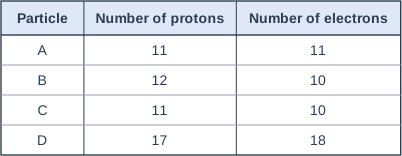
The table shows the numbers of protons and electrons in four particles, A, B, C and D.

Which particle is an atom? Give a reason for your answer.

Which two particles are particles of the same element?

Calculate the overall charge on particle B.

Table with columns "Particle", "Number of protons", "Number of electrons". Particle: A; Number of protons: 11; Number of electrons: 11 | Particle: B; Number of protons: 12; Number of electrons: 10 | Particle: C; Number of protons: 11; Number of electrons: 10 | Particle: D; Number of protons: 17; Number of electrons: 18.

Model answer

A is an atom, because it has the same number of protons as electrons (11 of each), so it has no overall charge.
A and C are particles of the same element, because they both have 11 protons.
Charge on B = (12 × +1) + (10 × -1) = +2

Explanation

An atom has equal numbers of protons and electrons. All particles of the same element have the same number of protons, so A and C are the same element even though C has lost an electron. B has two more protons than electrons, so its overall charge is +2. Matching particles by their number of electrons is a common mistake.

Mark scheme
  1. 1 mark

    A

    if more than one particle is given, 0 marks for this point

  2. 1 mark

    it has the same number of protons and electrons (so it has no overall charge)

    this mark can only be awarded if A is chosen; allow 11 protons and 11 electrons

  3. 1 mark

    A and C

    both letters needed; allow they both have 11 protons; do not accept particles with the same number of electrons (eg B and C)

  4. 1 mark

    +2

    (12 × +1) + (10 × -1) = +2; allow 2+ / 2 positive; a correct answer with no working scores the mark; do not accept -2 or 2 without a positive sign

Ready to try the rest? Every answer you write is marked against the mark scheme, so you can see exactly where the marks are.

Revision notes

The development of the model of the atom

The big idea

Nobody can see inside an atom, so scientists use models of it. Over about 200 years the model of the atom has changed several times, each time because new experimental evidence could not be explained by the old model. You need to describe each model, explain why it changed, and compare the plum pudding model with the nuclear model.

From solid spheres to the plum pudding

Before the discovery of the electron, atoms were thought to be tiny spheres that could not be divided.

The discovery of the electron showed that atoms contain even smaller particles, so they can be divided. Electrons are negative, but atoms have no overall charge, so atoms must also contain positive charge. This led to the plum pudding model: the atom is a ball of positive charge with negative electrons embedded in it. There is no nucleus. The positive charge and the mass are spread through the whole atom.

The alpha particle scattering experiment

Scientists fired a beam of alpha particles (small, positively charged particles) at a very thin sheet of gold foil and detected where they went. If the plum pudding model were correct, almost all of them should pass straight through with little or no deflection, because the charge and mass in each atom are spread out thinly.

ResultConclusion
Most alpha particles passed straight throughMost of the atom is empty space
Some were deflectedThe centre of the atom has a concentrated positive charge that repels them
A very small number bounced backThe mass is concentrated in a very small nucleus at the centre

The plum pudding model could not explain the alpha particles that bounced back. So it was replaced by the nuclear model: the mass of the atom is concentrated at the centre in a tiny, positively charged nucleus, with electrons around it.

Later changes

  • Niels Bohr adapted the nuclear model by suggesting that electrons orbit the nucleus at specific distances (the shells or energy levels used today). His model was accepted because his theoretical calculations agreed with experimental observations.
  • Later experiments showed that the positive charge of any nucleus can be subdivided into a whole number of smaller particles, each with the same amount of positive charge. These particles were named protons.
  • The experimental work of James Chadwick provided the evidence for neutrons in the nucleus. This was about 20 years after the nucleus became an accepted scientific idea. Neutrons have no charge, which made them harder to detect.

You do not need to know details of the experiments behind Bohr's model or Chadwick's work.

Comparing the two models

Plum pudding modelNuclear model
Nucleusnonea tiny nucleus at the centre
Positive chargespread through the whole atomconcentrated in the nucleus
Massspread evenly through the atomalmost all in the nucleus
Electronsembedded in the ball of positive chargeoutside the nucleus (in shells, after Bohr)
Empty spacenone: a solid ball of chargethe atom is mostly empty space

A model is kept while it explains the evidence. When new evidence cannot be explained, the model is adapted (as Bohr did) or replaced (as the nuclear model replaced the plum pudding model). A replaced model was still useful: the plum pudding model explained the evidence of its time, and testing its predictions led to the scattering experiment.

Writing a comparison

Compare the model of the atom used before the electron was discovered with the plum pudding model.

A "compare" answer needs both models in every point, linked by a word such as "whereas":

  • In the earlier model atoms could not be divided, whereas the plum pudding model had smaller particles (electrons) inside the atom.
  • The earlier model said nothing about charges inside the atom, whereas the plum pudding model had negative electrons in a ball of positive charge.
  • One similarity: neither model had a nucleus, because in both the matter of the atom filled a solid sphere.

Remember

The order of the models, and the evidence for each change:

  1. Tiny spheres that cannot be divided.
  2. The electron is discovered: the plum pudding model.
  3. Alpha particle scattering: the nuclear model.
  4. Bohr: electrons orbit at specific distances.
  5. Protons, then neutrons (Chadwick, about 20 years after the nucleus was accepted).

Common mistakes

  • Describing a nucleus in the plum pudding model. It has none: the positive charge is spread through the whole atom.
  • Saying the Bohr model replaced the plum pudding model. The nuclear model replaced it; Bohr later adapted the nuclear model.
  • Saying alpha particles bounced back because the nucleus is negative. Like charges repel, so a positive nucleus turns back the positive alpha particles.
  • Saying most alpha particles bounced back. Only a very small number did; most went straight through.
  • Answering a "compare" question by describing only one model.

Exam tip

In the 6-mark question on the scattering experiment, link every result to a conclusion ("most passed straight through, so most of the atom is empty space"), then finish with the scientific idea: the plum pudding model could not explain the new evidence, so it was replaced by the nuclear model.

Study Helper Hints first, answers after you try

Stuck on this one? Ask for a hint and I’ll point you in the right direction, without giving the answer away. Once you’ve checked your answer, I’ll show you how the marks are awarded.