Practise 18 exam-style questions on Soluble salts for AQA GCSE Combined Science (Foundation Chemistry Paper 1). Write your answer as you would in the exam and get it marked in seconds against the mark scheme, point by point, with the Study Helper on hand if you get stuck.
18 questions
1–6 marks each
Instant marking
No sign-up needed
18 questions, marked as you go
Sample questions with model answers
Here are 4 of the questions in this topic, each with a model answer, an explanation of why it earns the marks and the mark scheme an examiner would use.
Question 1
1 mark
A student has made some crystals of a salt. The crystals are still wet with solution.
What is the best way to dry the crystals?
Choose your answer.
Pat them dry between filter papers
Heat them strongly over a Bunsen flame
Rinse them with lots of hot water
Leave them in the remaining solution
Model answer
Pat them dry between filter papers
Explanation
Gently patting the crystals between filter papers soaks up the solution on their surface without damaging them; leaving them in a warm place to dry also works. Strong heating is a common wrong answer because it can break down the crystals. The salt is soluble, so rinsing with lots of hot water would dissolve the product.
Mark scheme
1 mark
Pat them dry between filter papers
If more than one option is given, 0 marks. Strong heating can damage the crystals (they may decompose or spit). Hot water would dissolve the crystals, because the salt is soluble. Leaving them in the solution keeps them wet.
Question 2
2 marks
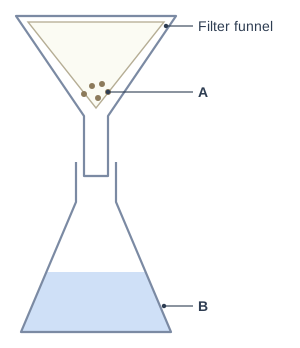
A student added excess calcium carbonate powder to dilute hydrochloric acid and stirred until the fizzing stopped. The student then filtered the mixture.
The diagram shows the filtration.
Name the substance at A and the substance at B.
Model answer
A is the excess (unreacted) calcium carbonate. B is calcium chloride solution.
Explanation
Filtering separates the excess insoluble solid from the solution. The solid left on the filter paper (the residue) is the unreacted calcium carbonate, and the liquid that passes through (the filtrate) is calcium chloride solution, because hydrochloric acid produces chlorides. Because excess calcium carbonate was used, no hydrochloric acid is left in the filtrate.
Mark scheme
1 mark
(A) (excess / unreacted) calcium carbonate
allow CaCO₃; 'residue' or 'solid' on its own does not score (the question asks for the substance); do not accept calcium chloride / calcium / calcium oxide.
1 mark
(B) calcium chloride solution
allow calcium chloride / CaCl₂(aq) / filtrate of calcium chloride; do not accept water on its own / hydrochloric acid / calcium carbonate solution / calcium chlorine / calcium chlorate.
Question 3
2 marks
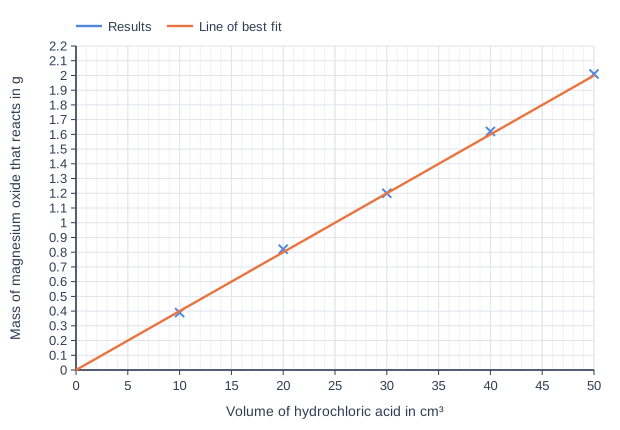
A student measured the mass of magnesium oxide that reacts with different volumes of the same dilute hydrochloric acid.
The graph shows the results and a line of best fit.
Use the line of best fit to determine the mass of magnesium oxide that reacts with 35 cm³ of the acid.
Then work out the mass of magnesium oxide that reacts with 70 cm³ of the acid.
Model answer
Reading from the line of best fit at 35 cm³: 1.40 g 70 cm³ is twice 35 cm³, so mass = 2 × 1.40 = 2.80 g
Explanation
Read up from 35 cm³ to the line of best fit and across to the mass axis: 1.40 g. The line is straight and goes through the origin, so the mass that reacts is proportional to the volume of acid; doubling the volume doubles the mass. Reading the nearest plotted point (1.20 g or 1.62 g) instead of the line is a common error.
Mark scheme
1 mark
1.40 (g)
allow any value from 1.35 to 1.45 (g) (half a small square). A correct answer with no working scores full marks. Full marks are not awarded for a correct final answer from incorrect working. do not accept 1.20 g or 1.62 g (plotted points at 30 cm³ and 40 cm³).
1 mark
(1.40 × 2 =) 2.80 (g)
allow any value from 2.70 to 2.90 (g); allow ecf: 2 × their reading at 35 cm³.
Question 4
4 marks
A student added 4.00 g of magnesium carbonate to some dilute sulfuric acid. When no more would react, the student filtered the mixture. The magnesium carbonate left on the filter paper was washed and dried. Its mass was 1.37 g.
Calculate the mass of magnesium carbonate that reacted.
Then calculate the percentage of the magnesium carbonate added that did not react. Give your answer to 2 significant figures.
Model answer
Mass reacted = 4.00 − 1.37 = 2.63 g Percentage that did not react = 1.37 ÷ 4.00 × 100 = 34.25% = 34% (2 significant figures)
Explanation
The mass that reacted is the difference between the mass added and the mass left over. The percentage that did not react is the mass left over (1.37 g) divided by the mass added (4.00 g), multiplied by 100. Common errors are using 2.63 g instead of 1.37 g for the percentage and not rounding to 2 significant figures.
Mark scheme
1 mark
(mass reacted =) 4.00 − 1.37 = 2.63 (g)
A correct answer with no working scores full marks for each part: 2.63 g scores this mark and 34 (%) scores the other three marks. Full marks are not awarded for a correct final answer from incorrect working.
1 mark
(percentage =) 1.37 ÷ 4.00 × 100
allow (4.00 − 2.63) ÷ 4.00 × 100.
1 mark
= 34.25 (%)
allow 34.3 (%).
1 mark
= 34 (%) (2 significant figures)
allow a correctly rounded answer to 2 significant figures from an incorrect calculation using values from the question: an answer of 66 (%) (the percentage that reacted, 2.63 ÷ 4.00 × 100 = 65.75) scores this mark only.
Ready to try the rest? Every answer you write is marked against the mark scheme, so you can see exactly where the marks are.
Ctrl + Enter to check
Study HelperHints first, answers after you try
Stuck on this one? Ask for a hint and I’ll point you in the right direction, without giving the answer away. Once you’ve checked your answer, I’ll show you how the marks are awarded.