
Level:
Correct: 0
Incorrect: 0
Marks: 0/0
Exam Practice
Course:
Topics:
AQA GCSE Combined Science (Foundation Chemistry Paper 1) Smart practice A mixed round aimed at your weak spots
Unit 8
Atomic structure and the periodic table
Unit 9
Bonding, structure, and the properties of matter
Chemical bonds, ionic, covalent and metallic
How bonding and structure are related to the properties of substances
The three states of matter and state symbols
Properties of ionic, covalent and metallic substances
Structure and bonding of carbon
Unit 10
Quantitative chemistry
Chemical measurements, conservation of mass and the quantitative interpretation of chemical equations
Conservation of mass and relative formula mass
Mass changes, chemical measurements and concentration
Unit 11
Chemical changes
Unit 12
Energy changes
Exothermic and endothermic reactions
Avg
score:
–
Topics
done:
0/19

Conservation of mass and relative formula mass

Practise 22 exam-style questions on Conservation of mass and relative formula mass for AQA GCSE Combined Science (Foundation Chemistry Paper 1). Write your answer as you would in the exam and get it marked in seconds against the mark scheme, point by point, with the Study Helper on hand if you get stuck.

  • 22 questions
  • 1–6 marks each
  • Instant marking
  • No sign-up needed
20 questions, marked as you go

Sample questions with model answers

Here are 4 of the questions in this topic, each with a model answer, an explanation of why it earns the marks and the mark scheme an examiner would use.

Question 1

1 mark

Hydrogen burns in oxygen to produce water. The balanced equation is:

2H₂ + O₂ → 2H₂O

The total relative formula mass (Mr) of the reactants, 2H₂ + O₂, is 36

What is the total relative formula mass of the product, 2H₂O?

Choose your answer.

  • 18
  • 32
  • 36
  • 72

Model answer

36

Explanation

In a balanced equation the total Mr of the reactants, in the quantities shown, equals the total Mr of the products, because no atoms are lost or made. So 2H₂O must total 36, which is 2 × 18. A common mistake is to forget the large 2 in front of H₂O and give 18.

Mark scheme
  1. 1 mark

    36

    If more than one option is given, 0 marks. 18 is the Mr of one H₂O, but the 2 in front means two water molecules. 32 is the Mr of the oxygen (O₂) only. 72 doubles the total of the reactants, as if mass were gained.
Question 2

2 marks

Nitrogen reacts with hydrogen to produce ammonia. The balanced equation is:

N₂ + 3H₂ → 2NH₃

Give the meaning of:
- the large number 3 written in front of H₂
- the small number 2 written after the N in N₂

Model answer

The large 3 means there are three molecules of hydrogen. The small 2 means each nitrogen molecule is made of two nitrogen atoms.

Explanation

A large number in front of a formula multiplies the whole formula, so 3H₂ means three hydrogen molecules (6 hydrogen atoms in total). A small number written after a symbol gives the number of atoms of that element in one molecule or formula, so N₂ is a molecule of two nitrogen atoms. Mixing these up is the most common error when balancing equations.

Mark scheme
  1. 1 mark

    (there are) three molecules of hydrogen / three H₂ (molecules)

    allow three lots / units / particles of hydrogen. do not accept three hydrogen atoms.

  2. 1 mark

    (each) nitrogen molecule contains two (nitrogen) atoms

    allow N₂ is made of two nitrogen atoms (joined together). do not accept two nitrogen molecules.

Question 3

2 marks

Explain, in terms of atoms, why the total mass of the substances in a sealed container does not change during a chemical reaction.

Model answer

No atoms are lost or made in the reaction: the atoms in the reactants are only rearranged to make the products. The container is sealed, so no atoms can enter or leave it, and the total mass stays the same.

Explanation

Mass is conserved because the same atoms are present before and after the reaction: they are just joined together in different ways. In a sealed container nothing can enter or leave, so the measured mass cannot change. Saying only 'mass cannot be made or destroyed' does not answer in terms of atoms.

Mark scheme
  1. 1 mark

    no atoms are lost or made

    any two from the three points, max 2. allow 'there are the same number of each type of atom before and after the reaction' or 'all the atoms in the reactants end up in the products'. ignore 'mass cannot be created or destroyed' unless atoms are mentioned. do not accept atoms changing into different atoms.

  2. 1 mark

    the atoms are (only) rearranged / join together in different ways (to make the products)

    allow 'bonds break and new bonds form between the same atoms'. ignore references to energy. If the answer only gives one idea (e.g. 'no atoms are lost or made') in different words twice, award 1 mark.

  3. 1 mark

    (because the container is sealed) no atoms can enter or leave (the container)

    allow 'nothing / no gas can get in or out of the sealed container'.

Question 4

4 marks

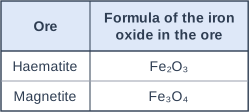
Haematite and magnetite are ores of iron. The table shows the formula of the iron oxide in each ore.

Relative atomic masses (Ar): O = 16   Fe = 56

Which of the two iron oxides contains the higher percentage by mass of iron?

You must show your working.

Table with columns "Ore", "Formula of the iron oxide in the ore". Ore: Haematite; Formula of the iron oxide in the ore: Fe₂O₃ | Ore: Magnetite; Formula of the iron oxide in the ore: Fe₃O₄.

Model answer

Mr of Fe₂O₃ = (2 × 56) + (3 × 16) = 160
Percentage of iron = (112 ÷ 160) × 100 = 70%
Mr of Fe₃O₄ = (3 × 56) + (4 × 16) = 232
Percentage of iron = (168 ÷ 232) × 100 = 72.4%
Fe₃O₄ (in magnetite) has the higher percentage by mass of iron.

Explanation

Each percentage uses the total mass of iron in the formula (2 × 56 or 3 × 56), not the mass of one iron atom. Fe₃O₄ has the higher percentage, 72.4% compared with 70%, even though the two formulae look similar. Using 56 instead of 112 or 168 is the most common error.

Mark scheme
  1. 1 mark

    Mr of Fe₂O₃ = 160 and Mr of Fe₃O₄ = 232

    allow (2 × 56) + (3 × 16) and (3 × 56) + (4 × 16)

  2. 1 mark

    percentage of iron in Fe₂O₃ = (112 ÷ 160) × 100 = 70 (%)

    allow ecf from their Mr

  3. 1 mark

    percentage of iron in Fe₃O₄ = (168 ÷ 232) × 100 = 72.4 (%)

    allow 72 (%) or 72.41 (%). allow ecf from their Mr

  4. 1 mark

    Fe₃O₄ / the iron oxide in magnetite (has the higher percentage of iron)

    allow ecf: the oxide with the higher percentage in their calculations. Because the question says 'You must show your working', a correct answer with no working (Fe₃O₄ or magnetite stated with no calculation) scores 0 marks. Other valid methods score full marks, e.g. the percentage of oxygen is 30% in Fe₂O₃ and 27.6% in Fe₃O₄, so Fe₃O₄ has the higher percentage of iron. Full marks are not awarded for a correct final answer from incorrect working.

Ready to try the rest? Every answer you write is marked against the mark scheme, so you can see exactly where the marks are.

Study Helper Hints first, answers after you try

Stuck on this one? Ask for a hint and I’ll point you in the right direction, without giving the answer away. Once you’ve checked your answer, I’ll show you how the marks are awarded.