
Level:
Correct: 0
Incorrect: 0
Marks: 0/0
Exam Practice
Course:
Topics:
AQA GCSE Combined Science (Foundation Chemistry Paper 1) Smart practice A mixed round aimed at your weak spots
Unit 8
Atomic structure and the periodic table
Unit 9
Bonding, structure, and the properties of matter
Chemical bonds, ionic, covalent and metallic
How bonding and structure are related to the properties of substances
The three states of matter and state symbols
Properties of ionic, covalent and metallic substances
Structure and bonding of carbon
Unit 10
Quantitative chemistry
Chemical measurements, conservation of mass and the quantitative interpretation of chemical equations
Conservation of mass and relative formula mass
Mass changes, chemical measurements and concentration
Unit 11
Chemical changes
Unit 12
Energy changes
Exothermic and endothermic reactions
Avg
score:
–
Topics
done:
0/19

Properties of ionic, covalent and metallic substances

Practise 22 exam-style questions on Properties of ionic, covalent and metallic substances for AQA GCSE Combined Science (Foundation Chemistry Paper 1). Write your answer as you would in the exam and get it marked in seconds against the mark scheme, point by point, with the Study Helper on hand if you get stuck.

  • 22 questions
  • 1–6 marks each
  • Instant marking
  • No sign-up needed
20 questions, marked as you go

Sample questions with model answers

Here are 4 of the questions in this topic, each with a model answer, an explanation of why it earns the marks and the mark scheme an examiner would use.

Question 1

1 mark

Substances made of small molecules do not conduct electricity.

Which statement explains why?

Choose your answer.

  • The molecules have no overall electric charge
  • The forces between the molecules are weak
  • The covalent bonds in the molecules are strong
  • The ions in the substance are not free to move

Model answer

The molecules have no overall electric charge

Explanation

To conduct electricity a substance needs charged particles that are free to move. Molecules have no overall charge and there are no free electrons or ions, so substances such as water, methane and sulfur do not conduct. The idea of 'ions not free to move' belongs to solid ionic compounds, not to molecules.

Mark scheme
  1. 1 mark

    The molecules have no overall electric charge

    If more than one option is given, 0 marks. Weak forces between the molecules explain the low melting and boiling points, not the lack of conduction. The covalent bonds are strong, but that explains why the molecules stay whole, not why there is no conduction. Substances made of small molecules contain no ions.
Question 2

2 marks

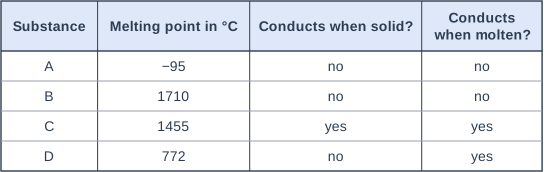
The table shows some properties of four substances, A, B, C and D.

One of the substances has a giant covalent structure.

Which substance has a giant covalent structure? Give a reason for your answer.

Table with columns "Substance", "Melting point in °C", "Conducts when solid?", "Conducts when molten?". Substance: A; Melting point in °C: −95; Conducts when solid?: no; Conducts when molten?: no | Substance: B; Melting point in °C: 1710; Conducts when solid?: no; Conducts when molten?: no | Substance: C; Melting point in °C: 1455; Conducts when solid?: yes; Conducts when molten?: yes | Substance: D; Melting point in °C: 772; Conducts when solid?: no; Conducts when molten?: yes.

Model answer

B. It has a very high melting point (1710 °C) and it does not conduct electricity, either as a solid or when molten.

Explanation

Giant covalent structures have very high melting points because many strong covalent bonds must be broken, and they do not conduct because they have no ions or delocalised electrons (graphite is the exception). The reason needs both properties: substance D also has a high melting point but conducts when molten, so it is ionic.

Mark scheme
  1. 1 mark

    B

    allow substance B

  2. 1 mark

    (it has a) very high melting point and it does not conduct electricity (as a solid or when molten)

    MP2 is dependent on MP1; both parts are needed: a high melting point alone could also be a metal or an ionic compound (C or D), and not conducting alone could also be small molecules (A); allow highest melting point for very high melting point

Question 3

2 marks

Rings are often made from an alloy of gold and copper.

One alloy contains 75% gold by mass. The rest of the alloy is copper.

A ring made of this alloy has a mass of 6.0 g.

Calculate the mass of gold in the ring.

Model answer

mass of gold = 6.0 × 75 ÷ 100
= 4.5 g

Explanation

75% means 75 g in every 100 g, so the mass of gold is 6.0 × 75 ÷ 100 = 4.5 g; the other 1.5 g is copper. Check the size of the answer: the gold must be less than the 6.0 g mass of the whole ring, so dividing by 0.75 (giving 8 g) cannot be right.

Mark scheme
  1. 1 mark

    6.0 × 75 ÷ 100 / 6.0 × 0.75

    a correct answer with no working scores full marks

  2. 1 mark

    = 4.5 (g)

    full marks are not awarded for a correct final answer from incorrect working; 1.5 (g) (the mass of copper) scores 0; 8 (6.0 ÷ 0.75) scores 0

Question 4

4 marks

Tungsten is a metal with a melting point of 3422 °C.

Tungsten was used to make the thin wire (filament) inside old-style light bulbs. The filament had to conduct electricity and it became very hot.

Explain why tungsten conducts electricity and has a high melting point.

Model answer

Tungsten conducts electricity because it has delocalised electrons. These electrons are free to move through the whole structure, so they can carry electrical charge through the metal.

Tungsten has a giant structure of atoms held together by strong metallic bonds. A large amount of energy is needed to overcome these bonds, so tungsten has a high melting point.

Explanation

Both properties come from metallic bonding. The delocalised electrons are free to move and carry charge, and the attraction between the positive ions and the delocalised electrons is strong throughout the giant structure, so a lot of energy is needed to melt the metal. Common errors are saying that ions carry the charge, or writing about intermolecular forces in a metal, which contains no molecules.

Mark scheme
  1. 1 mark

    (tungsten / metals have) delocalised electrons

    Conducting electricity: 2 marks. Allow free electrons / sea of electrons

  2. 1 mark

    (the delocalised electrons) carry (electrical) charge through the metal

    allow the electrons are free to move through the (whole) structure; ignore 'carry the current / electricity'; do not accept ions carry the charge / ions move

  3. 1 mark

    (tungsten has a) giant structure with strong metallic bonds

    High melting point: 2 marks. Allow strong attraction between the positive ions and the delocalised electrons; do not accept intermolecular forces / covalent bonds / ionic bonds

  4. 1 mark

    (so) a large amount of energy is needed to overcome / break the (metallic) bonds

    allow lots of energy is needed to separate the atoms

Ready to try the rest? Every answer you write is marked against the mark scheme, so you can see exactly where the marks are.

Study Helper Hints first, answers after you try

Stuck on this one? Ask for a hint and I’ll point you in the right direction, without giving the answer away. Once you’ve checked your answer, I’ll show you how the marks are awarded.