
Level:
Correct: 0
Incorrect: 0
Marks: 0/0
Exam Practice
Course:
Topics:
AQA GCSE Combined Science (Foundation Chemistry Paper 1) Smart practice A mixed round aimed at your weak spots
Unit 8
Atomic structure and the periodic table
Unit 9
Bonding, structure, and the properties of matter
Chemical bonds, ionic, covalent and metallic
How bonding and structure are related to the properties of substances
The three states of matter and state symbols
Properties of ionic, covalent and metallic substances
Structure and bonding of carbon
Unit 10
Quantitative chemistry
Chemical measurements, conservation of mass and the quantitative interpretation of chemical equations
Conservation of mass and relative formula mass
Mass changes, chemical measurements and concentration
Unit 11
Chemical changes
Unit 12
Energy changes
Exothermic and endothermic reactions
Avg
score:
–
Topics
done:
0/19

Exothermic and endothermic reactions

Practise 25 exam-style questions on Exothermic and endothermic reactions for AQA GCSE Combined Science (Foundation Chemistry Paper 1). Write your answer as you would in the exam and get it marked in seconds against the mark scheme, point by point, with the Study Helper on hand if you get stuck.

  • 25 questions
  • 1–6 marks each
  • Instant marking
  • No sign-up needed
20 questions, marked as you go

Sample questions with model answers

Here are 4 of the questions in this topic, each with a model answer, an explanation of why it earns the marks and the mark scheme an examiner would use.

Question 1

1 mark

When citric acid solution is mixed with sodium hydrogencarbonate, the temperature of the mixture falls.

Which statement about this reaction is correct?

Choose your answer.

  • Energy is taken in from the surroundings
  • Energy is transferred to the surroundings
  • The products have less energy than the reactants
  • No energy is transferred in the reaction

Model answer

Energy is taken in from the surroundings

Explanation

A fall in the temperature of the surroundings shows an endothermic reaction: the reacting chemicals take in energy from the surroundings. The reaction of citric acid with sodium hydrogencarbonate is an example named in the specification. Students often mix up the two directions, so link 'temperature falls' with 'energy taken in'.

Mark scheme
  1. 1 mark

    Energy is taken in from the surroundings

    If more than one option is given, 0 marks. If energy were transferred to the surroundings, the temperature would rise. In a reaction that takes in energy, the products have more energy than the reactants, not less. A change in temperature shows that energy is being transferred.
Question 2

2 marks

A student dissolved some ammonium chloride in water. The temperature of the water fell from 21.4 °C to 16.8 °C.

Calculate the temperature change.

State whether energy was transferred to the surroundings or taken in from the surroundings.

Model answer

Temperature change = 21.4 − 16.8 = 4.6 °C (a fall)
Energy was taken in from the surroundings.

Explanation

The temperature change is the difference between the starting and final temperatures, here a fall of 4.6 °C. A fall in temperature shows that energy was taken in from the surroundings (the water), so the process is endothermic. Adding the two temperatures, or saying energy was given out, are common errors.

Mark scheme
  1. 1 mark

    (21.4 − 16.8 =) 4.6 (°C) (decrease)

    allow −4.6 (°C); a correct answer with no working scores full marks for this mark. Full marks are not awarded for a correct final answer from incorrect working.

  2. 1 mark

    (energy was) taken in from the surroundings

    allow endothermic; allow energy was transferred from the water to the ammonium chloride; do not accept transferred to the surroundings.

Question 3

2 marks

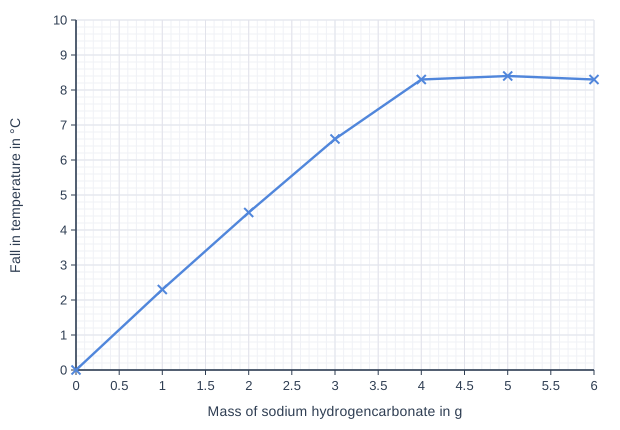
A student added different masses of sodium hydrogencarbonate to 25 cm³ portions of the same citric acid solution. The student measured the fall in temperature each time.

The graph shows the results.

Describe how the fall in temperature changes as the mass of sodium hydrogencarbonate increases.

Use values from the graph in your answer.

Line graph of fall in temperature in °C (y-axis, 0 to 10) against mass of sodium hydrogencarbonate in g (x-axis, 0 to 6). The line joins the points (0, 0), (1, 2.3), (2, 4.5), (3, 6.6), (4, 8.3), (5, 8.4), (6, 8.3).

Model answer

As the mass of sodium hydrogencarbonate increases from 0 g to about 4 g, the fall in temperature increases steadily, to about 8.3 °C. Above 4 g the fall in temperature levels off and stays at about 8.3 to 8.4 °C.

Explanation

Describe both parts of the graph and quote values: first the fall in temperature increases steadily with mass, then it levels off. Students often describe only the first part, or describe the y-axis as 'temperature' rather than the fall in temperature. You are not asked to explain the pattern, only to describe it.

Mark scheme
  1. 1 mark

    the fall in temperature increases (steadily) as the mass increases, up to about 4 g

    allow the fall in temperature is (directly) proportional to the mass up to about 3 to 4 g; allow a value, e.g. from 0 to 8.3 °C between 0 and 4 g. If no values from the graph are given anywhere in the answer, award a maximum of 1 mark.

  2. 1 mark

    then the fall in temperature stays about the same / levels off (at about 8.3 to 8.4 °C) for masses above 4 g

    allow stays constant / stops increasing; ignore explanations.

Question 4

4 marks

Methane and oxygen do not react when they are mixed at room temperature. A gas cooker uses a spark to light the methane. Once it is lit, the methane keeps burning without any more sparks.

Explain these observations.

Use ideas about particles and activation energy in your answer.

Model answer

For methane and oxygen to react, their particles must collide with at least the activation energy, the minimum energy needed for a reaction. At room temperature the particles do not have enough energy when they collide, so there is no reaction. The spark supplies energy, so some particles now have the activation energy and react. Combustion is exothermic, so this reaction releases energy to the surroundings. That energy is transferred to nearby methane and oxygen particles, giving them enough energy to react too, so the methane keeps burning without more sparks.

Explanation

The key ideas are that particles need at least the activation energy to react, that the spark provides this energy at the start, and that the exothermic reaction then provides energy for more particles to react. Top answers link each observation to its reason. A common mistake is to describe the activation energy as the energy given out by the reaction.

Mark scheme
  1. 4 marks

    Levels of response (4 marks).
    Level 2 (3-4 marks): Relevant points (reasons / causes) are identified, given in detail and logically linked to form a clear account.
    Level 1 (1-2 marks): Points are identified and stated simply, but their relevance is not clear and there is no attempt at logical linking.
    No relevant content: 0 marks.

    Indicative content (not a checklist; credit other valid points):
    Before the spark:
    - methane and oxygen particles must collide to react
    - the particles must collide with at least the activation energy (the minimum energy needed to react)
    - at room temperature the particles do not have enough energy, so they do not react
    The spark:
    - the spark supplies energy, so some particles have at least the activation energy
    - these particles react when they collide
    Keeps burning:
    - combustion is exothermic: energy is released / transferred to the surroundings
    - this energy is transferred to other methane and oxygen particles
    - so these particles now have enough energy (the activation energy) to react
    - so the reaction keeps going as long as methane and oxygen are supplied
    For Level 2, the answer must link the spark to providing the activation energy and link the exothermic reaction to providing energy for more particles to react.
    Common errors: saying the spark is a catalyst; saying combustion is endothermic; saying the activation energy is the energy released by the reaction. There are two marks in each level; use best fit. Full marks only if no incorrect statement contradicts a correct one.

Ready to try the rest? Every answer you write is marked against the mark scheme, so you can see exactly where the marks are.

Study Helper Hints first, answers after you try

Stuck on this one? Ask for a hint and I’ll point you in the right direction, without giving the answer away. Once you’ve checked your answer, I’ll show you how the marks are awarded.