Level:
Correct: 0
Incorrect: 0
Marks: 0/0
Exam Practice
Course:
Topics:
AQA GCSE Combined Science (Foundation Chemistry Paper 1) Smart practice A mixed round aimed at your weak spots
Unit 8
Atomic structure and the periodic table
Unit 9
Bonding, structure, and the properties of matter
Chemical bonds, ionic, covalent and metallic
How bonding and structure are related to the properties of substances
The three states of matter and state symbols
Properties of ionic, covalent and metallic substances
Structure and bonding of carbon
Unit 10
Quantitative chemistry
Chemical measurements, conservation of mass and the quantitative interpretation of chemical equations
Conservation of mass and relative formula mass
Mass changes, chemical measurements and concentration
Unit 11
Chemical changes
Unit 12
Energy changes
Exothermic and endothermic reactions
Avg
score:
–
Topics
done:
0/19

Group 1

Practise 21 exam-style questions on Group 1 for AQA GCSE Combined Science (Foundation Chemistry Paper 1). Write your answer as you would in the exam and get it marked in seconds against the mark scheme, point by point, with the Study Helper on hand if you get stuck.

  • 21 questions
  • 1–6 marks each
  • Instant marking
  • No sign-up needed
20 questions, marked as you go

Sample questions with model answers

Here are 4 of the questions in this topic, each with a model answer, an explanation of why it earns the marks and the mark scheme an examiner would use.

Question 1

1 mark

A teacher drops a small piece of potassium into a trough of water behind a safety screen.

Which observation would the class see?

Choose your answer.

  • The potassium burns with a lilac flame
  • The potassium sinks to the bottom
  • The potassium gives off a green gas
  • The potassium burns with a yellow flame

Model answer

The potassium burns with a lilac flame

Explanation

Potassium reacts so quickly with water that enough heat is released to set fire to the hydrogen, and potassium colours the flame lilac. It also floats, melts, fizzes and moves quickly over the surface. Choosing the yellow flame mixes potassium up with sodium.

Mark scheme
  1. 1 mark

    The potassium burns with a lilac flame

    If more than one option is given, 0 marks. Potassium is less dense than water, so it floats rather than sinks. The gas given off is hydrogen, which is colourless (a green gas would be chlorine). A yellow flame is seen when sodium burns, not potassium.

Question 2

1 mark

Lithium, sodium and potassium are stored in jars of oil.

Suggest why.

Model answer

The oil keeps air and moisture away from the metals, so they cannot react with oxygen or water vapour in the air.

Explanation

The alkali metals react quickly with oxygen and with water, both of which are in the air. Covering them with oil stops air and moisture reaching the metal. Just saying 'they are reactive' does not explain what the oil prevents.

Mark scheme
  1. 1 mark

    to stop the metals reacting with oxygen / water (vapour) / air

    allow to keep air / oxygen / moisture away from the metal. allow to stop them tarnishing (in air). ignore 'because they are (very) reactive' unless what they would react with is given. do not accept 'to stop them reacting with the oil' or 'to stop them evaporating / melting'.

Question 3

2 marks

Behind a safety screen, a teacher heats a small piece of lithium on a combustion spoon until it catches fire. The teacher then lowers the burning lithium into a gas jar of oxygen.

Name the product of the reaction.

Describe one observation the class would make during the reaction.

Model answer

The product is lithium oxide. The lithium burns with a bright red flame and a white solid forms.

Explanation

Alkali metals burn in oxygen to form metal oxides: lithium + oxygen → lithium oxide, which is a white solid. The lithium burns more brightly in pure oxygen than in air, with a red-tinged flame. Lithium hydroxide is the common wrong answer: a hydroxide is made only when the metal reacts with water.

Mark scheme
  1. 1 mark

    lithium oxide

    allow Li₂O / Li2O. do not accept lithium hydroxide (made with water, not oxygen), lithium dioxide or 'lithium oxygen'.

  2. 1 mark

    any one from: the lithium burns (more) brightly / burns with a (bright) red or crimson flame / a white solid (white powder / white smoke) forms

    allow 'glows brightly' or 'bright flame'. allow 'burns faster than in air'. ignore 'it reacts', 'it gets hot' or 'heat is given off' (not something that can be seen). do not accept a lilac or yellow flame, fizzing / bubbles, or 'a gas is given off'. If more than one observation is given, each wrong one cancels a correct one.

Question 4

3 marks

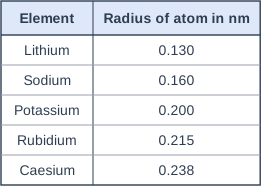
The table shows the radius of an atom of five Group 1 elements.

Calculate the percentage increase in the radius of the atom from sodium to potassium.

Give the reason why the radius of the atom increases going down Group 1.

Table with columns "Element", "Radius of atom in nm". Element: Lithium; Radius of atom in nm: 0.130 | Element: Sodium; Radius of atom in nm: 0.160 | Element: Potassium; Radius of atom in nm: 0.200 | Element: Rubidium; Radius of atom in nm: 0.215 | Element: Caesium; Radius of atom in nm: 0.238.

Model answer

Increase = 0.200 − 0.160 = 0.040 nm
Percentage increase = 0.040 ÷ 0.160 × 100 = 25%
The radius increases going down the group because each element has one more shell of electrons than the one above it.

Explanation

Work out the increase, then divide it by the starting value (the sodium radius, 0.160 nm) and multiply by 100. Dividing by the potassium radius (giving 20%) is the most common error. Each element further down Group 1 has an extra shell, so its outer electron is further from the nucleus; this is also why reactivity increases down the group.

Mark scheme
  1. 1 mark

    (increase =) 0.200 − 0.160 = 0.040 (nm)

    allow 0.04 seen.

  2. 1 mark

    (percentage increase =) 0.040 ÷ 0.160 × 100 = 25 (%)

    allow ecf from their increase, divided by 0.160 and multiplied by 100. An answer of 20 (%) (dividing by the potassium value, 0.200) scores 1 mark. An answer of 125 (%) (potassium's radius as a percentage of sodium's) scores 1 mark. A correct answer with no working scores full marks for the calculation (2 marks). Full marks are not awarded for a correct final answer from incorrect working. Mark the number; ignore a missing % sign.

  3. 1 mark

    each element has one more shell (energy level) of electrons than the element above it

    allow the atoms have more shells / more energy levels going down the group. allow the outer electron is in a shell further from the nucleus. ignore 'more electrons' or 'more protons' alone. do not accept 'more outer electrons' (every Group 1 atom has one outer electron) or 'the atoms are heavier'.

Ready to try the rest? Every answer you write is marked against the mark scheme, so you can see exactly where the marks are.

Revision notes

Group 1

The big idea

The elements in Group 1 are the alkali metals: lithium, sodium, potassium, rubidium, caesium and francium. They get their name because they react with water to form alkaline solutions. They have characteristic properties because of the single electron in their outer shell, and their reactivity increases going down the group.

Why they are alike

Every alkali metal atom has one electron in its outer shell. When it reacts, it loses this electron to form an ion with a 1+ charge and a full outer shell. Because they all react in the same way, their compounds have the same type of formula: LiCl, NaCl and KCl, or Li₂O, Na₂O and K₂O. These compounds are ionic, and the chlorides are white solids that dissolve in water to form colourless solutions.

Electron shell diagram: Lithium: particle with Li in the centre and electrons 2,1 drawn on 2 shells; Sodium: particle with Na in the centre and electrons 2,8,1 drawn on 3 shells; Potassium: particle with K in the centre and electrons 2,8,8,1 drawn on 4 shells.
Each atom has one outer electron. Going down the group there is one more shell each time, so the outer electron is further from the nucleus.

The alkali metals are unusual metals. They are soft enough to cut with a knife, they have low densities (lithium, sodium and potassium float on water), and they have low melting points, which decrease going down the group.

Reactions with water

All the alkali metals react with water to form a metal hydroxide and hydrogen:

metal + water → metal hydroxide + hydrogen

2K(s) + 2H₂O(l) → 2KOH(aq) + H₂(g)

The metal hydroxide dissolves to form an alkaline solution, so universal indicator turns purple.

MetalWhat you see when a small piece is added to water
Lithiumfloats, fizzes steadily, moves slowly on the surface, gradually gets smaller
Sodiumfloats, fizzes rapidly, melts into a ball, moves quickly around the surface
Potassiumfloats, melts, reacts very vigorously, and the hydrogen catches fire with a lilac flame

Reactions with oxygen and chlorine

  • Oxygen: the alkali metals react quickly with oxygen in the air. A freshly cut surface is shiny but soon goes dull (it tarnishes) as a layer of oxide forms. They are stored under oil to keep oxygen and water vapour away. Heated in air, they burn to form metal oxides, such as 4Li + O₂ → 2Li₂O. Sodium and potassium can also form other oxides when they burn in plenty of oxygen, but GCSE questions use the formula M₂O.
  • Chlorine: a heated alkali metal burns vigorously in chlorine to form a white solid metal chloride: 2Li + Cl₂ → 2LiCl. Sodium burns with a bright yellow-orange flame and forms white sodium chloride.

Why reactivity increases down the group

Going down Group 1:

  1. the atoms have more shells, so the outer electron is further from the nucleus;
  2. so the attraction between the nucleus and the outer electron is weaker;
  3. so the outer electron is lost more easily, and the metal is more reactive.

Identifying alkali metals from observations

Small pieces of three alkali metals, X, Y and Z, are added to water. They are lithium, sodium and potassium, in some order.

  • X fizzes steadily and moves slowly on the surface, but does not melt.
  • Y melts, moves very quickly, and the hydrogen burns with a lilac flame.
  • Z melts into a ball and moves quickly, but does not catch fire.

Identify X, Y and Z, and write a balanced equation for the reaction of X with water.

Reactivity increases down Group 1, so the most vigorous reaction (Y) is potassium's and the least vigorous (X) is lithium's. Z is sodium.

Lithium forms lithium hydroxide and hydrogen: Li + H₂O → LiOH + H₂

There are 2 hydrogen atoms on the left but 3 on the right. Doubling the Li, H₂O and LiOH gives 4 on each side:

2Li + 2H₂O → 2LiOH + H₂

Higher tier only

Half equation. When an alkali metal reacts, each atom loses one electron: Li → Li⁺ + e⁻. Loss of electrons is oxidation, so the metal atoms are oxidised. Further down the group, this happens more easily.

Common mistakes

  • Saying the metals "are alkalis". They react with water to form alkaline solutions of metal hydroxides.
  • Giving "hydrogen is made" or "it dissolves" as an observation. Say what you see: it fizzes, moves around and gets smaller.
  • Naming the product of the reaction with water as the metal oxide. It is the metal hydroxide (and hydrogen).
  • Explaining reactivity with "weaker attraction between the electron and the atom". Say the attraction between the nucleus and the outer electron is weaker.
  • Saying they are stored under oil just because they "are reactive". Say they would react with oxygen and water in the air.

Exam tip

In a 6-mark question about lithium, sodium and potassium in water, give a different observation for each metal, not just "reacts more", then state the trend and explain it through the distance of the outer electron from the nucleus.

Study Helper Hints first, answers after you try

Stuck on this one? Ask for a hint and I’ll point you in the right direction, without giving the answer away. Once you’ve checked your answer, I’ll show you how the marks are awarded.