
Level:
Correct: 0
Incorrect: 0
Marks: 0/0
Exam Practice
Course:
Topics:
AQA GCSE Combined Science (Foundation Chemistry Paper 1) Smart practice A mixed round aimed at your weak spots
Unit 8
Atomic structure and the periodic table
Unit 9
Bonding, structure, and the properties of matter
Chemical bonds, ionic, covalent and metallic
How bonding and structure are related to the properties of substances
The three states of matter and state symbols
Properties of ionic, covalent and metallic substances
Structure and bonding of carbon
Unit 10
Quantitative chemistry
Chemical measurements, conservation of mass and the quantitative interpretation of chemical equations
Conservation of mass and relative formula mass
Mass changes, chemical measurements and concentration
Unit 11
Chemical changes
Unit 12
Energy changes
Exothermic and endothermic reactions
Avg
score:
–
Topics
done:
0/19

Reactions of acids, neutralisation and the pH scale

Practise 23 exam-style questions on Reactions of acids, neutralisation and the pH scale for AQA GCSE Combined Science (Foundation Chemistry Paper 1). Write your answer as you would in the exam and get it marked in seconds against the mark scheme, point by point, with the Study Helper on hand if you get stuck.

  • 23 questions
  • 1–6 marks each
  • Instant marking
  • No sign-up needed
20 questions, marked as you go

Sample questions with model answers

Here are 4 of the questions in this topic, each with a model answer, an explanation of why it earns the marks and the mark scheme an examiner would use.

Question 1

1 mark

Lithium oxide reacts with dilute nitric acid.

What is the name of the salt produced?

Choose your answer.

  • Lithium chloride
  • Lithium nitrate
  • Lithium nitride
  • Lithium sulfate

Model answer

Lithium nitrate

Explanation

The name of a salt has two parts: the metal from the base, alkali or carbonate (here lithium) and a part from the acid. Hydrochloric acid produces chlorides, nitric acid produces nitrates and sulfuric acid produces sulfates. Nitride is a common wrong answer because it sounds like nitric, but a nitride contains no oxygen.

Mark scheme
  1. 1 mark

    Lithium nitrate

    If more than one option is given, 0 marks. Lithium chloride would be made with hydrochloric acid, and lithium sulfate with sulfuric acid. Lithium nitride is a compound of lithium and nitrogen only (the -ide ending): nitric acid produces nitrates.
Question 2

2 marks

An alkali is a base that dissolves in water.

Which two of these substances are bases that do not dissolve in water?

A copper oxide
B iron hydroxide
C potassium chloride
D sodium hydroxide
E sulfuric acid

Give two answers from this list: A, B, C, D, E.

Model answer

A (copper oxide) and B (iron hydroxide)

Explanation

Bases include metal oxides and metal hydroxides. Soluble metal hydroxides such as sodium hydroxide are alkalis; insoluble ones such as iron hydroxide, and insoluble metal oxides such as copper oxide, are bases that are not alkalis. Choosing sodium hydroxide is the common mistake: it is a base, but it dissolves in water.

Mark scheme
  1. 1 mark

    A / copper oxide

    Each wrong extra answer cancels a correct one (right + wrong = wrong): for example A, B and D scores 1 mark; A, B, C and D scores 0 marks. allow the names instead of the letters. D, sodium hydroxide, is a base but it dissolves in water, so it is an alkali. C is a salt and E is an acid.

  2. 1 mark

    B / iron hydroxide

    allow iron(II) hydroxide or iron(III) hydroxide; the two answers can be given in either order.

Question 3

2 marks

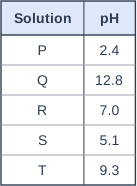
The table shows the pH of five solutions, P, Q, R, S and T.

Which two solutions are alkaline?

Give two answers from this list: P, Q, R, S, T.

Table with columns "Solution", "pH". Solution: P; pH: 2.4 | Solution: Q; pH: 12.8 | Solution: R; pH: 7.0 | Solution: S; pH: 5.1 | Solution: T; pH: 9.3.

Model answer

Q and T

Explanation

Alkaline solutions have a pH greater than 7, so Q (pH 12.8) and T (pH 9.3) are alkaline. R, with pH 7.0, is neutral, not alkaline. P and S have pH values below 7, so they are acidic.

Mark scheme
  1. 1 mark

    Q

    Each wrong extra answer cancels a correct one (right + wrong = wrong): for example Q, T and R scores 1 mark; Q, T, R and S scores 0 marks. R is neutral (pH 7.0); P and S are acidic (pH below 7).

  2. 1 mark

    T

    the two answers can be given in either order.

Question 4

4 marks

Water flowing out of an old mine is acidic. Before the water goes into a river, calcium hydroxide is added to neutralise it.

A scientist added calcium hydroxide powder, a little at a time, to a 500 cm³ sample of the mine water until a pH probe showed pH 7.0. The scientist did this with three samples of the mine water.

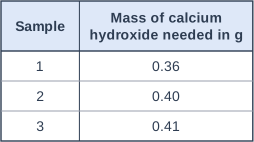
The table shows the results.

60 dm³ of water flows out of the mine every minute.

Calculate the mass of calcium hydroxide needed to neutralise the water that flows out of the mine in one minute.

Use the mean mass from the table.

Table with columns "Sample", "Mass of calcium hydroxide needed in g". Sample: 1; Mass of calcium hydroxide needed in g: 0.36 | Sample: 2; Mass of calcium hydroxide needed in g: 0.40 | Sample: 3; Mass of calcium hydroxide needed in g: 0.41.

Model answer

Mean mass = (0.36 + 0.40 + 0.41) ÷ 3 = 1.17 ÷ 3 = 0.39 g
60 dm³ = 60 000 cm³
60 000 ÷ 500 = 120
Mass of calcium hydroxide = 120 × 0.39 = 46.8 g

Explanation

First find the mean mass needed for one 500 cm³ sample (0.39 g). Then convert 60 dm³ to 60 000 cm³: this is 120 times the volume of the sample, so 120 times as much calcium hydroxide is needed. Forgetting to convert dm³ to cm³, which gives 0.0468 g, is the most common error.

Mark scheme
  1. 1 mark

    mean mass = (0.36 + 0.40 + 0.41) ÷ 3 = 0.39 (g)

    A correct answer with no working scores full marks (46.8 g scores 4 marks). Full marks are not awarded for a correct final answer from incorrect working. allow 1.17 ÷ 3.

  2. 1 mark

    60 dm³ = 60 000 cm³ or 500 cm³ = 0.500 dm³

    the conversion may be seen in the working, e.g. 60 000 ÷ 500 = 120 or 0.39 ÷ 0.500 = 0.78 (g per dm³).

  3. 1 mark

    60 000 ÷ 500 × 0.39 or 120 × 0.39 or 0.78 × 60

    allow ecf from their mean and / or their conversion; allow a single result used instead of the mean (e.g. 120 × 0.40).

  4. 1 mark

    = 46.8 (g)

    allow 47 (g); allow ecf only from an incorrect mean or a single result used instead of the mean (e.g. 48 g from 0.40 g scores 3 marks); an answer of 0.0468 (g) (volume not converted: 60 ÷ 500 × 0.39) scores 2 marks (the mean and the method mark); do not accept 0.39 (g), the mass for one 500 cm³ sample.

Ready to try the rest? Every answer you write is marked against the mark scheme, so you can see exactly where the marks are.

Study Helper Hints first, answers after you try

Stuck on this one? Ask for a hint and I’ll point you in the right direction, without giving the answer away. Once you’ve checked your answer, I’ll show you how the marks are awarded.