
Level:
Correct: 0
Incorrect: 0
Marks: 0/0
Exam Practice
Course:
Topics:
AQA GCSE Combined Science (Foundation Chemistry Paper 1) Smart practice A mixed round aimed at your weak spots
Unit 8
Atomic structure and the periodic table
Unit 9
Bonding, structure, and the properties of matter
Chemical bonds, ionic, covalent and metallic
How bonding and structure are related to the properties of substances
The three states of matter and state symbols
Properties of ionic, covalent and metallic substances
Structure and bonding of carbon
Unit 10
Quantitative chemistry
Chemical measurements, conservation of mass and the quantitative interpretation of chemical equations
Conservation of mass and relative formula mass
Mass changes, chemical measurements and concentration
Unit 11
Chemical changes
Unit 12
Energy changes
Exothermic and endothermic reactions
Avg
score:
–
Topics
done:
0/19

Mass changes, chemical measurements and concentration

Practise 20 exam-style questions on Mass changes, chemical measurements and concentration for AQA GCSE Combined Science (Foundation Chemistry Paper 1). Write your answer as you would in the exam and get it marked in seconds against the mark scheme, point by point, with the Study Helper on hand if you get stuck.

  • 20 questions
  • 1–6 marks each
  • Instant marking
  • No sign-up needed
20 questions, marked as you go

Sample questions with model answers

Here are 4 of the questions in this topic, each with a model answer, an explanation of why it earns the marks and the mark scheme an examiner would use.

Question 1

1 mark

What is 250 cm³ in dm³?

Choose your answer.

  • 0.025 dm³
  • 0.25 dm³
  • 2.5 dm³
  • 25 dm³

Model answer

0.25 dm³

Explanation

There are 1000 cm³ in 1 dm³, so 250 cm³ = 250 ÷ 1000 = 0.25 dm³. This conversion is needed in almost every concentration calculation, and dividing by 100 instead of 1000 is a common error.

Mark scheme
  1. 1 mark

    0.25 dm³

    If more than one option is given, 0 marks. 1 dm³ = 1000 cm³, so divide by 1000. 2.5 dm³ comes from dividing by 100, 25 dm³ from dividing by 10 and 0.025 dm³ from dividing by 10 000.
Question 2

2 marks

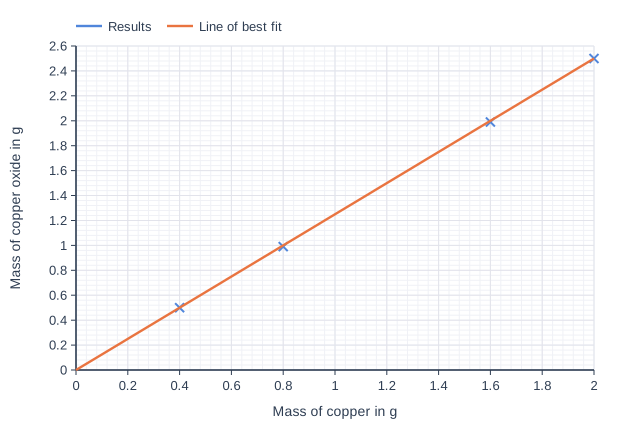
A student heated different masses of copper powder in air until the mass stopped changing. The copper reacted with oxygen to produce copper oxide.

The graph shows the student's results.

Determine the mass of oxygen that combined with 1.2 g of copper.

Use the graph.

Line graph of mass of copper oxide in g (y-axis, 0 to 2.6) against mass of copper in g (x-axis, 0 to 2). "Results" is shown as plotted points only (no line), at (0.4, 0.5), (0.8, 0.99), (1.6, 1.99), (2, 2.5). "Line of best fit" joins the points (0, 0), (2, 2.5).

Model answer

From the line of best fit, 1.2 g of copper produces 1.5 g of copper oxide.
Mass of oxygen = 1.5 − 1.2 = 0.3 g

Explanation

The graph gives the mass of copper oxide, not the mass of oxygen. The extra mass of the solid is the mass of oxygen atoms that joined the copper atoms, so subtract the mass of copper from the mass of copper oxide. Giving the copper oxide reading as the answer is the common mistake.

Mark scheme
  1. 1 mark

    (mass of copper oxide from 1.2 g of copper =) 1.5 (g)

    read from the line of best fit. allow 1.48 to 1.52 (g)

  2. 1 mark

    (mass of oxygen = 1.5 − 1.2 =) 0.3 (g)

    allow ecf: their reading − 1.2. allow 0.28 to 0.32 (g). A correct answer with no working scores 2 marks. Full marks are not awarded for a correct final answer from incorrect working. An answer of 1.5 (g) on its own scores 1 mark.

Question 3

2 marks

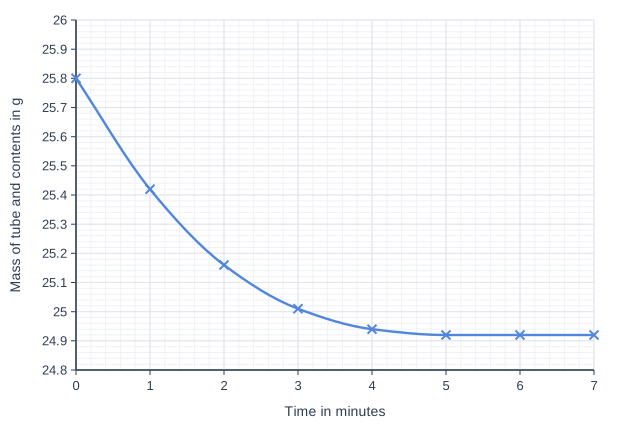
A student heated 2.50 g of zinc carbonate in a boiling tube. Zinc carbonate decomposes when it is heated:

ZnCO₃(s) → ZnO(s) + CO₂(g)

The student measured the mass of the tube and its contents every minute. The graph shows the results.

Determine the total mass of carbon dioxide given off.

Line graph of mass of tube and contents in g (y-axis, 24.8 to 26) against time in minutes (x-axis, 0 to 7). The line is a smooth curve through (0, 25.8), (1, 25.42), (2, 25.16), (3, 25.01), (4, 24.94), (5, 24.92), (6, 24.92), (7, 24.92).

Model answer

Mass at the start = 25.80 g
Mass at the end (when the mass stops changing) = 24.92 g
Mass of carbon dioxide = 25.80 − 24.92 = 0.88 g

Explanation

The mass decreases because carbon dioxide gas escapes from the open tube. When all the zinc carbonate has decomposed, the mass stops changing, so the total loss in mass is the mass of carbon dioxide given off. Use the final constant reading, not the reading after one or two minutes.

Mark scheme
  1. 1 mark

    (start) 25.80 (g) and (end) 24.92 (g)

    both values needed. allow 24.90 to 24.94 (g) for the end value.

  2. 1 mark

    (25.80 − 24.92 =) 0.88 (g)

    allow ecf from their readings. allow 0.86 to 0.90 (g). A correct answer with no working scores 2 marks. Full marks are not awarded for a correct final answer from incorrect working.

Question 4

4 marks

A teacher has two bottles of sodium chloride solution.

Bottle A: 6.0 g of sodium chloride in 200 cm³ of solution
Bottle B: 9.0 g of sodium chloride in 250 cm³ of solution

Which bottle contains the more concentrated solution?

You must show your working.

Model answer

Bottle A: 200 cm³ = 0.2 dm³, concentration = 6.0 ÷ 0.2 = 30 g/dm³
Bottle B: 250 cm³ = 0.25 dm³, concentration = 9.0 ÷ 0.25 = 36 g/dm³
Bottle B contains the more concentrated solution.

Explanation

Concentration depends on both the mass of solute and the volume of solution, so each bottle's concentration must be calculated in the same units before comparing. Bottle B has more sodium chloride but also more solution; its concentration is still higher, 36 g/dm³ compared with 30 g/dm³. Comparing only the masses is not enough.

Mark scheme
  1. 1 mark

    volumes converted: 200 cm³ = 0.2 dm³ and 250 cm³ = 0.25 dm³

    allow working in g/cm³ throughout (6.0 ÷ 200 and 9.0 ÷ 250) for this mark

  2. 1 mark

    (concentration of A = 6.0 ÷ 0.2 =) 30 (g/dm³)

    allow 0.03 (g/cm³). allow ecf from an incorrect conversion

  3. 1 mark

    (concentration of B = 9.0 ÷ 0.25 =) 36 (g/dm³)

    allow 0.036 (g/cm³). allow ecf from an incorrect conversion

  4. 1 mark

    bottle B (is more concentrated)

    allow ecf: the bottle with the higher concentration in their calculations. Because the question says 'You must show your working', a correct answer with no working (bottle B stated with no calculation) scores 0 marks. Full marks are not awarded for a correct final answer from incorrect working. A comparison based only on the masses (9.0 g is more than 6.0 g) scores 0.

Ready to try the rest? Every answer you write is marked against the mark scheme, so you can see exactly where the marks are.

Study Helper Hints first, answers after you try

Stuck on this one? Ask for a hint and I’ll point you in the right direction, without giving the answer away. Once you’ve checked your answer, I’ll show you how the marks are awarded.