
Level:
Correct: 0
Incorrect: 0
Marks: 0/0
Exam Practice
Course:
Topics:
AQA GCSE Combined Science (Foundation Chemistry Paper 1) Smart practice A mixed round aimed at your weak spots
Unit 8
Atomic structure and the periodic table
Unit 9
Bonding, structure, and the properties of matter
Chemical bonds, ionic, covalent and metallic
How bonding and structure are related to the properties of substances
The three states of matter and state symbols
Properties of ionic, covalent and metallic substances
Structure and bonding of carbon
Unit 10
Quantitative chemistry
Chemical measurements, conservation of mass and the quantitative interpretation of chemical equations
Conservation of mass and relative formula mass
Mass changes, chemical measurements and concentration
Unit 11
Chemical changes
Unit 12
Energy changes
Exothermic and endothermic reactions
Avg
score:
–
Topics
done:
0/19

Reactivity of metals

Practise 22 exam-style questions on Reactivity of metals for AQA GCSE Combined Science (Foundation Chemistry Paper 1). Write your answer as you would in the exam and get it marked in seconds against the mark scheme, point by point, with the Study Helper on hand if you get stuck.

  • 22 questions
  • 1–6 marks each
  • Instant marking
  • No sign-up needed
20 questions, marked as you go

Sample questions with model answers

Here are 4 of the questions in this topic, each with a model answer, an explanation of why it earns the marks and the mark scheme an examiner would use.

Question 1

1 mark

Which metal can be extracted from its oxide by heating the oxide with carbon?

Choose your answer.

  • Potassium
  • Magnesium
  • Iron
  • Calcium

Model answer

Iron

Explanation

Metals less reactive than carbon can be extracted from their oxides by reduction with carbon, because carbon takes the oxygen. Carbon is placed below magnesium (and aluminium) and above zinc in the reactivity series, so iron (below carbon) can be extracted this way, but potassium, calcium and magnesium (above carbon) cannot.

Mark scheme
  1. 1 mark

    Iron

    If more than one option is given, 0 marks. Iron is less reactive than carbon, so carbon can remove the oxygen from iron oxide. Potassium, magnesium and calcium are all more reactive than carbon, so carbon cannot reduce their oxides.
Question 2

2 marks

Gold is found in the Earth as the metal itself. Iron is found in the Earth as compounds, such as iron oxide.

Explain why.

Model answer

Gold is very unreactive, so it does not react with oxygen or other substances and stays as the metal. Iron is more reactive, so over time it has reacted with oxygen to form compounds such as iron oxide.

Explanation

Unreactive metals such as gold are found as the metal itself, but most metals are more reactive and have combined with other elements, so they must be extracted from their compounds by chemical reactions. Both parts need a reason based on reactivity.

Mark scheme
  1. 1 mark

    gold is (very) unreactive / does not react with oxygen (or other substances in the Earth)

    allow 'gold is very low in the reactivity series'.

  2. 1 mark

    iron is more reactive (than gold) so it has reacted (with oxygen / other elements) to form compounds

    allow 'iron reacts with oxygen (and water) to form iron oxide'. ignore 'iron rusts' on its own.

Question 3

2 marks

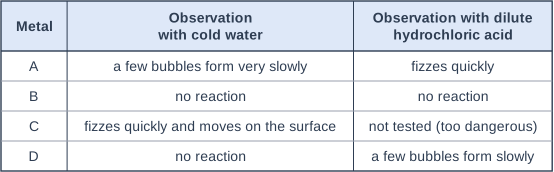
Four metals, labelled A, B, C and D, were each tested with cold water and with dilute hydrochloric acid. The table shows the observations.

Use the observations to place the metals in order of reactivity. Start with the most reactive.

Table with columns "Metal", "Observation with cold water", "Observation with dilute hydrochloric acid". Metal: A; Observation with cold water: a few bubbles form very slowly; Observation with dilute hydrochloric acid: fizzes quickly | Metal: B; Observation with cold water: no reaction; Observation with dilute hydrochloric acid: no reaction | Metal: C; Observation with cold water: fizzes quickly and moves on the surface; Observation with dilute hydrochloric acid: not tested (too dangerous) | Metal: D; Observation with cold water: no reaction; Observation with dilute hydrochloric acid: a few bubbles form slowly.

Model answer

C, A, D, B

Explanation

C reacts quickly even with cold water, so it is the most reactive. A reacts slowly with water but quickly with acid, D reacts only with acid and only slowly, and B does not react with either. The more vigorously a metal reacts with water and acids, the higher it is in the reactivity series.

Mark scheme
  1. 1 mark

    C first (most reactive)

    allow 1 mark for C as the most reactive even if the rest of the order is wrong

  2. 1 mark

    then A, then D, then B (order C, A, D, B)

    allow 1 mark for A before D before B even if C is not first. allow the reverse order (B, D, A, C) for 2 marks only if the answer clearly says it starts with the least reactive.

Question 4

4 marks

Iron is extracted from iron oxide by heating it with carbon:

2Fe₂O₃ + 3C → 4Fe + 3CO₂

Identify the substance that is oxidised and the substance that is reduced in this reaction. Give a reason for each answer.

Model answer

Carbon is oxidised because it gains oxygen to form carbon dioxide.
Iron oxide is reduced because it loses oxygen to form iron.

Explanation

Oxidation is the gain of oxygen and reduction is the loss of oxygen. Carbon is more reactive than iron, so it takes the oxygen from iron oxide: the carbon is oxidised and the iron oxide is reduced. A common error is to say that 'iron' is reduced or 'iron' loses oxygen, when it is the iron oxide that loses oxygen.

Mark scheme
  1. 1 mark

    carbon is oxidised

    allow C

  2. 1 mark

    (because carbon) gains oxygen (to form carbon dioxide)

    This mark depends on carbon being identified as oxidised.

  3. 1 mark

    iron oxide is reduced

    allow Fe₂O₃. do not accept 'iron is reduced': it is the iron oxide that is reduced.

  4. 1 mark

    (because iron oxide) loses oxygen (to form iron)

    This mark depends on iron oxide being identified as reduced. ignore answers in terms of electrons.

Ready to try the rest? Every answer you write is marked against the mark scheme, so you can see exactly where the marks are.

Study Helper Hints first, answers after you try

Stuck on this one? Ask for a hint and I’ll point you in the right direction, without giving the answer away. Once you’ve checked your answer, I’ll show you how the marks are awarded.