
Level:
Correct: 0
Incorrect: 0
Marks: 0/0
Exam Practice
Course:
Topics:
AQA GCSE Combined Science (Foundation Chemistry Paper 1) Smart practice A mixed round aimed at your weak spots
Unit 8
Atomic structure and the periodic table
Unit 9
Bonding, structure, and the properties of matter
Chemical bonds, ionic, covalent and metallic
How bonding and structure are related to the properties of substances
The three states of matter and state symbols
Properties of ionic, covalent and metallic substances
Structure and bonding of carbon
Unit 10
Quantitative chemistry
Chemical measurements, conservation of mass and the quantitative interpretation of chemical equations
Conservation of mass and relative formula mass
Mass changes, chemical measurements and concentration
Unit 11
Chemical changes
Unit 12
Energy changes
Exothermic and endothermic reactions
Avg
score:
–
Topics
done:
0/19

Chemical bonds, ionic, covalent and metallic

Practise 26 exam-style questions on Chemical bonds, ionic, covalent and metallic for AQA GCSE Combined Science (Foundation Chemistry Paper 1). Write your answer as you would in the exam and get it marked in seconds against the mark scheme, point by point, with the Study Helper on hand if you get stuck.

  • 26 questions
  • 1–6 marks each
  • Instant marking
  • No sign-up needed
20 questions, marked as you go

Sample questions with model answers

Here are 4 of the questions in this topic, each with a model answer, an explanation of why it earns the marks and the mark scheme an examiner would use.

Question 1

1 mark

Which statement describes the forces that hold the ions together in a giant ionic lattice?

Choose your answer.

  • Strong forces that act in all directions
  • Weak forces between small molecules
  • Strong forces that act in one direction only
  • Weak forces between shared pairs of electrons

Model answer

Strong forces that act in all directions

Explanation

An ionic compound is a giant structure of ions held together by strong electrostatic forces of attraction between oppositely charged ions. These forces act in all directions in the lattice, and this is called ionic bonding. Mixing up ionic bonding with intermolecular forces is a common error.

Mark scheme
  1. 1 mark

    Strong forces that act in all directions

    If more than one option is given, 0 marks. An ionic lattice contains ions, not small molecules, and the forces between oppositely charged ions are strong, not weak. Each ion attracts all the oppositely charged ions around it, so the forces act in all directions, not in one direction. Shared pairs of electrons are found in covalent bonds, not ionic bonds.
Question 2

1 mark

An oxygen atom has six electrons in its outer shell. Oxygen gas is made of O₂ molecules.

How many pairs of electrons are shared between the two atoms in an oxygen molecule?

Model answer

Two pairs of electrons are shared (a double bond).

Explanation

Each oxygen atom needs two more electrons to fill its outer shell. By sharing two pairs of electrons, each atom has eight electrons in its outer shell. Two shared pairs make a double covalent bond, O=O.

Mark scheme
  1. 1 mark

    2 (pairs)

    allow two / a double bond. allow 'four electrons' only if the answer clearly says electrons rather than pairs. do not accept 1, 4 pairs or 6.

Question 3

3 marks

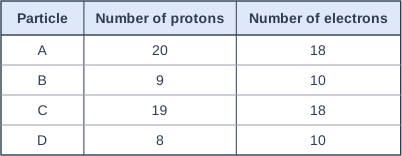
The table shows the numbers of protons and electrons in four particles, A, B, C and D. Each particle is an ion of an element in Group 1, 2, 6 or 7.

Work out the charge on particle A and the charge on particle B.

An argon atom has 18 electrons. Which two particles have the same electronic structure as an argon atom?

Table with columns "Particle", "Number of protons", "Number of electrons". Particle: A; Number of protons: 20; Number of electrons: 18 | Particle: B; Number of protons: 9; Number of electrons: 10 | Particle: C; Number of protons: 19; Number of electrons: 18 | Particle: D; Number of protons: 8; Number of electrons: 10.

Model answer

A has 20 protons and 18 electrons, so its charge is 2+.
B has 9 protons and 10 electrons, so its charge is 1−.
A and C each have 18 electrons, so they have the same electronic structure as argon (2,8,8).

Explanation

The charge on an ion is the number of protons minus the number of electrons: more protons than electrons gives a positive ion, more electrons gives a negative ion. Particles with the same number of electrons have the same electronic structure, so A (a calcium ion) and C (a potassium ion) both have argon's structure, 2,8,8. B and D (fluoride and oxide ions) have 10 electrons, so they have neon's structure instead.

Mark scheme
  1. 1 mark

    A: 2+

    allow +2 / A²⁺ (20 protons, 18 electrons). do not accept 2−, 18+ or 20+.

  2. 1 mark

    B: 1−

    allow −1 / − / B⁻ (9 protons, 10 electrons). do not accept 1+ or 10−. A correct answer with no working scores the mark. Full marks are not awarded for a correct final answer from incorrect working.

  3. 1 mark

    A and C

    Both letters are needed for the mark. This is a list question: if B or D is also given, 0 marks. This mark does not depend on the first two marks: it is for choosing the two particles with 18 electrons.

Question 4

4 marks

Sodium chloride has a giant ionic structure.

In a crystal of sodium chloride, the distance from the centre of one ion to the centre of the next ion is 2.8 × 10⁻¹⁰ m.

A grain of salt is a cube with edges 0.56 mm long.

1 mm = 1 × 10⁻³ m

Estimate the number of ions along one edge of the grain of salt.

Then estimate the total number of ions in the grain. Use the equation:

number of ions in the grain = (number of ions along one edge)³

Give both answers in standard form.

Model answer

Edge = 0.56 mm = 0.56 × 10⁻³ m = 5.6 × 10⁻⁴ m
Number of ions along one edge = 5.6 × 10⁻⁴ ÷ 2.8 × 10⁻¹⁰ = 2 × 10⁶
Number of ions in the grain = (2 × 10⁶)³ = 8 × 10¹⁸

Explanation

First make the units the same by converting the edge length from mm to m, then divide by the distance taken up by each ion: about two million ions fit along one edge. Cubing this gives about 8 × 10¹⁸ ions in one tiny grain, which is why a crystal is called a giant structure and why any model or diagram can show only a very small part of it. Forgetting to convert mm to m, or multiplying by 3 instead of cubing, are the common errors.

Mark scheme
  1. 1 mark

    (edge =) 0.56 × 10⁻³ m = 5.6 × 10⁻⁴ m

    allow 0.00056 (m).

  2. 1 mark

    (number of ions along one edge =) 5.6 × 10⁻⁴ ÷ 2.8 × 10⁻¹⁰ = 2 × 10⁶

    allow 2.0 × 10⁶. allow ecf from an incorrect or missing unit conversion (e.g. 0.56 ÷ 2.8 × 10⁻¹⁰ = 2 × 10⁹ scores this mark). allow typed forms such as '2 × 10 to the power 6' or 2E6.

  3. 1 mark

    (number of ions in the grain =) (2 × 10⁶)³

    allow ecf from their number of ions along one edge, cubed. allow 2 × 10⁶ × 2 × 10⁶ × 2 × 10⁶.

  4. 1 mark

    = 8 × 10¹⁸ (ions)

    allow 8.0 × 10¹⁸ or typed forms such as 8E18. allow ecf: a correctly calculated cube of their number along one edge (e.g. 8 × 10²⁷ from 2 × 10⁹). The question asks for standard form: if one or both correct answers are not in standard form (e.g. 2 000 000 or 8 000 000 000 000 000 000), max 3. An answer of 6 × 10⁶ (multiplying by 3 instead of cubing) scores 0 for the last two marks. A correct answer with no working scores full marks. Full marks are not awarded for a correct final answer from incorrect working.

Ready to try the rest? Every answer you write is marked against the mark scheme, so you can see exactly where the marks are.

Study Helper Hints first, answers after you try

Stuck on this one? Ask for a hint and I’ll point you in the right direction, without giving the answer away. Once you’ve checked your answer, I’ll show you how the marks are awarded.