Level:
Correct: 0
Incorrect: 0
Marks: 0/0
Exam Practice
Course:
Topics:
AQA GCSE Combined Science (Foundation Chemistry Paper 1) Smart practice A mixed round aimed at your weak spots
Unit 8
Atomic structure and the periodic table
Unit 9
Bonding, structure, and the properties of matter
Chemical bonds, ionic, covalent and metallic
How bonding and structure are related to the properties of substances
The three states of matter and state symbols
Properties of ionic, covalent and metallic substances
Structure and bonding of carbon
Unit 10
Quantitative chemistry
Chemical measurements, conservation of mass and the quantitative interpretation of chemical equations
Conservation of mass and relative formula mass
Mass changes, chemical measurements and concentration
Unit 11
Chemical changes
Unit 12
Energy changes
Exothermic and endothermic reactions
Avg
score:
–
Topics
done:
0/19

Group 7

Practise 21 exam-style questions on Group 7 for AQA GCSE Combined Science (Foundation Chemistry Paper 1). Write your answer as you would in the exam and get it marked in seconds against the mark scheme, point by point, with the Study Helper on hand if you get stuck.

  • 21 questions
  • 1–6 marks each
  • Instant marking
  • No sign-up needed
20 questions, marked as you go

Sample questions with model answers

Here are 4 of the questions in this topic, each with a model answer, an explanation of why it earns the marks and the mark scheme an examiner would use.

Question 1

1 mark

A student mixes pairs of solutions in a spotting tile.

Which pair of solutions would react in a displacement reaction?

Choose your answer.

  • Iodine solution and sodium bromide solution
  • Bromine water and sodium chloride solution
  • Chlorine water and sodium iodide solution
  • Iodine solution and sodium chloride solution

Model answer

Chlorine water and sodium iodide solution

Explanation

Reactivity decreases down Group 7 (chlorine > bromine > iodine), and a more reactive halogen displaces a less reactive halogen from a solution of its salt. Chlorine is above iodine, so it displaces iodine: chlorine + sodium iodide → sodium chloride + iodine. In the other three pairs the halogen added is less reactive than the one in the salt, so nothing happens.

Mark scheme
  1. 1 mark

    Chlorine water and sodium iodide solution

    If more than one option is given, 0 marks. A halogen only displaces a less reactive halogen from its salt. Iodine is less reactive than bromine and chlorine, so it cannot displace either of them. Bromine is less reactive than chlorine, so it cannot displace chlorine from sodium chloride.

Question 2

1 mark

A few drops of chlorine water are added to some colourless potassium iodide solution.

Give the colour of the solution at the end.

Model answer

Brown

Explanation

Chlorine is more reactive than iodine, so it displaces iodine: chlorine + potassium iodide → potassium chloride + iodine. Iodine dissolved in the solution is brown, while potassium chloride solution is colourless. Purple is the colour of iodine vapour, not of iodine in water.

Mark scheme
  1. 1 mark

    brown

    allow yellow-brown / orange-brown / red-brown / dark brown / (pale) yellow (dilute iodine solution can look yellow). do not accept colourless, purple or green. ignore 'darker' with no colour named.

Question 3

2 marks

All the halogens have similar chemical reactions.

Explain why.

Model answer

The atoms of all the halogens have seven electrons in their outer shell, so each atom gains one electron when it reacts with a metal, forming an ion with a 1− charge.

Explanation

The chemical reactions of an element depend on the electrons in its outer shell. Every halogen atom has seven, so they all react in the same way: by gaining one electron (or sharing one pair) to complete the outer shell. Simply saying 'they are in the same group' does not explain why.

Mark scheme
  1. 1 mark

    their atoms all have seven electrons in the outer shell

    allow 7 outer electrons / are all in Group 7 so have 7 outer electrons. ignore 'they are in the same group' alone.

  2. 1 mark

    so each atom gains one electron (when it reacts with a metal) / forms an ion with a 1− charge

    allow each atom needs one more electron to complete the outer shell / forms a halide ion. allow each atom shares one pair of electrons with a non-metal. do not accept 'loses one electron' or 'forms 7− ions'.

Question 4

3 marks

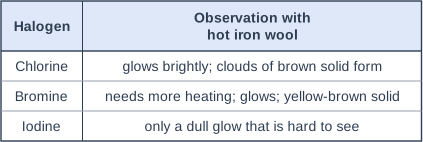
A teacher passes chlorine, bromine vapour and iodine vapour over hot iron wool in a fume cupboard.

The table shows the observations.

Give the order of reactivity shown by these results, starting with the most reactive.

Predict what would be seen if fluorine were passed over hot iron wool.

Suggest why the teacher uses a fume cupboard.

Table with columns "Halogen", "Observation with hot iron wool". Halogen: Chlorine; Observation with hot iron wool: glows brightly; clouds of brown solid form | Halogen: Bromine; Observation with hot iron wool: needs more heating; glows; yellow-brown solid | Halogen: Iodine; Observation with hot iron wool: only a dull glow that is hard to see.

Model answer

The order is chlorine, bromine, iodine. Fluorine is more reactive than chlorine, so the iron wool would glow even more brightly (it might burst into flames). The fume cupboard is used because the halogen gases and vapours are toxic.

Explanation

The brighter the glow, the more vigorous the reaction, so the results show reactivity decreasing down Group 7. Fluorine is at the top of the group, so it should react even more vigorously than chlorine. The demonstration is done in a fume cupboard because chlorine, bromine and iodine vapours are toxic.

Mark scheme
  1. 1 mark

    chlorine, bromine, iodine

    allow Cl, Br, I. The order must be correct.

  2. 1 mark

    the iron wool would react more vigorously than with chlorine / glow even more brightly / burst into flames

    Must be a comparison with chlorine or a clear statement of a more vigorous reaction. ignore 'it would react' alone. do not accept 'less vigorous than iodine'.

  3. 1 mark

    the halogens / their vapours are toxic (or harmful)

    allow 'chlorine is a toxic gas'. allow 'to remove the poisonous fumes'. ignore 'they are dangerous' or 'the reaction is violent' alone.

Ready to try the rest? Every answer you write is marked against the mark scheme, so you can see exactly where the marks are.

Revision notes

Group 7

The big idea

The elements in Group 7 are the halogens. They have similar reactions because they all have seven electrons in their outer shell. The halogens are non-metals and consist of molecules made of pairs of atoms. Going down the group, their melting and boiling points rise and their reactivity falls, and a more reactive halogen can displace a less reactive one from a solution of its salt.

The halogens

Each halogen atom needs one more electron for a full outer shell. Two atoms share a pair of electrons in a single covalent bond, so every halogen is made of diatomic molecules, and in equations you must write F₂, Cl₂, Br₂ and I₂.

HalogenFormulaRelative molecular massAt room temperature
FluorineF₂38pale yellow gas
ChlorineCl₂71green gas
BromineBr₂160red-brown liquid
IodineI₂254grey-black solid

Chlorine and bromine are toxic, so they are used in a fume cupboard.

Trends down the group

Physical trends. The further down the group an element is, the higher its relative molecular mass, melting point and boiling point, and the darker its colour. The molecules are larger, so the forces between the molecules are stronger and need more energy to overcome. The covalent bond inside each molecule is not broken when a halogen melts or boils.

Line graph of temperature in °C (y-axis, -250 to 200) against relative molecular mass (x-axis, 0 to 280). "Boiling point" joins the points (38, -188), (71, -34), (160, 59), (254, 184). "Melting point" (dashed) joins the points (38, -220), (71, -101), (160, -7), (254, 114).
Fluorine, chlorine, bromine and iodine (left to right): melting and boiling points rise as the molecules get bigger.

Reactivity decreases going down the group. Halogens react by gaining one electron. Further down, the outer shell is further from the nucleus, so the attraction for the extra electron is weaker and it is gained less easily. Fluorine is the most reactive halogen. This is the opposite trend to Group 1, where losing an electron gets easier down the group.

Compounds of the halogens

  • With metals, the halogens form ionic compounds (salts) containing halide ions with a 1− charge: chloride Cl⁻, bromide Br⁻ and iodide I⁻. The name ends in -ide: magnesium and bromine form magnesium bromide, Mg + Br₂ → MgBr₂.
  • With non-metals, the halogens form covalent compounds made of small molecules, in which atoms share pairs of electrons: H₂ + Cl₂ → 2HCl. Hydrogen chloride, hydrogen bromide and hydrogen iodide are gases that dissolve in water to form acidic solutions.

Displacement reactions

A more reactive halogen can displace a less reactive halogen from an aqueous solution of its salt. The order of reactivity is chlorine, then bromine, then iodine.

  • Chlorine displaces bromine from bromide solutions (the solution turns orange) and iodine from iodide solutions (it turns brown).
  • Bromine displaces iodine from iodide solutions, but cannot displace chlorine.
  • Iodine cannot displace either of them, so mixing it with a chloride or bromide gives no reaction.

The colour change is the evidence: bromine in water is orange-yellow and iodine in water is brown.

Extracting bromine from sea water

Sea water contains dissolved bromide salts, such as magnesium bromide, MgBr₂. Bromine is extracted by bubbling chlorine through it. Explain why this works, write a balanced equation, and explain why iodine could not be used instead.

Chlorine is above bromine in Group 7, so it is more reactive and displaces bromine from its salt. The bromine formed colours the solution orange.

chlorine + magnesium bromide → magnesium chloride + bromine

Cl₂ + MgBr₂ → MgCl₂ + Br₂

Check: 2 Cl, 1 Mg and 2 Br atoms on each side.

Iodine is below bromine, so it is less reactive and cannot displace bromine from its salt.

Higher tier only

Ionic and half equations for displacement. The metal ions do not change, so they are spectator ions and are left out. For chlorine reacting with bromide ions:

Cl₂ + 2Br⁻ → 2Cl⁻ + Br₂

Cl₂ + 2e⁻ → 2Cl⁻ (chlorine gains electrons: reduction)

2Br⁻ → Br₂ + 2e⁻ (bromide ions lose electrons: oxidation)

The halogen that does the displacing is reduced, and the halide ions that are displaced are oxidised.

Common mistakes

  • Saying halogens react alike because they have "the same number of electrons" or "the same number of shells". They have seven outer electrons.
  • Saying boiling a halogen breaks covalent bonds. It overcomes the forces between molecules.
  • Saying halogens lower in the group "lose electrons more easily". Halogens gain electrons, and this gets harder down the group.
  • Naming a salt with the element name, such as "lithium iodine". It is lithium iodide.
  • Writing Cl or Br instead of Cl₂ or Br₂ in an equation.

Exam tip

To explain the reactivity trend, use this chain: halogens react by gaining an electron; going down, the outer shell is further from the nucleus; so the attraction for the electron is weaker; so it is gained less easily. For displacement questions, name the colour you would see and say which halogen is more reactive.

Study Helper Hints first, answers after you try

Stuck on this one? Ask for a hint and I’ll point you in the right direction, without giving the answer away. Once you’ve checked your answer, I’ll show you how the marks are awarded.