Practise 22 exam-style questions on Mixtures for AQA GCSE Combined Science (Foundation Chemistry Paper 1). Write your answer as you would in the exam and get it marked in seconds against the mark scheme, point by point, with the Study Helper on hand if you get stuck.
22 questions
1–6 marks each
Instant marking
No sign-up needed
20 questions, marked as you go
Sample questions with model answers
Here are 4 of the questions in this topic, each with a model answer, an explanation of why it earns the marks and the mark scheme an examiner would use.
Question 1
1 mark
Air is a mixture that contains nitrogen and oxygen.
Which statement about the oxygen in air is correct?
Choose your answer.
It is chemically combined with the nitrogen
It keeps its own chemical properties
It can only be removed by a chemical reaction
It forms a compound with the formula NO₂
Model answer
It keeps its own chemical properties
Explanation
In a mixture, each substance keeps its own chemical properties because the substances are not chemically combined. The oxygen in air still lets fuels burn and is used for respiration, just as pure oxygen is. This is why mixtures can be separated by physical processes.
Mark scheme
1 mark
It keeps its own chemical properties
If more than one option is given, 0 marks. In a mixture the substances are not chemically combined. Mixtures can be separated by physical processes, so a chemical reaction is not the only way to remove the oxygen. NO₂ is a compound (nitrogen dioxide); air is a mixture and has no formula.
Question 2
2 marks
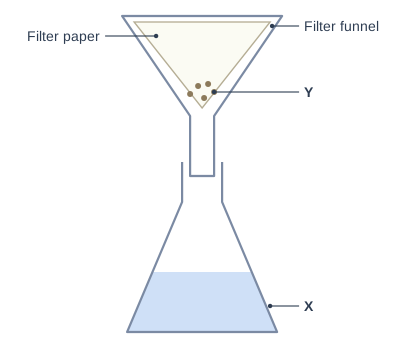
Figure 1 shows the apparatus a student used to separate chalk from a mixture of chalk and water. Chalk does not dissolve in water.
What name is given to the solid labelled Y?
What name is given to the liquid labelled X?
Model answer
Y is the residue. X is the filtrate.
Explanation
The insoluble solid left on the filter paper, here the chalk, is called the residue. The liquid that passes through the filter paper is called the filtrate; here it is water. Students often mix up these two words.
Mark scheme
1 mark
Y: residue
ignore chalk on its own (it does not give the name asked for); do not accept filtrate or precipitate
1 mark
X: filtrate
allow phonetic spelling, eg filtrait; ignore water on its own; if the two names are the wrong way round, 0 marks
Question 3
2 marks
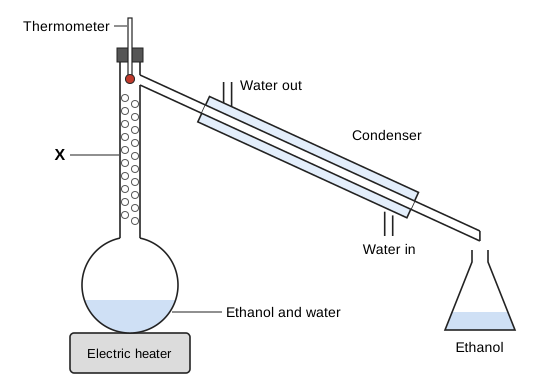
Figure 1 shows the apparatus a student used to separate ethanol from a mixture of ethanol and water.
Name the piece of apparatus labelled X.
The flask is heated with an electric heater and not with a Bunsen burner. Give one reason why.
Model answer
X is the fractionating column. Ethanol is flammable, so its vapour could catch fire if a Bunsen burner flame were used.
Explanation
The fractionating column, packed with glass beads, separates liquids with different boiling points. Ethanol is flammable, so it should be heated with an electric heater or a water bath, never with a naked flame. 'It is safer' on its own does not explain why.
Mark scheme
1 mark
fractionating column
allow fractional distillation column / fractionation column; do not accept condenser
1 mark
ethanol is flammable / ethanol (vapour) could catch fire (from a flame)
allow ethanol burns easily; ignore 'it is safer' unqualified; ignore 'it heats more evenly'
Question 4
4 marks
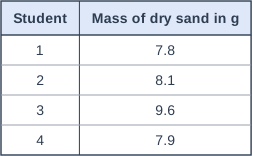
Four students each separated the sand from a 20.0 g sample of a mixture of sand and salt. They all used the same method. The table shows the mass of dry sand each student collected.
The result for Student 3 is anomalous.
Calculate the mean mass of sand collected. Do not include the anomalous result.
Calculate the percentage by mass of sand in the mixture. Use your mean.
Model answer
Mean = (7.8 + 8.1 + 7.9) ÷ 3 = 23.8 ÷ 3 = 7.93 g Percentage of sand = 7.93 ÷ 20.0 × 100 = 39.7%
Explanation
Leave out the anomalous result (9.6 g) before finding the mean: 23.8 ÷ 3 = 7.93 g. Then divide the mass of sand by the mass of the whole sample and multiply by 100. Student 3's mass may be too high because the sand was still wet, or because some salt had not dissolved and stayed with the sand.
Mark scheme
1 mark
(7.8 + 8.1 + 7.9) ÷ 3 / 23.8 ÷ 3
allow (7.8 + 8.1 + 9.6 + 7.9) ÷ 4 = 8.35 (g) for 1 mark only (the anomalous result included); a correct answer with no working scores 2 marks for the mean
1 mark
(mean =) 7.93 (g)
allow 7.9 / 7.933 (g)
1 mark
7.93 ÷ 20.0 × 100
allow ecf from an incorrect mean, eg 8.35 ÷ 20.0 × 100 = 41.75 (%)
1 mark
= 39.7 (%)
allow 39.5 to 39.7 / 40 (%); allow ecf from an incorrect mean; a correct answer with no working scores 2 marks for the percentage; full marks are not awarded for a correct final answer from incorrect working
Ready to try the rest? Every answer you write is marked against the mark scheme, so you can see exactly where the marks are.
Ctrl + Enter to check
Study HelperHints first, answers after you try
Stuck on this one? Ask for a hint and I’ll point you in the right direction, without giving the answer away. Once you’ve checked your answer, I’ll show you how the marks are awarded.