Level:
Correct: 0
Incorrect: 0
Marks: 0/0
Practice
Course:
Topics:
Year 2 Maths Smart practice A mixed round aimed at your weak spots
Unit 1
Place value
Unit 2
Addition and subtraction
Unit 3
Multiplication and division
Unit 4
Fractions
Unit 5
Measurement
Unit 6
Geometry
Unit 7
Statistics
Avg
score:
–
Topics
done:
0/34

Thirds

Practise 13 questions on Thirds for Year 2 Maths. Tap your answer and find out straight away if you are right, with the Study Helper on hand if you get stuck.

  • 13 questions
  • 1–4 marks each
  • Instant marking
  • No sign-up needed
13 questions, marked as you go

Sample questions with model answers

Here are 4 of the questions in this topic, each with a model answer, an explanation of why it earns the marks and the mark scheme.

Question 1

1 mark

How many thirds make one whole?

Model answer

3 thirds make one whole.

3

Explanation

Cut something into thirds and you get 3 equal pieces. All 3 pieces together make the whole thing again. A common mistake is to write \(\dfrac{1}{3}\), which is only one of the pieces.

Mark scheme
  1. 1 mark

    3

    Accept three, 3 thirds or 3/3 (three thirds). Do not accept 1/3 or 2.

Question 2

1 mark

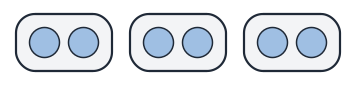
The picture shows 9 counters in 3 equal groups.

What fraction of the counters is in one group?

Counters in 3 hoops. Each hoop has the same number of counters.

Model answer

There are 3 equal groups, so one group is a third.

\(\dfrac{1}{3}\)

Explanation

The counters are split into 3 equal groups, so each group is one third of them. A common mistake is to write 3. That is how many counters are in a group, not the fraction.

Mark scheme
  1. 1 mark

    \(\dfrac{1}{3}\)

    Accept 1/3, a third, one third or 3/9. Do not accept 3, which is the number of counters in a group, or 1/9.

Question 3

2 marks

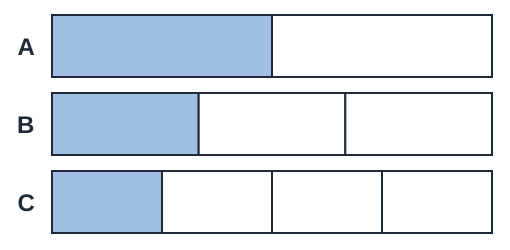
The picture shows three bars, A, B and C. The bars are the same size. One part of each bar is shaded.

Which bar has the biggest shaded part?

Which bar has the smallest shaded part?

Three bars of the same size, one above the other, labelled A, B and C. A is in 2 equal parts, B is in 3 equal parts and C is in 4 equal parts. One part of each bar is shaded.

Model answer

Biggest: A

Smallest: C

Explanation

Bar A is in 2 parts, bar B is in 3 parts and bar C is in 4 parts. Fewer parts means bigger parts. A common mistake is to choose C as the biggest because 4 is the biggest number.

Mark scheme
  1. 1 mark

    Biggest: A

    Accept "bar A". Do not accept C.

  2. 1 mark

    Smallest: C

    Accept "bar C". Do not accept A.

Question 4

4 marks

The picture shows 6 counters in 3 equal groups.

How many counters make \(\dfrac{1}{3}\) of them?

How many counters make \(\dfrac{2}{3}\) of them?

Ali says, "3 thirds of the counters is all of them."

Is Ali right? How do you know?

Counters in 3 hoops. Each hoop has the same number of counters.

Model answer

2 counters make \(\dfrac{1}{3}\).

4 counters make \(\dfrac{2}{3}\).

Yes. The 3 groups have all 6 counters, so 3 thirds make a whole.

Explanation

One group is one third, so it has 2 counters, and two groups have 4. Three groups use up all 6 counters. A common mistake is to say one third is 3 counters, but 3 is the number of groups.

Mark scheme
  1. 1 mark

    2 counters make \(\dfrac{1}{3}\)

    Accept 2 or two. Do not accept 3, which is the number of groups.

  2. 1 mark

    4 counters make \(\dfrac{2}{3}\)

    Accept 4 or four. No follow through: both answers are read from the picture. Do not accept 6, which is all the counters.

  3. 1 mark

    Yes, with a relevant but incomplete reason (for example, "there are 3 groups" or "each group is a third")

    "Yes" alone, or "Yes, he is right", scores 0.

  4. 1 mark

    A complete reason: 3 thirds make a whole / the 3 groups have all 6 counters / \(2 + 2 + 2 = 6\) / 3 lots of 2 is 6

    A complete correct reason on its own scores both of these two marks.

Ready to try the rest? Tap your answers and see straight away how you did.

Topic notes

Thirds

The big idea

A fraction is a part of a whole. The whole is all of something. When you cut a whole into 3 equal parts, each part is a third. Equal parts are all the same size.

What is a third?

You write one third as \(\dfrac{1}{3}\). The bottom number says how many equal parts there are. The top number says how many parts you mean.

3 thirds make a whole. A cut only makes thirds if all 3 parts are equal. So always check the sizes.

A bar split into 3 equal parts, each labelled one third. One part is shaded. A brace shows that all 3 parts make 1 whole.
A bar in 3 equal parts. Each part is one third. All 3 thirds make 1 whole.

A flag has 3 stripes of the same width. The stripes are red, white and blue. What fraction of the flag is red? How many stripes make the whole flag?

All the stripes are the same width, so they are equal parts.

There are 3 equal parts, so the bottom number is 3.

1 stripe is red, so the top number is 1.

\(\dfrac{1}{3}\) of the flag is red.

3 stripes make the whole flag.

Thirds of a length or a set

You can cut a length into thirds too. You can also split a set, which is a group of things. Split the things into 3 equal groups. One group is one third.

24 children make 3 equal teams. What fraction of the children is in each team? How many children is that?

There are 3 equal teams, so each team is \(\dfrac{1}{3}\) of the children.

Put 1 child in each team, again and again. Each time uses 3 children.

Count in 3s until you reach 24: 3, 6, 9, 12, 15, 18, 21, 24.

You said 8 numbers, so each team has 8 children.

Check your answer: \(8 + 8 + 8 = 24\).

Comparing halves, thirds and quarters

Cut the same whole into 2, 3 or 4 equal parts. Fewer parts means bigger parts.

Three bars of the same length. The top bar is 2 halves, the middle bar is 3 thirds and the bottom bar is 4 quarters. The first part of each bar is shaded. The shaded half is longest and the shaded quarter is shortest.
Three bars of the same size. The shaded half is the biggest part. The shaded quarter is the smallest part.

One melon is cut into 3 equal slices. Another melon of the same size is cut into 4 equal slices. Jo wants the bigger slice. Which melon should she take a slice from?

A slice of the first melon is \(\dfrac{1}{3}\) of a melon.

A slice of the second melon is \(\dfrac{1}{4}\) of a melon.

Fewer parts means bigger parts. So Jo should take a slice from the melon cut into 3.

Stretch: two thirds

2 of the 3 equal parts make two thirds. You write this as \(\dfrac{2}{3}\).

Think of a flag with 3 equal stripes. 2 stripes are green and 1 is yellow. So \(\dfrac{2}{3}\) of the flag is green.

Common mistakes

  • Comparing shaded parts with white parts. Count all the parts for the bottom number.
  • Not checking the sizes. 3 parts are thirds only if they are equal.
  • Thinking a bigger bottom number means a bigger part. \(\dfrac{1}{4}\) is smaller than \(\dfrac{1}{2}\).
  • Writing 3 as the fraction. 3 is how many parts there are, and one part is \(\dfrac{1}{3}\).
  • Putting the 3 on top. The bottom number counts all the parts, so the 3 belongs at the bottom.

Top tip

Fold a strip of paper into 3 equal parts. Then shade one part and say "one third".

Study Helper Hints first, answers after you try

Stuck on this one? Ask for a hint and I’ll point you in the right direction, without giving the answer away. Once you’ve checked your answer, I’ll show you how the marks are awarded.