Level:
Correct: 0
Incorrect: 0
Marks: 0/0
Practice
Course:
Topics:
Year 2 Maths Smart practice A mixed round aimed at your weak spots
Unit 1
Place value
Unit 2
Addition and subtraction
Unit 3
Multiplication and division
Unit 4
Fractions
Unit 5
Measurement
Unit 6
Geometry
Unit 7
Statistics
Avg
score:
–
Topics
done:
0/34

Comparing and ordering numbers

Practise 19 questions on Comparing and ordering numbers for Year 2 Maths. Tap your answer and find out straight away if you are right, with the Study Helper on hand if you get stuck.

  • 19 questions
  • 1–4 marks each
  • Instant marking
  • No sign-up needed
19 questions, marked as you go

Sample questions with model answers

Here are 4 of the questions in this topic, each with a model answer, an explanation of why it earns the marks and the mark scheme.

Question 1

1 mark

Which number is smaller, 43 or 39?

Model answer

39 has 3 tens.
43 has 4 tens.
39 is smaller.

Explanation

Look at the tens first. 39 has 3 tens and 43 has 4 tens, so 39 is smaller. A common mistake is to look at the ones and think the 9 makes 39 bigger.

Mark scheme
  1. 1 mark

    39

    Accept thirty-nine. Do not accept 43.

Question 2

1 mark

Which one is correct?

Model answer

34 has 3 tens and 43 has 4 tens.
\(34 < 43\)

Explanation

34 is less than 43, so the open side of the sign must face 43. A common mistake is to choose \(34 > 43\) by mixing up the signs.

Mark scheme
  1. 1 mark

    \(34 < 43\)

    Accept 34 is less than 43, or 'the third one'. Do not accept any other.

Question 3

2 marks

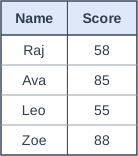
The table shows the scores in a game.

Who scored the most?

Who scored the least?

Table with columns "Name", "Score". Name: Raj; Score: 58 | Name: Ava; Score: 85 | Name: Leo; Score: 55 | Name: Zoe; Score: 88.

Model answer

85 and 88 have 8 tens. 88 is more.
58 and 55 have 5 tens. 55 is less.
Zoe scored the most. Leo scored the least.

Explanation

Look at the tens first, then the ones. 88 is more than 85, and 55 is less than 58. A common mistake is to choose Ava for the most, without looking at the ones.

Mark scheme
  1. 1 mark

    Zoe

    Accept 88. Do not accept Ava.

  2. 1 mark

    Leo

    Accept 55. Do not accept Raj. If the answers are not labelled, take them in the order the questions are asked. Correct answers with no working score full marks.

Question 4

4 marks

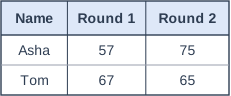
The table shows the scores in two rounds of a game.

Who scored more in round 1?

Who scored more in round 2?

Which sentence is right for Asha's two scores?

Which sentence is right for Tom's two scores?

Table with columns "Name", "Round 1", "Round 2". Name: Asha; Round 1: 57; Round 2: 75 | Name: Tom; Round 1: 67; Round 2: 65.

Model answer

Round 1: 67 is more than 57, so Tom.
Round 2: 75 is more than 65, so Asha.
\(57 < 75\)
\(67 > 65\)

Explanation

Read one row of the table at a time, and look at the tens first. In Tom's scores the tens are the same, so compare the ones. A common mistake is to mix up the signs: the open side faces the bigger number.

Mark scheme
  1. 1 mark

    Tom

    Accept 67. Do not accept Asha.

  2. 1 mark

    Asha

    Accept 75. Do not accept Tom.

  3. 1 mark

    \(57 < 75\) or \(75 > 57\)

    Accept the sign typed as a character or in words, such as '57 is less than 75' or '75 is more than 57'. Do not accept a wrong sign, such as \(57 > 75\).

  4. 1 mark

    \(67 > 65\) or \(65 < 67\)

    Accept the sign typed as a character or in words, such as '67 is greater than 65' or '65 is less than 67'. Do not accept a wrong sign, such as \(67 < 65\). If the answers are not labelled, take them in the order the questions are asked. Correct answers with no working score full marks.

Ready to try the rest? Tap your answers and see straight away how you did.

Topic notes

Comparing and ordering numbers

The big idea

To compare two numbers means to find out which is bigger. To order numbers means to put them in a line. The line can go from smallest to largest. It can also go from largest to smallest. The tens help you do this.

Look at the tens first

  1. Look at the tens. More tens means a bigger number.
  2. If the tens are the same, look at the ones.

Look at 63 and 47. 63 has 6 tens. 47 has 4 tens. So 63 is bigger. You do not need the ones.

Look at 63 and 69. Both have 6 tens. 3 ones is less than 9 ones. So 69 is bigger.

A number line shows numbers in order. They get bigger as you go to the right.

A number line from 40 to 70. Arrow A points to 47. Arrow B points to 63.
Arrow A points to 47. Arrow B points to 63. B is further to the right, so 63 is bigger.

Ages, scores and lengths work the same way. A bigger number can mean older, longer or a higher score.

The signs

SignSayExample
\(<\)is less than\(47 < 63\)
\(>\)is greater than\(63 > 47\)
\(=\)is equal to6 tens \(=\) 60

Equal means the same. The open side of \(<\) or \(>\) faces the bigger number. The point faces the smaller number.

A red tower has 48 bricks. A blue tower has 51 bricks. Which tower has fewer bricks?

48 has 4 tens. 51 has 5 tens.

4 tens is less than 5 tens. So \(48 < 51\).

The red tower has fewer bricks.

A green toy snake is 74 cm long. A yellow toy snake is 78 cm long. Write the lengths with a sign between them. Which snake is shorter?

Both have 7 tens. So look at the ones.

4 ones is less than 8 ones. So 74 is smaller.

The open side faces 78, the bigger number: \(74 < 78\).

The green snake is shorter.

Putting numbers in order

Sort the numbers by their tens first. If two numbers have the same tens, sort those two by their ones. Read the words with care. They tell you where to start: with the smallest or the largest.

Four children hold number cards. Jo has 86. Bea has 49. Cal has 83. Dev has 41. They line up with the largest number first. Who stands last?

86 and 83 have 8 tens. They come first.

49 and 41 have 4 tens. They come next.

Now use the ones. 86 is bigger than 83. 49 is bigger than 41.

The order is 86, 83, 49, 41. That is Jo, Cal, Bea, Dev.

Dev stands last.

Common mistakes

  • Looking at the ones first. 48 is less than 51, even though 8 is more than 1.
  • Mixing up the signs. The open side faces the bigger number.
  • Starting at the wrong end. Check if the words say smallest or largest.
  • Choosing a round number because it looks big. 80 is less than 82.
  • Forgetting what tens are worth. 6 tens is equal to 60. It is not less.

Top tip

Cover the ones with your finger. Compare the tens. If they match, take your finger away.

Study Helper Hints first, answers after you try

Stuck on this one? Ask for a hint and I’ll point you in the right direction, without giving the answer away. Once you’ve checked your answer, I’ll show you how the marks are awarded.