Level:
Correct: 0
Incorrect: 0
Marks: 0/0
Practice
Course:
Topics:
Year 2 Maths Smart practice A mixed round aimed at your weak spots
Unit 1
Place value
Unit 2
Addition and subtraction
Unit 3
Multiplication and division
Unit 4
Fractions
Unit 5
Measurement
Unit 6
Geometry
Unit 7
Statistics
Avg
score:
–
Topics
done:
0/34

Telling the time

Practise 20 questions on Telling the time for Year 2 Maths. Tap your answer and find out straight away if you are right, with the Study Helper on hand if you get stuck.

  • 20 questions
  • 1–4 marks each
  • Instant marking
  • No sign-up needed
20 questions, marked as you go

Sample questions with model answers

Here are 4 of the questions in this topic, each with a model answer, an explanation of why it earns the marks and the mark scheme.

Question 1

1 mark

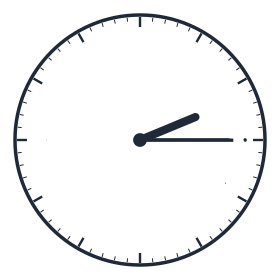
The picture shows the clock in Mia's bedroom.

What time does it show?

A round clock with the numbers 1 to 12. The short hour hand is a little past the 2. The long minute hand points to the 3.

Model answer

Quarter past 2

Explanation

The long minute hand points to the 3, which is a quarter of the way round. The short hour hand is just past the 2, so it is quarter past 2. A common mistake is to say quarter to, but the hand on the 3 always means quarter past.

Mark scheme
  1. 1 mark

    Quarter past 2

    Accept quarter past two, 15 minutes past 2, 15 past 2, two fifteen, 2:15 or 2.15. Any sensible way of writing the time is fine. Do not accept quarter to 2 or quarter to 3.

Question 2

1 mark

It is quarter past 7.

Which number does the minute hand point to?

Model answer

3

Explanation

Quarter past means a quarter of the way round the clock, which is the 3. A common mistake is to choose 9, but the 9 is for quarter to.

Mark scheme
  1. 1 mark

    3

    Accept the 3 or three. Do not accept 15 (the minutes), 7 (the hour) or 9 (that is for quarter to).

Question 3

2 marks

It is 20 past 4.

Which number does the minute hand point to?

The hour hand is between which two numbers?

Model answer

The minute hand points to the 4.
The hour hand is between the 4 and the 5.

Explanation

20 minutes is 4 jumps of 5, so the minute hand is on the 4. It is after 4 o'clock and before 5 o'clock, so the hour hand is between the 4 and the 5. A common mistake is to say 20, but there is no 20 on a clock.

Mark scheme
  1. 1 mark

    The minute hand points to the 4

    Accept 4, the 4 or four. Do not accept 20.

  2. 1 mark

    The hour hand is between the 4 and the 5

    Accept 4 and 5, or 5 and 4. Do not accept 3 and 4. Each answer earns its own mark, and no working is needed.

Question 4

4 marks

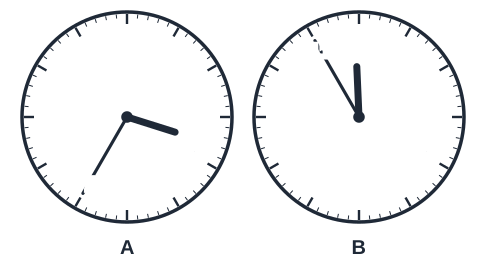
The picture shows clock A and clock B.

What time does clock A show?

What time does clock B show?

Two round clocks with the numbers 1 to 12, labelled A and B. On clock A the short hour hand is between the 3 and the 4, and the long minute hand points to the 7. On clock B the short hour hand is nearly at the 12, and the long minute hand points to the 11.

Model answer

Clock A: 25 to 4
Clock B: 5 to 12

Explanation

Both long hands are on the left side, so count on in fives to the 12. Clock A has 25 minutes to go and clock B has 5 minutes to go. Then name the next hour. A common mistake is to name the hour the short hand has just passed and say 5 to 11.

Mark scheme
  1. 1 mark

    Clock A: the minutes read correctly as 25 minutes to (or 35 minutes past)

    The full answer is 25 to 4. Any correct way of writing it scores this mark and the next: 25 minutes to 4, twenty-five to four, 35 minutes past 3, 3:35 or 3.35.

  2. 1 mark

    Clock A: the hour read correctly: the time is after 3 o'clock and before 4 o'clock

    25 to 3 scores the minutes mark only. 25 past 3 scores this mark only.

  3. 1 mark

    Clock B: the minutes read correctly as 5 minutes to (or 55 minutes past)

    The full answer is 5 to 12. Any correct way of writing it scores this mark and the next: 5 minutes to 12, five to twelve, 55 minutes past 11, 11:55 or 11.55.

  4. 1 mark

    Clock B: the hour read correctly: the time is after 11 o'clock and before 12 o'clock

    5 to 11 scores the minutes mark only. 5 past 11 scores this mark only. Each clock is marked on its own. Correct answers with no working score full marks.

Ready to try the rest? Tap your answers and see straight away how you did.

Topic notes

Telling the time

The big idea

A clock tells us the time. The short hand is the hour hand. The long hand is the minute hand. Look at the long hand first.

O'clock and half past

  • Long hand on the 12: it is o'clock. The short hand points to the hour.
  • Long hand on the 6: it is half past. It has gone halfway round. The short hand is halfway to the next number.

Quarter past and quarter to

  • Long hand on the 3: it is quarter past. It has gone a quarter of the way round.
  • Long hand on the 9: it is quarter to. There is a quarter left to go. The short hand is nearly at the next number.

The long hand counts in 5s

It takes 5 minutes for the long hand to move to the next number. So we count in 5s, like the 5 times table.

A clock with the numbers 1 to 12. Outside the clock the minutes go round in 5s from 5 to 60. The long hand points to the 4, next to 20 minutes. The short hand is just past the 9.
The numbers outside the clock show the minutes. This clock shows 20 minutes past 9.

What time does the clock in the picture show?

The long hand is on the 4. Count in 5s from the 12: 5, 10, 15, 20.

It is on the right side of the clock, so we say past.

The short hand is just past the 9.

The time is 20 past 9.

Past and to

Past means after an o'clock. To means before the next o'clock.

  • Long hand on the right side of the clock: say past. Count in 5s from the 12 round to the long hand.
  • Long hand on the left side of the clock: say to. Count in 5s from the long hand on to the 12. Then name the next hour.
A clock with the numbers 1 to 12. The long hand points to the 8. The short hand is between the 4 and the 5, closer to the 5.
This clock shows 20 minutes to 5. The long hand is on the 8. The short hand is getting close to the 5.

Look at the clock in this picture. What time does it show?

The long hand is on the left side, on the 8. So we say to.

Count in 5s from the 8 to the 12: 5, 10, 15, 20.

The next hour is 5, so the time is 20 to 5.

It is quarter past 11. Where do the hands point?

Quarter past means the long hand is on the 3.

It is just after 11 o'clock. So the short hand is just past the 11.

Cakes come out of the oven at 25 to 10. Which number does the long hand point to?

It is a "to" time, so go back from the 12 in 5s.

The 11 is 5. The 10 is 10. The 9 is 15. The 8 is 20. The 7 is 25.

The long hand points to the 7.

Remember

  • Count the long hand in 5s.
  • Right side means past. Left side means to.
  • For a "to" time, name the next hour.

Common mistakes

  • Mixing up the hands. The short hand shows the hour, and the long hand shows the minutes.
  • Reading the number as the minutes. A long hand on the 1 means 5 minutes, not 1 minute.
  • Mixing up quarter past and quarter to. Quarter past is on the right. Quarter to is on the left.
  • Naming the wrong hour with "to". The short hand is nearly at the 3. So say 10 to 3, not 10 to 2.
  • Thinking half past uses the next hour. At half past 7, the short hand has not reached the 8.

Top tip

Say the time out loud as you count. It helps to touch each number with your finger.

Study Helper Hints first, answers after you try

Stuck on this one? Ask for a hint and I’ll point you in the right direction, without giving the answer away. Once you’ve checked your answer, I’ll show you how the marks are awarded.