Level:
Correct: 0
Incorrect: 0
Marks: 0/0
Practice
Course:
Topics:
Year 2 Maths Smart practice A mixed round aimed at your weak spots
Unit 1
Place value
Unit 2
Addition and subtraction
Unit 3
Multiplication and division
Unit 4
Fractions
Unit 5
Measurement
Unit 6
Geometry
Unit 7
Statistics
Avg
score:
–
Topics
done:
0/34

2-D shapes

Practise 19 questions on 2-D shapes for Year 2 Maths. Tap your answer and find out straight away if you are right, with the Study Helper on hand if you get stuck.

  • 19 questions
  • 1–4 marks each
  • Instant marking
  • No sign-up needed
19 questions, marked as you go

Sample questions with model answers

Here are 4 of the questions in this topic, each with a model answer, an explanation of why it earns the marks and the mark scheme.

Question 1

1 mark

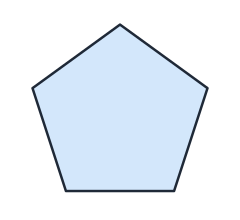
The picture shows a shape.

What is the name of this shape?

One flat shape with straight sides, with a point at the top.

Model answer

pentagon

Explanation

Count the sides: there are 5. A shape with 5 straight sides is a pentagon. A common mistake is to say hexagon, but a hexagon has 6 sides.

Mark scheme
  1. 1 mark

    pentagon

    Accept a clear misspelling. Do not accept hexagon or octagon.

Question 2

1 mark

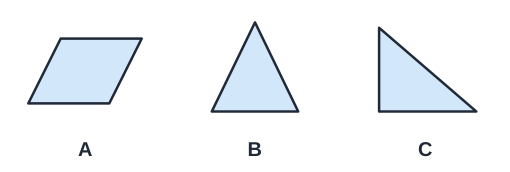
The picture shows three shapes. Imagine folding each one down the middle.

Which shape has two halves that match?

Three flat shapes in a row, labelled A, B and C. No lines are drawn on them.

Model answer

B

Explanation

Shape B has its point right above the middle of its bottom side, so its two halves match. A common mistake is to choose A. It looks even, but it slants, so its halves do not match.

Mark scheme
  1. 1 mark

    B

    Accept 'shape B'. Do not accept A or C. A shape name with no letter scores 0.

Question 3

2 marks

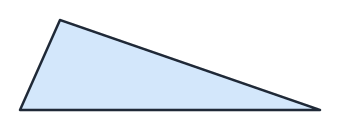
The picture shows a long, thin shape.

Raj says, "This is not a triangle because it is too thin."

Is Raj right? How do you know?

One long, thin flat shape with straight sides.

Model answer

No. It has 3 sides, so it is a triangle.

Explanation

Any flat shape with 3 straight sides is a triangle. It can be big or small, wide or thin. A common mistake is to think a triangle must look neat and even.

Mark scheme
  1. 1 mark

    No, with a relevant but incomplete reason, such as 'thin does not matter' or 'it is still a triangle'

    Yes or No alone scores 0.

  2. 1 mark

    a complete reason: it has 3 sides (or 3 corners, or 3 vertices), so it is a triangle

    A complete correct reason on its own scores both marks. Accept 'it has 3 sides' on its own. A wrong reason, such as 'it is pointy', scores 0.

Question 4

4 marks

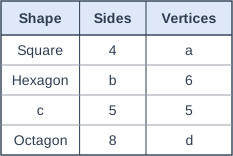
The table shows some shapes. Some parts are missing.

What are a, b, c and d?

Table with columns "Shape", "Sides", "Vertices". Shape: Square; Sides: 4; Vertices: a | Shape: Hexagon; Sides: b; Vertices: 6 | Shape: c; Sides: 5; Vertices: 5 | Shape: Octagon; Sides: 8; Vertices: d.

Model answer

a = 4, b = 6, c = pentagon, d = 8

Explanation

A shape has the same number of vertices as sides. So a square has 4 vertices and an octagon has 8. A common mistake is to write hexagon for c, but 5 sides make a pentagon.

Mark scheme
  1. 1 mark

    a = 4

    Each letter earns one mark on its own. Accept the four answers in order, such as '4, 6, pentagon, 8'.

  2. 1 mark

    b = 6

    Accept six.

  3. 1 mark

    c = pentagon

    Accept a clear misspelling. Do not accept hexagon.

  4. 1 mark

    d = 8

    Accept eight.

Ready to try the rest? Tap your answers and see straight away how you did.

Topic notes

2-D shapes

The big idea

A 2-D shape is a flat shape. You can draw it on a page. Each shape has a name. We can often find the name by counting its sides.

Sides and vertices

A side is a straight line on the edge of a shape. A vertex is a corner, where two sides meet. When there is more than one, we say vertices.

ShapeSidesVertices
triangle33
square44
rectangle44
pentagon55
hexagon66
octagon88

All 4 sides of a square are the same length. A rectangle has 2 long sides and 2 short sides.

A circle is round. It has one curved edge. It has no straight sides and no vertices.

Six flat shapes with their names: a triangle, a square, a rectangle, a pentagon, a hexagon and an octagon.
Count the sides of each shape.

Ali sees a round clock, a door and half a sandwich cut from corner to corner. What shape is each one?

The clock has one curved edge and no corners. It is a circle.

The door has 2 long sides and 2 short sides. It is a rectangle.

The half sandwich has 3 straight sides. It is a triangle.

Any size, any way round

A shape can be big or small. It can be wide or thin. It can be turned round. Its name stays the same, so count the sides.

Guess my shape. It has more vertices than a square. It has fewer vertices than a hexagon. What is it?

A square has 4 vertices.

A hexagon has 6 vertices.

The number between 4 and 6 is 5.

A shape with 5 vertices has 5 sides. It is a pentagon.

Sorting shapes

To sort shapes, we put them into groups. Ask one question about each shape, such as "Does it have a curved edge?"

Ola sorts shapes into two boxes. Box A has a square and a rectangle. Box B has a triangle, a hexagon and an octagon. What is her rule?

Count the sides in Box A: 4 and 4.

Count the sides in Box B: 3, 6 and 8.

Every shape in Box A has 4 sides. No shape in Box B has 4 sides.

Her rule is 4 sides, or not 4 sides.

A line of symmetry

A line of symmetry cuts a shape into two halves that match. Imagine folding the shape along the line. The two halves fit on top of each other. We look for a line that goes straight up and down.

A circle and a triangle, each with a dashed line straight down its middle, labelled the halves match. A pentagon with its point off to one side and a dashed line down its middle, labelled the parts do not match.
Each dashed line goes straight down the middle. The two parts of the pentagon do not match, so its line is not a line of symmetry.

Mia folds a round paper plate straight down the middle. Is the fold a line of symmetry?

Look at the two parts. Each one is half of the plate.

They fit exactly on top of each other.

So yes, the fold is a line of symmetry.

Common mistakes

  • Counting the start corner twice. Keep your finger on it as you count round.
  • Mixing up the names. Hexagon and six both have an x. An octagon has 8 sides, like the 8 arms of an octopus.
  • Thinking a shape must look neat to have its name. Count the sides.
  • Thinking every up and down line is a line of symmetry. Fold the shape in your head. The two parts must match.

Top tip

Cut shapes out of paper and fold them. Do the two halves match?

Study Helper Hints first, answers after you try

Stuck on this one? Ask for a hint and I’ll point you in the right direction, without giving the answer away. Once you’ve checked your answer, I’ll show you how the marks are awarded.