Level:
Correct: 0
Incorrect: 0
Marks: 0/0
Practice
Course:
Topics:
Year 2 Maths Smart practice A mixed round aimed at your weak spots
Unit 1
Place value
Unit 2
Addition and subtraction
Unit 3
Multiplication and division
Unit 4
Fractions
Unit 5
Measurement
Unit 6
Geometry
Unit 7
Statistics
Avg
score:
–
Topics
done:
0/34

Block diagrams

Practise 16 questions on Block diagrams for Year 2 Maths. Tap your answer and find out straight away if you are right, with the Study Helper on hand if you get stuck.

  • 16 questions
  • 1–4 marks each
  • Instant marking
  • No sign-up needed
16 questions, marked as you go

Sample questions with model answers

Here are 4 of the questions in this topic, each with a model answer, an explanation of why it earns the marks and the mark scheme.

Question 1

1 mark

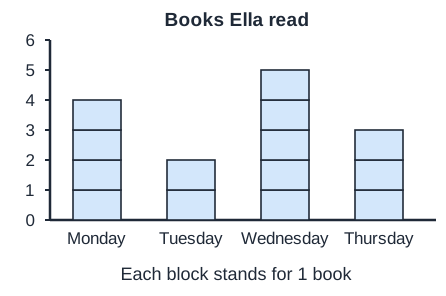
The block diagram shows the books Ella read each day.

Which day has the shortest column?

A block diagram of books Ella read, with columns for Monday, Tuesday, Wednesday and Thursday. Each block stands for 1 book. Numbers go up the side. The heights of the columns can be read from the blocks.

Model answer

Tuesday

Explanation

The shortest column has the fewest blocks. Tuesday has only 2 blocks. A common mistake is to choose the first column, Monday, without looking at the heights.

Mark scheme
  1. 1 mark

    Tuesday

    Accept Tue. Accept a clear misspelling. Do not accept 2 on its own, or any other day.

Question 2

1 mark

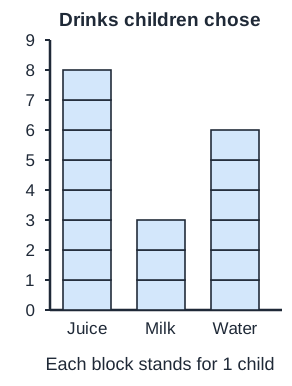
The block diagram shows the drinks that children chose.

How many children chose juice?

A block diagram of drinks children chose, with columns for Juice, Milk and Water. Each block stands for 1 child. Numbers go up the side. The heights of the columns can be read from the blocks.

Model answer

8

Explanation

Look at the top of the Juice column, then look across to the numbers at the side. It reaches 8. A common mistake is to read the number above or below.

Mark scheme
  1. 1 mark

    8

    Do not accept 3 (milk), 7 or 9.

Question 3

2 marks

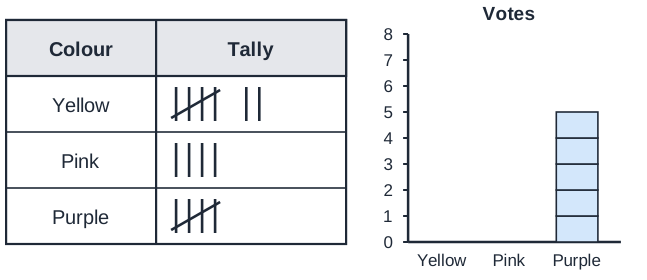
The picture shows a tally chart and a block diagram. They show the same votes. Two columns are empty.

How many blocks does the Yellow column need?

How many blocks does the Pink column need?

On the left is a tally chart. Yellow: 4 marks with a line across them, then 2 single marks. Pink: 4 single marks. Purple: 4 marks with a line across them. On the right is a block diagram with columns for Yellow, Pink and Purple. Only Purple has blocks. Numbers go up the side.

Model answer

Yellow: 7 blocks
Pink: 4 blocks

Explanation

Read each tally. Yellow is a group of 5 and 2 more, which makes 7. Pink is 4 single marks. A common mistake is to count a group of five as just 1.

Mark scheme
  1. 1 mark

    Yellow: 7 (blocks)

    Accept seven. Each answer earns one mark on its own. Two numbers with no words, in the order asked ('7, 4'), score both marks. Do not accept 3 (a group and 2 marks counted as 3 things).

  2. 1 mark

    Pink: 4 (blocks)

    Accept four. Swapped answers ('4, 7') score 0.

Question 4

4 marks

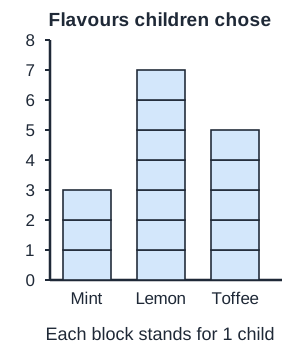
The block diagram shows the flavours children chose.

Put the flavours in order. Start with the tallest column.

The shortest column grows until it is as tall as the tallest. How many more blocks does it need?

A block diagram of flavours children chose, with columns for Mint, Lemon and Toffee. Each block stands for 1 child. Numbers go up the side. The heights of the columns can be read from the blocks.

Model answer

Lemon, Toffee, Mint
\(7 - 3 = 4\)
4 more blocks

Explanation

Lemon has 7 blocks, Toffee has 5 and Mint has 3. Mint needs to go from 3 up to 7, which is 4 more. A common mistake is to add 7 and 3 and get 10.

Mark scheme
  1. 2 marks

    Lemon, Toffee, Mint

    Accept a clear misspelling. One mistake is two flavours swapped, such as 'Toffee, Lemon, Mint', and scores 1 of these 2 marks. A reversed list ('Mint, Toffee, Lemon') also scores 1. Anything else scores 0.

  2. 1 mark

    uses 7 and 3, such as \(7 - 3\), or counts on from 3 to 7; or the correct answer 4 with no working

    Allow follow-through from a wrong reading.

  3. 1 mark

    4 (blocks)

    Accept four. Allow follow-through from a wrong reading. Do not accept 10, which adds the two numbers. A correct answer with no working scores full marks.

Ready to try the rest? Tap your answers and see straight away how you did.

Topic notes

Block diagrams

The big idea

A block diagram shows numbers with blocks. Each block stands for one thing. The blocks stack up to make a column. A taller column means a bigger number.

Reading a block diagram

In this block diagram, each block stands for 1 child.

A block diagram of how children came to school, with numbers up the side from 0 to 6. Each block stands for 1 child. Walk has 5 blocks, bus has 2 blocks and bike has 4 blocks.
How some children came to school. Each block stands for 1 child.

There are two ways to read a column.

  • Count the blocks in the column.
  • Look at the top of the column. Then look across to the numbers at the side.

The Bike column has 4 blocks, and its top is level with the 4. So 4 children came by bike.

Look at the block diagram. Which way did exactly 5 children come to school?

Find 5 at the side.

Look across from the 5.

The column that stops there is Walk.

Tallest and shortest

The tallest column shows the most. The shortest column shows the least. You can see them without reading any numbers. Walk is the tallest. Bus is the shortest.

Totals and differences

To find a total, read every column. Then add the numbers.

For how many more or how many fewer, read both columns. Then find the difference. You can also count the extra blocks at the top of the taller column.

Bike has 4 and Bus has 2. Bike has 2 extra blocks, so 2 more children came by bike. That also means 2 fewer children came by bus.

A teacher has 12 stickers. She gives one to each child in the diagram. How many stickers are left over?

Read each column: Walk is 5, Bus is 2 and Bike is 4.

Add them: \(5 + 2 = 7\), then \(7 + 4 = 11\).

So 11 stickers are given out.

Now take that away from 12: \(12 - 11 = 1\).

There is 1 sticker left over.

Matching a table or tally chart

A table, a tally chart and a block diagram can all show the same numbers. To check them, take one row at a time. Find its column and read it. For a tally, count the marks first.

Kim makes this table from the block diagram. One row is wrong. Which one?

Way to schoolChildren
Walk5
Bus3
Bike4

Check Walk. The column has 5 blocks, so this row is right.

Check Bus. The column has 2 blocks, but the table says 3.

Check Bike. The column has 4 blocks, so this row is right.

The Bus row is wrong. It should say 2.

Stretch: numbers that go up in 2s

Sometimes each block stands for 2. Then the numbers at the side go up in 2s. Count the blocks in 2s.

A block diagram of goals with numbers up the side in 2s, from 0 to 10. Each block stands for 2 goals. Reds has 4 blocks, Blues has 1 block and Greens has 3 blocks.
Goals scored by three teams. Each block stands for 2 goals.

The Reds have 4 blocks. Count them in 2s: 2, 4, 6, 8. So the Reds scored 8 goals.

The Blues score 4 more goals. How many blocks do they have now?

The Blues have 1 block. That stands for 2 goals.

\(2 + 4 = 6\) goals.

Count in 2s to 6: 2, 4, 6. That is 3 counts.

They have 3 blocks now. Their column is now as tall as the Greens column.

Common mistakes

  • Reading the wrong column. Put your finger on the name at the bottom and go up.
  • Reading the number above or below. Look straight across from the top of the column.
  • Adding when the question asks how many more. Find the difference.
  • Writing a number when the question asks which column. Write the name.
  • Giving only the tallest column for a total. Add all the columns.

Top tip

Put a ruler across the top of a column. It will point to the right number.

Study Helper Hints first, answers after you try

Stuck on this one? Ask for a hint and I’ll point you in the right direction, without giving the answer away. Once you’ve checked your answer, I’ll show you how the marks are awarded.