Practise 22 questions on Number bonds to 20 and 100 for Year 2 Maths. Tap your answer and find out straight away if you are right, with the Study Helper on hand if you get stuck.
22 questions
1–4 marks each
Instant marking
No sign-up needed
20 questions, marked as you go
Sample questions with model answers
Here are 4 of the questions in this topic, each with a model answer, an explanation of why it earns the marks and the mark scheme.
Question 1
1 mark
Work out \(9 + 6\)
Model answer
\(9 + 1 = 10\) \(10 + 5 = 15\)
Explanation
Take 1 from the 6 to turn 9 into 10. Then 5 more makes 15. A common mistake is to count the 9 again and say 14.
Mark scheme
1 mark
15
Do not accept 14, which comes from counting the 9 as the first count. Accept the number in words.
Question 2
1 mark
Here is a fact family.
\(6 + 8 = 14\)
\(8 + 6 = 14\)
\(14 - 6 = 8\)
One more subtraction fact belongs here. Which one is it?
Model answer
\(14 - 8 = 6\)
Explanation
A fact family uses the same three numbers. You take one part away from the whole to leave the other part. A common mistake is to write \(14 - 6 = 8\) again.
Mark scheme
1 mark
\(14 - 8 = 6\)
Accept it in words, such as "14 take away 8 is 6", and accept it written the other way round, \(6 = 14 - 8\). Do not accept \(14 - 6 = 8\), which is already in the family. \(14 - 8\) with no answer does not earn the mark.
Question 3
2 marks
You know that \(8 + 2 = 10\).
What is \(80 + 20\)?
What is \(100 - 20\)?
Model answer
\(80 + 20 = 100\) \(100 - 20 = 80\)
Explanation
8 tens and 2 tens make 10 tens, which is 100. Take 2 tens away from 100 and you have 8 tens. A common mistake is to forget the tens and say 10 and 8.
Mark scheme
1 mark
100
Each answer earns one mark. A list is read in the same order as the sums. Do not accept 10.
1 mark
80
Do not accept 8. Accept the number in words.
Question 4
4 marks
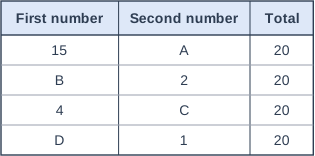
Each row of the table shows two numbers that make 20.
What number does each letter stand for?
Model answer
A = 5 B = 18 C = 16 D = 19
Explanation
Each row must make 20. Count on to 20 from the number you can see. A common mistake is to write 9 for D, but \(9 + 1\) only makes 10.
Mark scheme
1 mark
A = 5
Each letter earns one mark, whatever the other letters score. \(15 + 5 = 20\). A list is read in the order A, B, C, D.
1 mark
B = 18
\(18 + 2 = 20\).
1 mark
C = 16
\(4 + 16 = 20\). Do not accept 6, because \(4 + 6 = 10\).
1 mark
D = 19
\(19 + 1 = 20\). Do not accept 9, because \(9 + 1 = 10\). A correct answer with no working scores full marks. Accept the number in words.
Ready to try the rest? Tap your answers and see straight away how you did.
Ctrl + Enter to check
Study HelperHints first, answers after you try
Stuck on this one? Ask for a hint and I’ll point you in the right direction, without giving the answer away. Once you’ve checked your answer, I’ll show you how the marks are awarded.