Level:
Correct: 0
Incorrect: 0
Marks: 0/0
Practice
Course:
Topics:
Year 2 Maths Smart practice A mixed round aimed at your weak spots
Unit 1
Place value
Unit 2
Addition and subtraction
Unit 3
Multiplication and division
Unit 4
Fractions
Unit 5
Measurement
Unit 6
Geometry
Unit 7
Statistics
Avg
score:
–
Topics
done:
0/34

3-D shapes

Practise 19 questions on 3-D shapes for Year 2 Maths. Tap your answer and find out straight away if you are right, with the Study Helper on hand if you get stuck.

  • 19 questions
  • 1–4 marks each
  • Instant marking
  • No sign-up needed
19 questions, marked as you go

Sample questions with model answers

Here are 4 of the questions in this topic, each with a model answer, an explanation of why it earns the marks and the mark scheme.

Question 1

1 mark

A toy brick is a cube.

How many faces does the brick have?

Model answer

6

Explanation

The brick has a top, a bottom and 4 faces round the sides. That makes 6 faces. A common mistake is to say 4, by forgetting the top and the bottom.

Mark scheme
  1. 1 mark

    6

    Accept six or 6 faces. Do not accept 4 or 12.

Question 2

1 mark

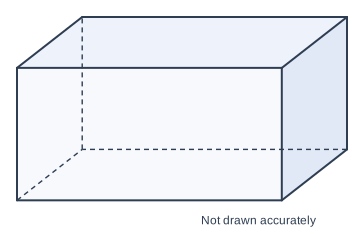
The picture shows a cuboid.

How many faces does it have?

A cuboid drawn in 3D with hidden edges shown as dashed lines. The diagram is labelled "Not drawn accurately".

Model answer

6

Explanation

A cuboid has a top, a bottom, a front, a back, a left and a right. That is 6 faces. A common mistake is to say 3, by counting only the faces you can see at the front.

Mark scheme
  1. 1 mark

    6

    Accept six or 6 faces. Do not accept 3 (only the faces in front) or 4.

Question 3

2 marks

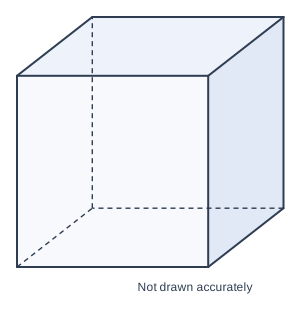
The picture shows a cube.

How many edges does it have?

How many vertices does it have?

A cube drawn in 3D with hidden edges shown as dashed lines. The diagram is labelled "Not drawn accurately".

Model answer

12 edges and 8 vertices

Explanation

An edge is where two faces meet, and a vertex is a corner. There are 4 edges on top, 4 on the bottom and 4 going up. A common mistake is to count only the solid lines and say 9 edges, but the dashed lines are edges too.

Mark scheme
  1. 1 mark

    12 edges

    Accept twelve. Each answer earns one mark on its own. Two numbers with no words, in the order asked ('12, 8'), score both marks. Do not accept 9, which counts only the solid lines.

  2. 1 mark

    8 vertices

    Accept eight or 8 corners. Swapped answers ('8 edges and 12 vertices', or '8, 12') score 0. Do not accept 7, which counts only the corners in front.

Question 4

4 marks

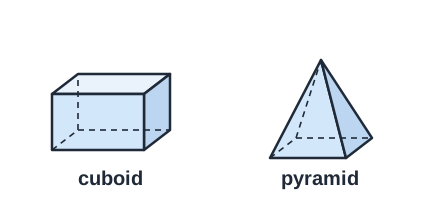
The picture shows a cuboid and a square-based pyramid.

How many more edges does the cuboid have?

How many more vertices does the cuboid have?

A cuboid on the left and a square-based pyramid on the right, each with its name under it. Hidden edges are shown as dashed lines.

Model answer

Edges: \(12 - 8 = 4\) more
Vertices: \(8 - 5 = 3\) more

Explanation

Count the dashed lines too. The cuboid has 12 edges and 8 vertices, and the pyramid has 8 edges and 5 vertices. A common mistake is to use 4 vertices for the pyramid, by forgetting the point at the top.

Mark scheme
  1. 1 mark

    uses 12 edges for the cuboid and 8 edges for the pyramid; or the correct answer 4 with no working

    Accept \(12 - 8\).

  2. 1 mark

    4 (more edges)

    Accept four. Allow follow-through from the pupil's numbers of edges.

  3. 1 mark

    uses 8 vertices for the cuboid and 5 vertices for the pyramid; or the correct answer 3 with no working

    Accept \(8 - 5\).

  4. 1 mark

    3 (more vertices)

    Accept three. Allow follow-through from the pupil's numbers of vertices. Two answers with no words, in the order asked ('4, 3'), score all 4 marks. Swapped answers ('3, 4') score 0. A correct answer with no working scores full marks.

Ready to try the rest? Tap your answers and see straight away how you did.

Topic notes

3-D shapes

The big idea

A 3-D shape is a solid shape. You can pick it up and hold it. A ball, a tin and a box are all 3-D shapes. We describe them by their faces, edges and vertices.

Faces, edges and vertices

  • A face is a flat surface. Each face is a 2-D shape.
  • An edge is a line where two faces meet.
  • A vertex is a corner, where edges meet. Two or more are called vertices.
Four 3-D shapes with their names: a cube, a cuboid, a pyramid and a triangular prism. Hidden edges are dashed. On the cube, a face, an edge and a vertex are labelled.
Dashed lines show the edges hidden at the back.
ShapeFacesEdgesVerticesShapes of the faces
cube61286 squares
cuboid6128rectangles, and sometimes 2 squares
square-based pyramid5851 square and 4 triangles
triangular prism5962 triangles and 3 rectangles

A pyramid comes to one point at the top. A prism has the same shape all the way along.

Shapes with a curved surface

A curved surface is smooth and it bends. A shape can roll on it. It is not a flat face.

  • A sphere is round all over, like a ball. It has 1 curved surface and no flat faces.
  • A cylinder has 2 flat faces, and each one is a circle. A curved surface goes between them.
  • A cone has 1 flat face, which is a circle. A curved surface goes up to a point.
A sphere, a cylinder and a cone with their names. On the cylinder, the flat circle on top and the curved surface are labelled. On the cone, the point is labelled.
A sphere, a cylinder and a cone all have a curved surface.

A shape keeps its name however you turn it.

What 3-D shape is a marble, a cereal box and a party hat?

A marble is round all over. It is a sphere.

A cereal box has flat rectangle faces. It is a cuboid.

A party hat has a round bottom and comes up to a point. It is a cone.

Jay dips each face of a square-based pyramid in paint. He presses each face on a page. What shapes does he print?

The bottom face is a square. He prints 1 square.

The faces round the sides are triangles. There are 4 of them. He prints 4 triangles.

Counting and sorting

Count in groups, so that you do not miss any.

Kai makes a triangular prism from straws. Each edge is one straw. How many straws does he need?

There are 3 edges round the front triangle.

There are 3 edges round the back triangle.

There are 3 edges joining the front to the back.

\(3 + 3 + 3 = 9\), so he needs 9 straws.

To sort 3-D shapes, ask one question about each shape.

Which of these can you stack in a tall tower: cubes, cones, cylinders or spheres?

A tower needs flat faces on the top and the bottom.

  • A cube has them, so it stacks.
  • A cylinder has them, so it stacks.
  • A cone has a point at the top, so it does not stack.
  • A sphere has no flat faces, so it does not stack.

Common mistakes

  • Using a flat shape's name for a solid. A ball is a sphere.
  • Forgetting the faces you cannot see. Count the top, the bottom and the back.
  • Missing the dashed lines. They show edges too.
  • Counting a curved surface as a flat face. It bends, so it is not flat.
  • Leaving out the top of a pyramid when you count vertices. Its point is a vertex too.

Top tip

Hold a real box when you can. Put a small sticker on each face as you count it.

Study Helper Hints first, answers after you try

Stuck on this one? Ask for a hint and I’ll point you in the right direction, without giving the answer away. Once you’ve checked your answer, I’ll show you how the marks are awarded.