Level:
Correct: 0
Incorrect: 0
Marks: 0/0
Practice
Course:
Topics:
Year 2 Maths Smart practice A mixed round aimed at your weak spots
Unit 1
Place value
Unit 2
Addition and subtraction
Unit 3
Multiplication and division
Unit 4
Fractions
Unit 5
Measurement
Unit 6
Geometry
Unit 7
Statistics
Avg
score:
–
Topics
done:
0/34

Pictograms

Practise 16 questions on Pictograms for Year 2 Maths. Tap your answer and find out straight away if you are right, with the Study Helper on hand if you get stuck.

  • 16 questions
  • 1–4 marks each
  • Instant marking
  • No sign-up needed
16 questions, marked as you go

Sample questions with model answers

Here are 4 of the questions in this topic, each with a model answer, an explanation of why it earns the marks and the mark scheme.

Question 1

1 mark

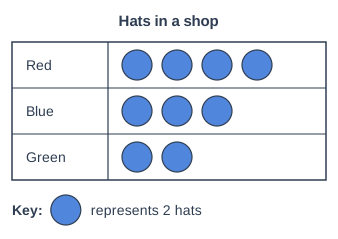
The pictogram shows the hats in a shop.

How many red hats are there?

Pictogram titled "Hats in a shop", a table with 3 rows of circle symbols. Key: one circle represents 2 hats. Red: 4 circles. Blue: 3 circles. Green: 2 circles.

Model answer

8

Explanation

The key says each circle stands for 2 hats. There are 4 circles for red, so count in 2s: 2, 4, 6, 8. A common mistake is to count the circles and say 4.

Mark scheme
  1. 1 mark

    8 (hats)

    Accept eight. Do not accept 4, the number of circles.

Question 2

1 mark

In a pictogram, one square stands for 2 apples.

How many squares show 8 apples?

Model answer

4

Explanation

Count in 2s until you reach 8: 2, 4, 6, 8. That is 4 counts, so 4 squares. A common mistake is to say 8, but one square stands for more than one apple.

Mark scheme
  1. 1 mark

    4

    Do not accept 8 (the number of apples), 2 or 6.

Question 3

2 marks

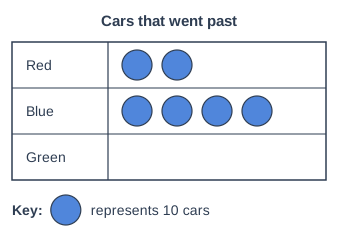
Zoe counted the cars that went past her school. She is making a pictogram of their colours. The Green row is still empty.

30 green cars went past.

How many circles does the Green row need?

Pictogram titled "Cars that went past", a table with 3 rows of circle symbols. Key: one circle represents 10 cars. Red: 2 circles. Blue: 4 circles. Green: blank row (nothing drawn yet).

Model answer

10, 20, 30
3 circles

Explanation

The key says each circle is 10 cars. Count in 10s until you reach 30: 10, 20, 30. That is 3 counts, so 3 circles. A common mistake is to say 30, but that is the number of cars.

Mark scheme
  1. 1 mark

    counts in 10s up to 30, or says 3 lots of 10 make 30; or the correct answer 3 with no working

    Accept \(30 \div 10\).

  2. 1 mark

    3 (circles)

    Accept three. Do not accept 30, the number of cars. A correct answer with no working scores full marks.

Question 4

4 marks

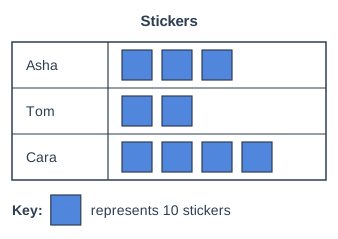
The pictogram shows the stickers three friends have.

Asha gives 10 stickers to Tom.

How many squares does Asha's row need now?

How many squares does Tom's row need now?

Who has the most stickers now?

How many more does that friend have than Asha?

Pictogram titled "Stickers", a table with 3 rows of square symbols. Key: one square represents 10 stickers. Asha: 3 squares. Tom: 2 squares. Cara: 4 squares.

Model answer

Asha: 2 squares
Tom: 3 squares
Cara has the most.
\(40 - 20 = 20\) more

Explanation

Each square is 10 stickers. Asha gives away one square, so she goes from 3 squares to 2, and Tom goes from 2 squares to 3. A common mistake is to change only one row.

Mark scheme
  1. 1 mark

    Asha: 2 (squares)

    Accept two. Each answer earns one mark on its own.

  2. 1 mark

    Tom: 3 (squares)

    Accept three. Do not accept 2, which is his row before.

  3. 1 mark

    Cara

    Accept a clear misspelling. Allow follow-through only if the pupil's squares give Asha or Tom more than 4 squares.

  4. 1 mark

    20 (more stickers)

    Accept twenty. From \(40 - 20\). Allow follow-through from the pupil's squares. Do not accept 2, the number of extra squares.

Ready to try the rest? Tap your answers and see straight away how you did.

Topic notes

Pictograms

The big idea

A pictogram uses little pictures to show numbers. Each picture is called a symbol. Each row is for one group of things. A longer row means a bigger number.

The key

The key tells you how many one symbol stands for. Always read the key first. The key may say represents. That means "stands for". One symbol may stand for 1, 2, 5 or 10. Count along the row in steps of that number.

A pictogram of balloons at a party. One circle stands for 5 balloons. Red has 4 circles, Yellow has 2 circles and Green has 5 circles.
The key says one circle stands for 5 balloons.

Look at the Green row. Say 5, 10, 15, 20, 25. So there are 25 green balloons.

Which colour has exactly 20 balloons?

The key says one circle stands for 5.

Count in 5s until you reach 20: 5, 10, 15, 20.

That is 4 counts, so we need the row with 4 circles.

That row is Red.

Most, least and how many more

The row with the most symbols shows the most. The row with the fewest symbols shows the least. Green has the most balloons. Yellow has the fewest.

For how many more or how many fewer, read both rows. Then find the difference.

Green has 25 and Yellow has 10. \(25 - 10 = 15\), so there are 15 more green balloons. That also means there are 15 fewer yellow balloons.

Or look at the extra symbols. Green has 3 more circles. Count them in 5s: 5, 10, 15.

Totals

To find a total, read every row. Then add the numbers.

There are 40 children at the party. Each child has one balloon. Are there enough balloons? How many are left over?

Read each row: Red is 20, Yellow is 10 and Green is 25.

Add them: \(20 + 10 = 30\), then \(30 + 25 = 55\).

There are 55 balloons. 55 is more than 40, so there are enough.

Take away one balloon for each child: \(55 - 40 = 15\).

There are 15 balloons left over.

How many symbols?

How many symbols does a row need? Count in the key's steps until you reach the number.

Ana finds 50 pine cones. How many circles does her row need if one circle stands for 10? What if one circle stands for 5?

One circle stands for 10. Count in 10s: 10, 20, 30, 40, 50. That is 5 counts, so she needs 5 circles.

One circle stands for 5. Count in 5s: 5, 10, 15, 20, 25, 30, 35, 40, 45, 50. That is 10 counts, so she needs 10 circles.

When one circle stands for a smaller number, you need more circles.

Stretch: half a symbol

When one symbol stands for 2, half a symbol stands for 1.

A pictogram of eggs from three hens. One circle stands for 2 eggs. Hen A has 3 and a half circles, Hen B has 2 circles and Hen C has 1 and a half circles.
One whole circle stands for 2 eggs. Half a circle stands for 1 egg.

Look at Hen A. How can 7 eggs be shown with circles?

Count in 2s: 2, 4, 6. That is 3 whole circles.

We need 1 more egg to make 7.

Half a circle stands for 1 egg.

So Hen A's row has 3 whole circles and half a circle.

Common mistakes

  • Counting each symbol as 1. Use the key to see what each symbol stands for.
  • Giving the extra symbols as the answer to how many more. Each extra symbol stands for the number in the key.
  • Giving the number of things when the question asks how many symbols. Read the question again.
  • Writing a number when the question asks for a name. Write the name of the row.
  • Counting half a symbol as a whole symbol. Half a circle is only half of the key's number.

Top tip

Put your finger on the key before you start. Then say the steps out loud as you go along the row.

Study Helper Hints first, answers after you try

Stuck on this one? Ask for a hint and I’ll point you in the right direction, without giving the answer away. Once you’ve checked your answer, I’ll show you how the marks are awarded.