Practise 13 questions on Temperature for Year 2 Maths. Tap your answer and find out straight away if you are right, with the Study Helper on hand if you get stuck.
13 questions
1–4 marks each
Instant marking
No sign-up needed
13 questions, marked as you go
Sample questions with model answers
Here are 4 of the questions in this topic, each with a model answer, an explanation of why it earns the marks and the mark scheme.
Question 1
1 mark
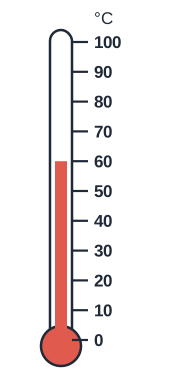
A thermometer is in some hot soup. The picture shows the thermometer.
How many degrees Celsius is the soup?
Model answer
The red line stops at 60. The soup is 60 °C.
Explanation
The numbers on this thermometer go up in 10s. The top of the red line is level with 60, so the soup is 60 °C. A common mistake is to count the marks and say 6.
Mark scheme
1 mark
60
Accept 60, 60 °C, 60 degrees, 60 degrees Celsius or sixty. Do not accept 6 (counting the marks), or 50 or 70 (the numbers next to it).
Question 2
1 mark
It is a very hot day at the beach. What is a sensible temperature?
Model answer
30 °C.
Explanation
A warm room is about 20 °C, so a very hot day is a bit more than that. That makes 30 °C sensible. A common mistake is to choose 100 °C, but that is as hot as boiling water.
Mark scheme
1 mark
30 °C
Accept 30. Do not accept 3 °C (very cold), 70 °C or 100 °C (hotter than any weather, and 100 °C is as hot as boiling water).
Question 3
2 marks
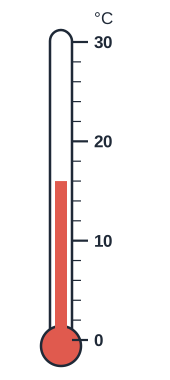
Look at the thermometer in the picture.
Ali says, "It shows 13 °C."
Is Ali right? How do you know?
Model answer
No. Each small step is 2 degrees. Count on from 10: 12, 14, 16. It shows 16 °C.
Explanation
There are 5 small steps from 10 to 20, so each step is 2 degrees. The red line is 3 steps past 10, so count 12, 14, 16. Ali counted each step as 1 degree, which is why he said 13.
Mark scheme
1 mark
Says No, with a relevant but incomplete reason, such as "he read it wrong" or "he counted the marks wrong"
No alone scores 0. Yes scores 0 with any reason.
1 mark
A complete reason: it shows 16 °C / each small step is 2 degrees, not 1 / it goes 12, 14, 16
Accept "No, it is 16". A complete correct reason on its own scores both marks. A No with only a wrong temperature, such as "No, it is 15 °C", scores 0.
Question 4
4 marks
A room is 20 °C. A fridge is 5 °C. A cup of tea is 30 degrees hotter than the room.
How many degrees colder is the fridge than the room?
How hot is the cup of tea?
Model answer
\(20 - 5 = 15\), so the fridge is 15 degrees colder. \(20 + 30 = 50\), so the tea is 50 °C.
Explanation
How much colder means find the difference, so count on from 5 to 20. Hotter means the number goes up, so add 30 to the 20 °C of the room. A common mistake is to say the tea is 30 °C, but it is 30 degrees hotter than the room.
Mark scheme
1 mark
Takes 5 from 20, such as \(20 - 5\), or counts on from 5 to 20; or the correct answer 15 degrees with no working
1 mark
15 degrees
Accept 15, 15 °C or fifteen. Do not accept 25 (adding).
1 mark
Adds 30 to 20, such as \(20 + 30\); or the correct answer 50 °C with no working
1 mark
50 °C
Accept 50, 50 degrees or fifty. Do not accept 30 °C (the 30 degrees on its own) or 10 °C (taking away). A correct answer to either part with no working scores full marks for that part: 15 degrees alone scores 2, and 50 °C alone scores 2.
Ready to try the rest? Tap your answers and see straight away how you did.
Ctrl + Enter to check
Study HelperHints first, answers after you try
Stuck on this one? Ask for a hint and I’ll point you in the right direction, without giving the answer away. Once you’ve checked your answer, I’ll show you how the marks are awarded.