Practise 19 questions on Length and height for Year 2 Maths. Tap your answer and find out straight away if you are right, with the Study Helper on hand if you get stuck.
19 questions
1–4 marks each
Instant marking
No sign-up needed
19 questions, marked as you go
Sample questions with model answers
Here are 4 of the questions in this topic, each with a model answer, an explanation of why it earns the marks and the mark scheme.
Question 1
1 mark
Which of these is about 2 metres tall?
Model answer
A door.
Explanation
A metre is about one big stride. A door is about two of those tall. A common mistake is to think 2 is a small number, so it must be a small thing like a mug.
Mark scheme
1 mark
a door
Accept door. Do not accept a mug, a shoe or a spoon: they are all much shorter, and are measured in centimetres.
Question 2
1 mark
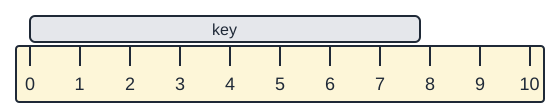
The picture shows a key above a ruler. The key starts at 0. Its end is close to a number, but not on it.
How long is the key, to the nearest centimetre?
Model answer
The end of the key is very close to 8. The key is about 8 cm long.
Explanation
Look at the end of the key. It has gone past 7, but it has not quite reached 8. It is much closer to 8, so the key is 8 cm to the nearest centimetre. A common mistake is to say 7, the last number it passed.
Mark scheme
1 mark
8 cm
Accept 8 with or without the unit, or eight, and "about 8 cm" or "nearly 8 cm". Do not accept 7 (the last number the key has passed, although its end is much closer to 8), "7 and a bit" (not to the nearest centimetre) or 9.
Question 3
2 marks
Put these lengths in order. Start with the shortest.
47 cm, 74 cm, 40 cm, 70 cm
Model answer
40 cm, 47 cm, 70 cm, 74 cm
Explanation
Look at the tens first. 40 and 47 have 4 tens, so they come first, and 40 is less than 47. Then come 70 and 74. A common mistake is to think 47 and 74 are the same because they use the same digits.
Mark scheme
1 mark
The order has one mistake (two lengths swapped, or one length in the wrong place), or is the list in reverse order, longest first; or the correct order with no working
A list with more than one mistake that is not the exact reverse scores 0.
1 mark
40 cm, 47 cm, 70 cm, 74 cm
All four must be in this order. Accept the numbers with no units. The reverse order, 74, 70, 47, 40, scores the first mark only. A correct answer with no working scores full marks.
Question 4
4 marks
A frog jumps 30 cm. A rabbit jumps twice as far.
How far does the rabbit jump?
How much further does the rabbit jump than the frog?
Model answer
\(30 + 30 = 60\), so the rabbit jumps 60 cm. \(60 - 30 = 30\), so it jumps 30 cm further.
Explanation
Twice as far means two lots of 30 cm, which is 60 cm. To find how much further, take the frog's jump from the rabbit's jump. A common mistake is to add the jumps and say 90 cm.
Mark scheme
1 mark
Doubles 30, such as \(30 + 30\) or \(2 \times 30\); or the correct answer 60 cm with no working
1 mark
60 cm
Accept 60 with or without the unit. Do not accept 32 (adding 2).
1 mark
Takes 30 from their rabbit jump, or counts on from 30, such as \(60 - 30\); or the correct answer 30 cm with no working
1 mark
30 cm
Accept 30 with or without the unit. Allow their rabbit jump minus 30, worked out correctly. Do not accept 90 (adding the jumps). A correct answer to either part with no working scores full marks for that part: 60 cm alone scores 2, and 30 cm alone scores 2.
Ready to try the rest? Tap your answers and see straight away how you did.
Ctrl + Enter to check
Study HelperHints first, answers after you try
Stuck on this one? Ask for a hint and I’ll point you in the right direction, without giving the answer away. Once you’ve checked your answer, I’ll show you how the marks are awarded.