Practise 18 questions on Equal groups and arrays for Year 2 Maths. Tap your answer and find out straight away if you are right, with the Study Helper on hand if you get stuck.
18 questions
1–4 marks each
Instant marking
No sign-up needed
18 questions, marked as you go
Sample questions with model answers
Here are 4 of the questions in this topic, each with a model answer, an explanation of why it earns the marks and the mark scheme.
Question 1
1 mark
What is the missing number?
\(10 + 10 + 10 + 10 + 10 = \square \times 10\)
Model answer
There are 5 tens, so \(5 \times 10\). The missing number is 5.
Explanation
Count how many 10s are added. There are 5 of them, so it is 5 lots of 10. A common mistake is to write the total, 50, in the box.
Mark scheme
1 mark
5
Accept five. Do not accept 50 (the total) or 10.
Question 2
1 mark
What is the missing number?
\(10 \times 7 = 7 \times \square\)
Model answer
\(10 \times 7 = 7 \times 10\) The missing number is 10.
Explanation
You can multiply two numbers in any order and get the same answer. So \(10 \times 7\) is the same as \(7 \times 10\). A common mistake is to write 70, the answer, in the box.
Mark scheme
1 mark
10
Accept ten. Do not accept 70 (the answer to each side) or 7.
Question 3
2 marks
An array has 5 rows, with 2 dots in each row.
Raj adds 1 more row of 2 dots.
How many rows are there now?
How many dots are there now?
Model answer
6 rows \(6 \times 2 = 12\) dots
Explanation
5 rows and 1 more row make 6 rows. 6 rows of 2 is 12 dots. A common mistake is to add 1 dot instead of a row of 2.
Mark scheme
1 mark
6 rows
Accept 6. A correct answer with no working scores the mark.
1 mark
12 dots
Accept 12. Follow through: their number of rows times 2. A correct answer with no working scores full marks.
Question 4
4 marks
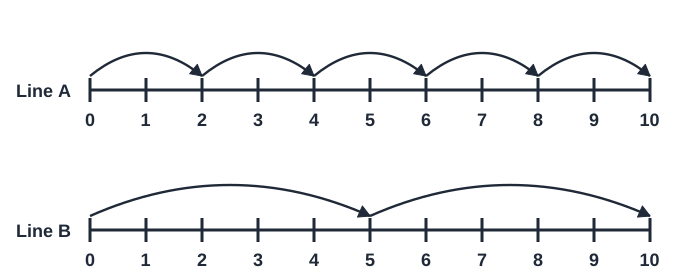
The picture shows two number lines.
Line A shows 5 jumps of 2.
Line B shows 2 jumps of 5.
Which multiplication sentence is for line A?
Which multiplication sentence is for line B?
What do you notice?
Model answer
\(5 \times 2 = 10\) \(2 \times 5 = 10\) Both lines land on 10, so the order does not matter.
Explanation
5 jumps of 2 and 2 jumps of 5 both land on 10. This shows you can multiply two numbers in any order. A common mistake is to write only one sentence.
Mark scheme
1 mark
\(5 \times 2 = 10\) for line A
Also accept \(2 \times 5 = 10\). Accept any way of typing the times sign. The two numbers and the answer are all needed. A correct answer with no working scores the mark.
1 mark
\(2 \times 5 = 10\) for line B
Also accept \(5 \times 2 = 10\). The two numbers and the answer are all needed. If both sentences leave out the answer 10, such as \(5 \times 2\) and \(2 \times 5\), score 1 of these first 2 marks. A correct answer with no working scores the mark.
1 mark
A relevant but incomplete comment, such as 'they use the same numbers'
A complete comment on its own scores both of these last 2 marks.
1 mark
A complete comment: both lines land on 10 / both answers are 10 / they make the same answer / you can multiply in any order
Do not accept 'they are both lines' or 'they have jumps'.
Ready to try the rest? Tap your answers and see straight away how you did.
Ctrl + Enter to check
Study HelperHints first, answers after you try
Stuck on this one? Ask for a hint and I’ll point you in the right direction, without giving the answer away. Once you’ve checked your answer, I’ll show you how the marks are awarded.