Practise 16 questions on Tally charts and tables for Year 2 Maths. Tap your answer and find out straight away if you are right, with the Study Helper on hand if you get stuck.
16 questions
1–4 marks each
Instant marking
No sign-up needed
16 questions, marked as you go
Sample questions with model answers
Here are 4 of the questions in this topic, each with a model answer, an explanation of why it earns the marks and the mark scheme.
Question 1
1 mark
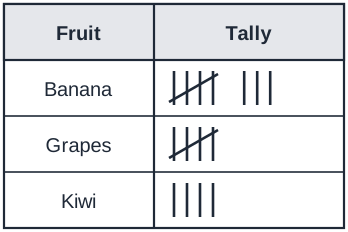
The tally chart shows the fruit children chose at snack time.
Which fruit did the most children choose?
Model answer
banana
Explanation
Count the tally for each fruit. Banana has 8, grapes has 5 and kiwi has 4. A common mistake is to look for the longest row of single marks instead of counting them.
Mark scheme
1 mark
banana
Accept a clear misspelling. Accept 'banana, 8'. Do not accept 8 on its own, or grapes or kiwi.
Question 2
1 mark
Ben's tally has 2 groups. Each group has a line across it. Then there is 1 single mark.
What number does Ben's tally show?
Model answer
11
Explanation
A group with a line across is 5 marks. Count the groups in 5s: 5, 10. Then 1 more makes 11. A common mistake is to forget the line across and count each group as 4.
Mark scheme
1 mark
11
Accept eleven. Do not accept 3 (each group counted as one mark), 9 (each group counted as 4, leaving out the line across) or 21 (each group counted as 10).
Question 3
2 marks
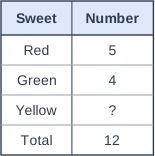
The table shows the sweets in a bag. One number is missing.
What is the missing number?
Model answer
\(5 + 4 = 9\) \(12 - 9 = 3\) 3 yellow sweets
Explanation
The total is 12. Red and green make 9, so yellow must be what is left. A common mistake is to add 12 as well and get 21.
Mark scheme
1 mark
adds 5 and 4 to make 9 and takes it from 12, or counts on from 9 to 12; or the correct answer 3 with no working
Accept \(12 - 9\) or \(9 + 3 = 12\).
1 mark
3 (yellow sweets)
Accept three. Do not accept 21, which adds all three numbers, or 9. A correct answer with no working scores full marks.
Question 4
4 marks
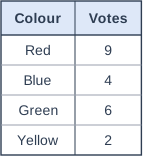
The table shows the votes for four colours.
Sam says, "Red got more votes than blue and yellow together."
Is Sam right? How do you know?
Put the colours in order. Start with the fewest votes.
Model answer
Yes. Blue and yellow make 6, and 9 is more than 6. Yellow, Blue, Green, Red
Explanation
Add the votes for blue and yellow: \(4 + 2 = 6\). Red has 9, which is more. For the order, the fewest votes come first. A common mistake is to compare red with one colour only.
Mark scheme
1 mark
Yes, with a relevant but incomplete reason, such as 'red has a lot of votes'
Yes or No alone scores 0.
1 mark
a complete reason: blue and yellow together make 6, and red has 9 / 9 is more than 6
A complete correct reason on its own scores both of these marks. Accept \(4 + 2 = 6\) with a comparison with 9.
2 marks
Yellow, Blue, Green, Red
Accept a clear misspelling. One mistake is two colours swapped, such as 'Yellow, Green, Blue, Red', and scores 1 of these 2 marks. A reversed list ('Red, Green, Blue, Yellow') also scores 1. Anything else scores 0.
Ready to try the rest? Tap your answers and see straight away how you did.
Ctrl + Enter to check
Study HelperHints first, answers after you try
Stuck on this one? Ask for a hint and I’ll point you in the right direction, without giving the answer away. Once you’ve checked your answer, I’ll show you how the marks are awarded.