Practise 16 questions on Capacity and volume for Year 2 Maths. Tap your answer and find out straight away if you are right, with the Study Helper on hand if you get stuck.
16 questions
1–4 marks each
Instant marking
No sign-up needed
16 questions, marked as you go
Sample questions with model answers
Here are 4 of the questions in this topic, each with a model answer, an explanation of why it earns the marks and the mark scheme.
Question 1
1 mark
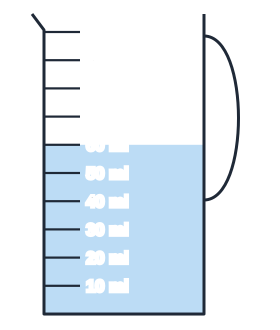
The picture shows a small jug of water. The lines go up in 10s.
How much water is in it, in millilitres?
Model answer
The water comes up to the 60 ml line. There is 60 ml of water.
Explanation
The lines on this jug go up in 10s. The top of the water is level with the line marked 60 ml. A common mistake is to count the lines and say 6, but each line is 10 ml.
Mark scheme
1 mark
60
Accept 60, 60 ml, 60 millilitres or sixty. Do not accept 6 (counting the lines), or 50 or 70 (the lines next to it).
Question 2
1 mark
A jug holds 600 ml. A cup holds 100 ml.
How many cups of water will fill the jug?
Model answer
100 ml, 200 ml, 300 ml, 400 ml, 500 ml, 600 ml That is 6 lots of 100 ml. 6 cups fill the jug.
Explanation
Each cup adds 100 ml, so count up in 100s until you reach 600 ml. You say 6 amounts, so it takes 6 cups. A common mistake is to take 100 ml from 600 ml and say 500 ml.
Mark scheme
1 mark
6 cups
Accept 6 or six, with or without the word cups. Do not accept 60, 500 (taking 100 from 600) or 700.
Question 3
2 marks
A fish tank holds 20 litres when it is full. It is half full now.
How many litres are in the tank?
Raj pours in 3 more litres. How many litres are in it now?
Model answer
Half of 20 is 10, so there are 10 litres. \(10 + 3 = 13\) Now there are 13 litres.
Explanation
Half full means half of what the tank holds, and half of 20 is 10. Pouring in means add, so \(10 + 3 = 13\). A common mistake is to add the 3 to 20, but the tank was only half full.
Mark scheme
1 mark
10 litres
Accept 10 with or without the unit, or ten. Mark the two answers separately. Do not accept 20 (the tank when it is full).
1 mark
13 litres
Accept 13 with or without the unit, or thirteen. Allow their first answer plus 3, worked out correctly. Do not accept 23 (adding 3 to the full tank).
Question 4
4 marks
A sink holds 20 litres. A small bucket holds 2 litres. A big bucket holds 5 litres.
How many small buckets will fill the sink?
How many big buckets will fill the sink?
Model answer
\(20 \div 2 = 10\), so 10 small buckets. \(20 \div 5 = 4\), so 4 big buckets.
Explanation
Count in 2s to 20 to find the small buckets, and you say 10 numbers. Count in 5s to 20 for the big buckets, and you say 4 numbers. A common mistake is to think the big bucket needs more trips, but it holds more each time.
Mark scheme
1 mark
Counts up in 2s to 20, or finds how many 2s make 20, such as \(20 \div 2\); or the correct answer 10 small buckets with no working
1 mark
10 small buckets
Accept 10 or ten, with or without the words small buckets. Do not accept 18 (taking 2 from 20) or 40 (doubling 20).
1 mark
Counts up in 5s to 20, or finds how many 5s make 20, such as \(20 \div 5\); or the correct answer 4 big buckets with no working
1 mark
4 big buckets
Accept 4 or four, with or without the words big buckets. Do not accept 15 (taking 5 from 20). A correct answer to either part with no working scores full marks for that part: 10 alone scores 2, and 4 alone scores 2. If the answers are swapped (4 small, 10 big), neither answer mark is earned, and the method marks are earned only if the working is correct.
Ready to try the rest? Tap your answers and see straight away how you did.
Ctrl + Enter to check
Study HelperHints first, answers after you try
Stuck on this one? Ask for a hint and I’ll point you in the right direction, without giving the answer away. Once you’ve checked your answer, I’ll show you how the marks are awarded.