Practise 16 questions on Mass for Year 2 Maths. Tap your answer and find out straight away if you are right, with the Study Helper on hand if you get stuck.
16 questions
1–4 marks each
Instant marking
No sign-up needed
16 questions, marked as you go
Sample questions with model answers
Here are 4 of the questions in this topic, each with a model answer, an explanation of why it earns the marks and the mark scheme.
Question 1
1 mark
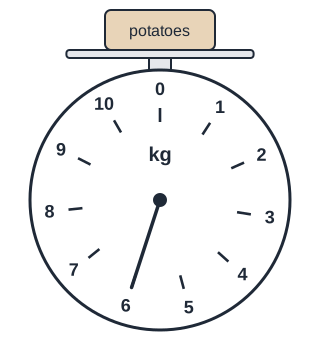
The picture shows a bag of potatoes on a weighing scale.
How many kilograms is the bag?
Model answer
The needle points to 6. The bag is 6 kg.
Explanation
Start at 0 and follow the numbers round in order. They go up in 1s. The needle points to 6, so the bag is 6 kg. A common mistake is to read the number next to the right one, so look closely at where the needle points.
Mark scheme
1 mark
6
Accept 6, 6 kg, 6 kilograms or six. Do not accept 5 or 7 (the numbers next to it) or 6 g.
Question 2
1 mark
A bun is 45 g. A biscuit is 25 g.
What is their total mass?
Model answer
\(45 + 25 = 70\) Their total mass is 70 g.
Explanation
Total means add. Add the tens: \(40 + 20 = 60\). Add the ones: \(5 + 5 = 10\). Then \(60 + 10 = 70\). A common mistake is to forget the ten made by the ones and say 60.
Mark scheme
1 mark
70 g
Accept 70 with or without the unit, or seventy. Do not accept 60 (leaving out the ten made by \(5 + 5\)) or 20 (the difference).
Question 3
2 marks
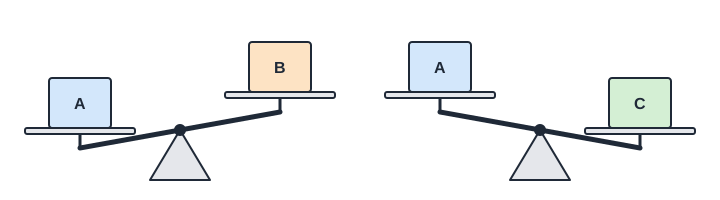
The picture shows boxes A, B and C on two balances.
Which box is the heaviest?
Which box is the lightest?
Model answer
A is heavier than B. C is heavier than A. The heaviest is C. The lightest is B.
Explanation
The lower side is the heavier one. The first balance shows that A is heavier than B. The second shows that C is heavier than A. So C is the heaviest, then A, then B. A common mistake is to think the higher side is the heavier one.
Mark scheme
1 mark
The heaviest is C
Accept C or box C. Mark the two answers separately. If the answers are swapped (heaviest B, lightest C), neither mark is earned.
1 mark
The lightest is B
Accept B or box B. Do not accept A, which is heavier than B and lighter than C.
Question 4
4 marks
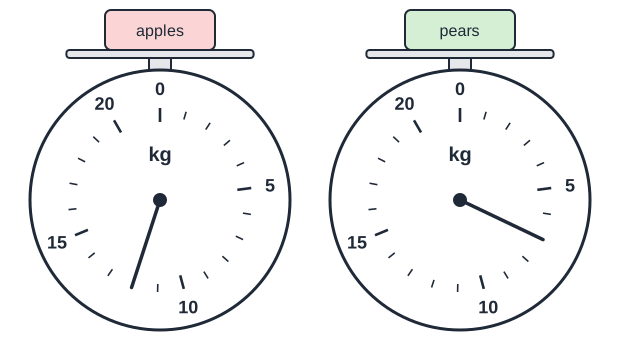
The picture shows two boxes on two scales. One box has apples. One box has pears.
How much heavier is the box of apples?
What is the total mass of the two boxes?
Model answer
The apples are 12 kg. The pears are 7 kg. \(12 - 7 = 5\), so the apples are 5 kg heavier. \(12 + 7 = 19\), so the total is 19 kg.
Explanation
Each small step is 1 kg. The needles show 12 kg and 7 kg. Take away to find how much heavier, and add to find the total. A common mistake is to read a needle as the number next to it, such as 10 instead of 12.
Mark scheme
1 mark
Reads the apples as 12 kg and the pears as 7 kg, such as \(12 - 7\); or the correct answer 5 kg with no working
Both readings must be right for this mark. A wrong reading does not earn it, but the marks after it can follow from the pupil's own readings.
1 mark
5 kg
Accept 5 with or without the unit, or five. Allow the difference of their two readings, worked out correctly. Do not accept 12 kg (the apples alone).
1 mark
Adds their two readings, such as \(12 + 7\); or the correct answer 19 kg with no working
1 mark
19 kg
Accept 19 with or without the unit, or nineteen. Allow the sum of their two readings, worked out correctly. A correct answer to either part with no working scores full marks for that part: 5 kg alone scores 2, and 19 kg alone scores 2.
Ready to try the rest? Tap your answers and see straight away how you did.
Ctrl + Enter to check
Study HelperHints first, answers after you try
Stuck on this one? Ask for a hint and I’ll point you in the right direction, without giving the answer away. Once you’ve checked your answer, I’ll show you how the marks are awarded.