Level:
Correct: 0
Incorrect: 0
Marks: 0/0
Exam Practice
Course:
Topics:
OCR GCSE Biology (Paper 3) Smart practice A mixed round aimed at your weak spots
Avg
score:
–
Topics
done:
0/29

Water uptake, transpiration and translocation

Practise 17 exam-style questions on Water uptake, transpiration and translocation for OCR GCSE Biology (Paper 3). Write your answer as you would in the exam and get it marked in seconds against the mark scheme, point by point, with the Study Helper on hand if you get stuck.

  • 17 questions
  • 1–6 marks each
  • Instant marking
  • No sign-up needed
17 questions, marked as you go

Sample questions with model answers

Here are 4 of the questions in this topic, each with a model answer, an explanation of why it earns the marks and the mark scheme an examiner would use.

Question 1

1 mark

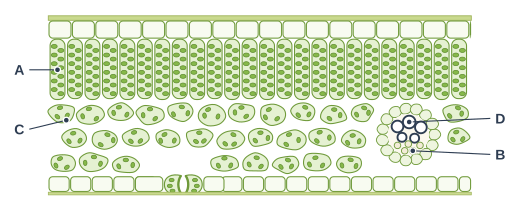
The diagram shows a cross-section through part of a leaf.

Which labelled tissue carries sucrose out of the leaf to other parts of the plant?

Choose your answer.

  • A tissue A
  • B tissue B
  • C tissue C
  • D tissue D
Diagram of a cross-section through a leaf (upper surface at the top). Layers of cells. From the top: a thin outer layer covering the surface; a single row of flat clear cells; a layer of tall closely packed cells full of green discs; a layer of rounded cells with fewer green discs and spaces between them; another row of flat clear cells; and another thin outer layer. In the layer of rounded cells, on the right, is a round bundle with large hollow cells in its upper part and smaller cells in its lower part. In the bottom row a small pore lies between two bean-shaped cells, which contain green discs, with a space above it. Label A points to the layer of tall, closely packed cells full of green discs; label B points to the smaller cells in the lower part of the round bundle; label C points to the layer of rounded, loosely packed cells below the tall cells; label D points to the large hollow cells in the upper part of the round bundle.

Model answer

B

Explanation

In a leaf vein the xylem is the group of large, hollow, thick-walled cells and the phloem is the group of smaller cells next to it. The xylem brings water and mineral ions into the leaf, and the phloem carries away the sucrose made from the glucose produced by photosynthesis. A common error is to choose the xylem because it is the larger, more obvious tissue.

Mark scheme
  1. 1 mark

    B / tissue B (the phloem)

    The only correct answer is B: B is the phloem, the smaller cells in the lower part of the vein (vascular bundle), which carry sucrose made in the leaf to other parts of the plant by translocation. A is not correct because A is the palisade mesophyll, where most photosynthesis takes place; C is not correct because C is the spongy mesophyll, which has air spaces for gas exchange; D is not correct because D is the xylem, the large hollow cells that bring water and mineral ions into the leaf. ALLOW the letter or the option. If more than one option is given, do not award the mark.
Question 2

2 marks

A student wrote six statements about how water moves through a plant, from the soil to the air. They are in the wrong order.

P Water vapour diffuses out of the leaf through a stoma.
Q Water enters a root hair cell from the soil by osmosis.
R Water moves up the stem in a xylem vessel.
S Water evaporates from the surface of a cell inside the leaf.
T Water moves from cell to cell across the root to the xylem.
U Water is pumped up the stem in the phloem by active transport.

One statement is not part of this process. Identify this statement. Write the other five letters in the correct order, starting with the first step.

Model answer

Statement U is not part of the process.

Q, T, R, S, P

Explanation

Water enters the root hair cells by osmosis, crosses the root to the xylem, travels up the stem in the xylem, evaporates from the cell surfaces inside the leaf and finally diffuses out through the stomata as water vapour. Statement U is wrong because water moves in the xylem, and it is pulled up by transpiration, not pumped by active transport. A common error is to put diffusion through the stomata before evaporation: the water must become vapour before it can leave.

Mark scheme
  1. 1 mark

    U (is not part of the process)

    ALLOW the statement written out instead of the letter. DO NOT ALLOW more than one letter given as the incorrect statement.

  2. 1 mark

    Q, T, R, S, P

    The order must be fully correct. DO NOT award this mark if U is included in the order. IGNORE commas, arrows or spaces between the letters.

Question 3

3 marks

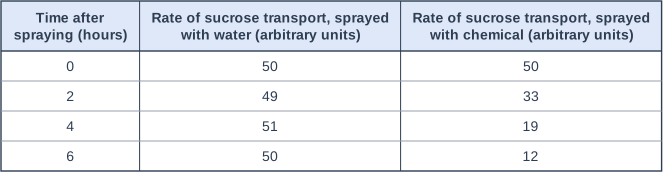
A scientist sprayed the leaves of some bean plants with a chemical that makes stomata close. She sprayed other bean plants with water only. All the plants were kept in bright light.

She then measured the rate at which sucrose was transported in the phloem of the stems for the next 6 hours.

The table shows the results.

Explain the results for the plants sprayed with the chemical.

Table with columns "Time after spraying (hours)", "Rate of sucrose transport, sprayed with water (arbitrary units)", "Rate of sucrose transport, sprayed with chemical (arbitrary units)". Time after spraying (hours): 0; Rate of sucrose transport, sprayed with water (arbitrary units): 50; Rate of sucrose transport, sprayed with chemical (arbitrary units): 50 | Time after spraying (hours): 2; Rate of sucrose transport, sprayed with water (arbitrary units): 49; Rate of sucrose transport, sprayed with chemical (arbitrary units): 33 | Time after spraying (hours): 4; Rate of sucrose transport, sprayed with water (arbitrary units): 51; Rate of sucrose transport, sprayed with chemical (arbitrary units): 19 | Time after spraying (hours): 6; Rate of sucrose transport, sprayed with water (arbitrary units): 50; Rate of sucrose transport, sprayed with chemical (arbitrary units): 12.

Model answer

The chemical closes the stomata, so carbon dioxide can no longer diffuse into the leaves. Without carbon dioxide the rate of photosynthesis falls, so the leaves make less glucose and less sucrose. Less sucrose is then available to be translocated out of the leaves in the phloem, so the rate of transport falls from 50 to 12 arbitrary units, while it stays at about 50 in the plants sprayed with water. It falls gradually rather than at once because the leaves still have some stored sugar and starch to turn into sucrose.

Explanation

Link the three processes in order: stomata let carbon dioxide in, carbon dioxide is needed for photosynthesis, and photosynthesis makes the sugar that the phloem translocates. The control plants show that the fall is caused by the chemical. A common error is to say that the plant stops transporting sucrose because it loses less water: the phloem does not depend on transpiration.

Mark scheme
  1. 1 mark

    with the stomata closed, (little or no) carbon dioxide can diffuse into the leaves

    max 3. ALLOW carbon dioxide cannot enter the leaf (through the stomata). IGNORE less water is lost by transpiration unless linked to the results.

  2. 1 mark

    so the rate of photosynthesis falls and less glucose / sucrose is made in the leaves

    ALLOW less sugar is made. DO NOT ALLOW the plants cannot respire.

  3. 1 mark

    so less sucrose is available to be translocated in the phloem (from the leaves to other parts of the plant)

    ALLOW less sucrose is loaded into / moved out of the leaves in the phloem. DO NOT ALLOW xylem.

  4. 1 mark

    the rate falls gradually (from 50 to 12 arbitrary units over 6 hours), not at once, because the leaves still contain some sugar / stored starch that is turned into sucrose and transported

    ALLOW the leaves use up the sugar / starch they had already made before the stomata closed.

  5. 1 mark

    the rate stays at about 50 (arbitrary units) for the plants sprayed with water, so the fall is caused by the chemical (closing the stomata)

    ALLOW the control plants show that spraying with water alone does not change the rate.

Question 4

4 marks

Scientists can measure how fast water moves up the trunk of a tree by using a pulse of heat.

• A tiny heater is pushed into the xylem in the trunk. One temperature sensor is placed 15 mm above the heater and another 15 mm below it.
• The heater gives out a short pulse of heat.
• The sensor above the heater records its highest temperature 45 seconds later. The sensor below the heater records almost no rise in temperature.

Calculate the speed of the water moving up the xylem, in m per hour.

Explain the results from the two sensors.

Model answer

Speed = 15 ÷ 45 = 0.33 mm/s
0.33 × 3600 = 1200 mm per hour = 1.2 m per hour

Water in the xylem is moving upwards, from the roots to the leaves, so the warmed water is carried up to the sensor above the heater. Water in the xylem flows in one direction only, so almost none of the heat is carried down to the sensor below. The water is pulled up the xylem by transpiration, as water evaporates from the leaves.

Explanation

Speed = distance ÷ time; convert seconds to hours (× 3600) and millimetres to metres (÷ 1000). The heat pulse travels with the water, so it shows both the speed and the direction of flow in the xylem: up only, in the transpiration stream. A common error is to explain the result by 'heat rises', which would not depend on the xylem at all.

Mark scheme
  1. 1 mark

    speed: 15 ÷ 45 = 0.33 (mm/s); or a correct final answer of 1.2 m per hour with no working

    An answer of 1.2 m per hour with no working scores marking points 1 and 2. ALLOW 0.333 (mm/s) or 20 (mm per minute) for marking point 1. ALLOW 1 mark for 1200 (mm per hour) or 0.33 (mm/s) given as the final answer (not converted to m per hour).

  2. 1 mark

    conversion: 0.33 × 3600 ÷ 1000 = 1.2 (m per hour)

    ALLOW 15 mm × 80 (pulses of 45 s in an hour) = 1200 mm = 1.2 m. ALLOW 1.19 or 1.20 (from 0.33). ALLOW ECF from an incorrect speed, correctly converted.

  3. 2 marks

    explanation, any two of the following (one mark each):
    • the water in the xylem flows upwards (from the roots to the leaves), so the moving water carries the heat up to the sensor above
    • water in the xylem does not flow downwards / flows in one direction only, so (almost) no heat reaches the sensor below
    • the water is pulled up by transpiration / by evaporation of water from the leaves (the transpiration stream)

    1 mark for each point, max 2. DO NOT ALLOW the heat rises / hot water rises as the only explanation. DO NOT ALLOW the phloem carries the water. IGNORE references to sucrose.

Ready to try the rest? Every answer you write is marked against the mark scheme, so you can see exactly where the marks are.

Study Helper Hints first, answers after you try

Stuck on this one? Ask for a hint and I’ll point you in the right direction, without giving the answer away. Once you’ve checked your answer, I’ll show you how the marks are awarded.