
Level:
Correct: 0
Incorrect: 0
Marks: 0/0
Exam Practice
Course:
Topics:
OCR GCSE Biology (Paper 3) Smart practice A mixed round aimed at your weak spots
Avg
score:
–
Topics
done:
0/29

Osmotic balance, the kidneys and ADH

Practise 19 exam-style questions on Osmotic balance, the kidneys and ADH for OCR GCSE Biology (Paper 3). Write your answer as you would in the exam and get it marked in seconds against the mark scheme, point by point, with the Study Helper on hand if you get stuck.

  • 19 questions
  • 1–6 marks each
  • Instant marking
  • No sign-up needed
19 questions, marked as you go

Sample questions with model answers

Here are 4 of the questions in this topic, each with a model answer, an explanation of why it earns the marks and the mark scheme an examiner would use.

Question 1

1 mark

A person feels thirsty when receptors in the brain detect a change in the blood.

Which change in the blood causes thirst?

Choose your answer.

  • A The concentration of ADH in the blood plasma rises.
  • B The concentration of glucose in the blood plasma falls.
  • C The water potential of the blood plasma falls.
  • D The water potential of the blood plasma rises.

Model answer

C (The water potential of the blood plasma falls.)

Explanation

Thirst is one of the two responses to a fall in the water potential of the blood: the person drinks, which adds water, while ADH makes the kidneys reabsorb more water, which reduces water loss. Both responses raise the water potential back to normal. A common confusion is to think that ADH itself makes a person thirsty.

Mark scheme
  1. 1 mark

    C / The water potential of the blood plasma falls.

    The only correct answer is C: when the body loses water (or takes in a lot of salt) the blood plasma becomes more concentrated, so its water potential falls; receptors in the brain detect this and the person feels thirsty. A is not correct because ADH is released in response to the same change and acts on the kidneys, but it does not cause thirst; B is not correct because a fall in blood glucose is corrected by glucagon and does not cause thirst; D is not correct because a rise in water potential means the blood contains extra water, which reduces thirst. ALLOW the letter or the option. If more than one option is given, do not award the mark.
Question 2

2 marks

Each kidney tubule is surrounded by a dense network of blood capillaries.

Explain why this is important when the body needs to conserve water.

Model answer

When the body needs to conserve water, a lot of water is reabsorbed from the tubule and collecting duct. This water passes into the blood in the capillaries, so it returns to the circulation instead of being lost in the urine. Because the capillaries are wrapped closely round the tubule, the distance is short and the flowing blood carries the water away, which keeps a water potential gradient so that reabsorption continues.

Explanation

Reabsorption means taking substances back from the filtrate into the blood, so the blood vessels must be close to the tubule. A short distance makes the movement fast, and the moving blood keeps removing the reabsorbed water. Answers that only say 'the blood is filtered' describe the glomerulus, not the capillaries around the tubule.

Mark scheme
  1. 1 mark

    water reabsorbed from the tubule / collecting duct (by osmosis) passes into the blood in the capillaries, so it is returned to the body / circulation (instead of being lost in urine)

    The idea that reabsorbed water enters the blood is needed. IGNORE glucose reabsorption unless linked to water.

  2. 1 mark

    the capillaries are very close to the tubule, so the distance is short and water is reabsorbed quickly

    ALLOW the blood flow carries the reabsorbed water away, keeping a water potential gradient (so reabsorption continues). ALLOW the blood keeps moving, so the water does not build up next to the tubule. ALLOW large surface area for reabsorption.

Question 3

3 marks

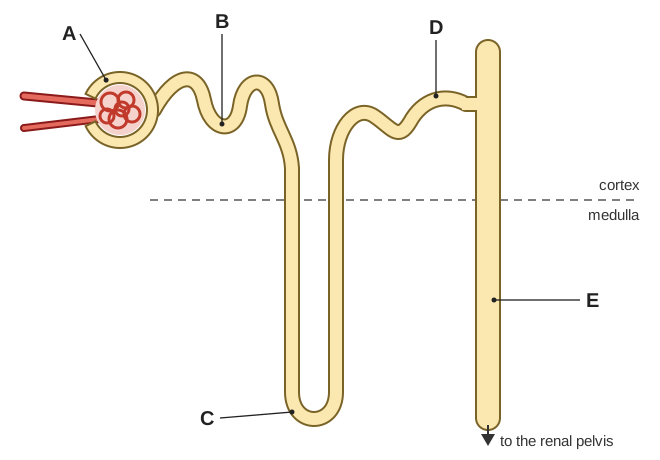
The diagram shows a kidney tubule.

Name the part labelled B.

In a rare inherited condition, the cells lining the part labelled B take up glucose from the filtrate more slowly than normal. People with this condition have glucose in their urine even though the concentration of glucose in their blood is normal.

Explain why.

A diagram of a kidney tubule. At the top left, a cup-shaped structure surrounds a knot of red blood vessels, and two red blood vessels enter it from the left; letter A points to the wall of the cup. The tube leaving the cup coils (letter B), runs straight down past a dashed line labelled cortex above and medulla below, bends round in a U shape (letter C) and comes back up, coils again above the dashed line (letter D), and joins a wider vertical tube on the right (letter E). An arrow at the bottom of the wide tube is labelled to the renal pelvis.

Model answer

B is the proximal convoluted tubule.

Glucose is small enough to be filtered out of the blood in the glomerulus, so the filtrate in Bowman's capsule contains glucose at the same concentration as the blood. Normally all of this glucose is reabsorbed into the blood by the cells lining the proximal convoluted tubule. In this condition the cells take up glucose too slowly, so not all of it is reabsorbed; the rest stays in the filtrate, passes through the loop of Henle and the collecting duct, and ends up in the urine.

Explanation

Glucose in the urine does not always mean diabetes. Here the blood glucose is normal, so the same amount of glucose is filtered as usual; the problem is that the proximal convoluted tubule cannot reabsorb all of it. Say clearly that glucose is first filtered and then reabsorbed, and name the first coiled part of the tubule.

Mark scheme
  1. 1 mark

    B: proximal convoluted tubule

    ALLOW PCT / first coiled tubule / first convoluted tubule. DO NOT ALLOW distal convoluted tubule / second coiled tubule. DO NOT ALLOW convoluted tubule with no further detail.

  2. 1 mark

    glucose is filtered from the blood (in the glomerulus) into Bowman's capsule / the filtrate (in the tubule) contains glucose (at the normal blood concentration)

    ALLOW glucose passes from the blood into the tubule at the start of the tubule.

  3. 1 mark

    normally all the glucose is reabsorbed (into the blood) in part B / the proximal convoluted tubule, but here not all of it is reabsorbed, so some glucose stays in the filtrate and passes into the urine

    ALLOW less glucose is reabsorbed (by active transport), so glucose is left in the urine. The idea of reabsorption (or taking glucose back into the blood) is needed. IGNORE references to insulin or diabetes.

Question 4

4 marks

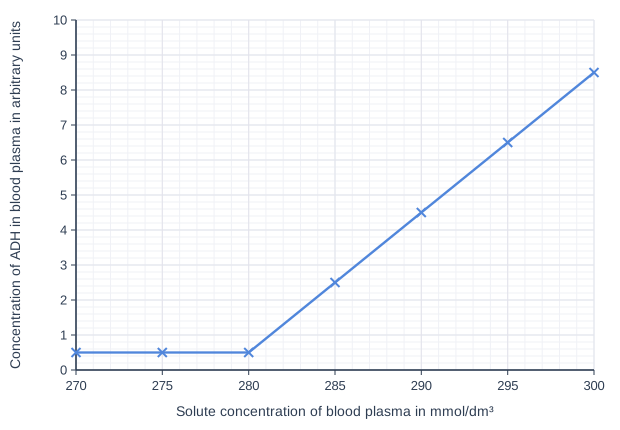
Scientists changed the solute concentration of the blood plasma of volunteers by giving them salt solution or water. They measured the concentration of ADH in the volunteers' blood plasma at each solute concentration.

The graph shows the results.

Describe the relationship shown by the graph.

Explain how this relationship helps to keep the solute concentration of the blood plasma within narrow limits.

Line graph of Concentration of ADH in blood plasma in arbitrary units (y-axis, 0 to 10) against solute concentration of blood plasma in mmol/dm³ (x-axis, 270 to 300). The line joins the points (270, 0.5), (275, 0.5), (280, 0.5), (285, 2.5), (290, 4.5), (295, 6.5), (300, 8.5).

Model answer

Up to a solute concentration of 280 mmol/dm³ the ADH concentration stays low, at 0.5 arbitrary units. Above 280 mmol/dm³ the ADH concentration increases steadily in a straight line, by 2 arbitrary units for every 5 mmol/dm³, reaching 8.5 arbitrary units at 300 mmol/dm³.

If the plasma becomes more concentrated, more ADH is released. ADH makes the collecting ducts more permeable to water, so more water is reabsorbed into the blood and the plasma is diluted back towards normal. If the plasma becomes too dilute, very little ADH is released, so less water is reabsorbed and the extra water is lost in dilute urine. This is negative feedback, and because a bigger rise causes more ADH to be released, larger changes are corrected more strongly.

Explanation

When describing a graph, give its shape in each part and quote values, including the point where the line changes (280 mmol/dm³). The line is straight above 280 mmol/dm³ but does not pass through the origin, so 'directly proportional' is not correct. In the explanation, follow the chain from the change in the blood to ADH, permeability, water reabsorption and the correction of the change.

Mark scheme
  1. 1 mark

    (description) at solute concentrations up to 280 mmol/dm³, the ADH concentration is low / stays the same (at 0.5 arbitrary units)

    Max 2 for the description (marking points 1 and 2) and max 2 for the explanation (marking points 3, 4 and 5). ALLOW very little ADH below about 280 mmol/dm³.

  2. 1 mark

    (description) above 280 mmol/dm³, the ADH concentration increases steadily / at a constant rate / in a straight line as the solute concentration increases (by 2 arbitrary units for each 5 mmol/dm³, from 0.5 to 8.5 arbitrary units)

    ALLOW a positive correlation above 280 mmol/dm³ if the threshold is also described. DO NOT ALLOW directly proportional (the line does not pass through the origin).

  3. 1 mark

    (explanation) when the solute concentration rises (the water potential of the blood falls), more ADH is released, so the collecting ducts / kidney tubules become more permeable to water and more water is reabsorbed into the blood, so the solute concentration falls again

    ALLOW a smaller volume of more concentrated urine is produced. The link from more ADH to more water reabsorbed is needed.

  4. 1 mark

    (explanation) when the solute concentration is low, very little ADH is released, so less water is reabsorbed and more water is lost in a large volume of dilute urine, so the solute concentration rises again

    ORA (allow the reverse argument) of marking point 3 when it is applied to a fall in solute concentration.

  5. 1 mark

    (explanation) this is negative feedback: the response reverses the change, and the larger the rise in solute concentration, the more ADH is released / the bigger the response

    The words 'negative feedback' must be used, or the idea that the response reverses the change.

Ready to try the rest? Every answer you write is marked against the mark scheme, so you can see exactly where the marks are.

Study Helper Hints first, answers after you try

Stuck on this one? Ask for a hint and I’ll point you in the right direction, without giving the answer away. Once you’ve checked your answer, I’ll show you how the marks are awarded.