
Level:
Correct: 0
Incorrect: 0
Marks: 0/0
Exam Practice
Course:
Topics:
OCR GCSE Biology (Paper 3) Smart practice A mixed round aimed at your weak spots
Avg
score:
–
Topics
done:
0/29

Cell differentiation and stem cells

Practise 16 exam-style questions on Cell differentiation and stem cells for OCR GCSE Biology (Paper 3). Write your answer as you would in the exam and get it marked in seconds against the mark scheme, point by point, with the Study Helper on hand if you get stuck.

  • 16 questions
  • 1–6 marks each
  • Instant marking
  • No sign-up needed
16 questions, marked as you go

Sample questions with model answers

Here are 4 of the questions in this topic, each with a model answer, an explanation of why it earns the marks and the mark scheme an examiner would use.

Question 1

1 mark

A cell produced by the meristem in a young root differentiates into a xylem cell.

Which change happens to the cell as it differentiates?

Choose your answer.

  • A it develops a long extension (a hair) into the soil
  • B it develops many chloroplasts
  • C it develops thick walls containing lignin
  • D it grows a long tail

Model answer

C

Explanation

During differentiation a cell gains the structures it needs for one job. Xylem cells develop thick, lignified walls and become hollow tubes for carrying water. The other options describe the features of different specialised cells (root hair, palisade and sperm cells).

Mark scheme
  1. 1 mark

    C / it develops thick walls containing lignin

    The only correct answer is C: xylem cells develop thick walls strengthened with lignin and form hollow tubes that carry water. A is not correct because a long extension into the soil is a feature of a root hair cell; B is not correct because many chloroplasts are a feature of palisade cells in leaves, and root cells underground do not photosynthesise; D is not correct because a tail is a feature of a sperm cell, not of any plant cell. ALLOW the letter or the option. If more than one option is given, do not award the mark.
Question 2

2 marks

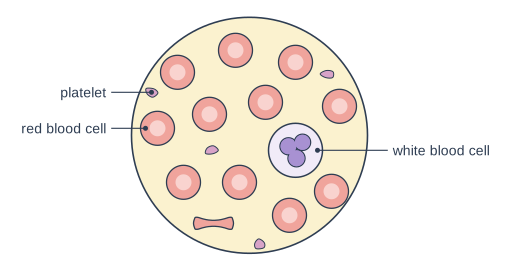
The diagram shows a sample of human blood seen with a light microscope. The red blood cells, the white blood cells and the platelets (cell fragments) are all produced from stem cells in the bone marrow.

Red blood cells carry oxygen. White blood cells help to destroy pathogens. Platelets help the blood to clot.

Explain why it is important that these stem cells produce more than one type of specialised cell.

Use an example from the diagram in your answer.

Diagram: a circular field of view of a pale yellow liquid containing many round pale red discs with paler centres (one more is seen from the side, showing that it is thinner in the middle than at the edges), one larger pale cell with a purple lobed structure inside it, and four small irregular fragments. The label "red blood cell" points to one of the many round pale red discs with paler centres; the label "white blood cell" points to the larger pale cell with a purple lobed structure inside it; the label "platelet" points to one of the small irregular fragments.

Model answer

The blood has several different jobs, and each job needs cells with a different structure. For example, a red blood cell has no nucleus, so there is more room for haemoglobin and it can carry as much oxygen as possible, but a cell like this could not also destroy pathogens or help the blood to clot. One type of cell could not do all these jobs well, so the stem cells produce several types of specialised cell, each adapted to its own job. This lets the blood carry out all of its functions efficiently.

Explanation

Differentiation matters because each specialised cell is adapted to do one job well, and one type of cell could not do every job. Blood shows this clearly: the same bone marrow stem cells give rise to cells with very different structures. Link a feature seen in the diagram, such as the red blood cell having no nucleus, to its function, rather than only repeating the functions given in the question.

Mark scheme
  1. 1 mark

    each type of cell has a different structure, adapted to (only) one function / each type of cell is specialised for its own job

    max 2. Max 1 if no example of a specialised cell from the diagram is used. ALLOW different jobs need cells with different features. IGNORE repeats of the functions given in the question without further explanation.

  2. 1 mark

    one type of cell could not carry out all of these functions (well) / a cell adapted for one function would be poor at the others

    ALLOW so the jobs are divided between different types of cell.

  3. 1 mark

    so the blood can carry out all of its functions (at the same time / efficiently)

    ALLOW differentiation makes the blood / the body more efficient.

  4. 1 mark

    a feature from the diagram linked to its function: red blood cells have no nucleus (so there is more room for haemoglobin) / are biconcave discs (giving a large surface area), so they can carry more oxygen

    The feature must be linked to the function. ALLOW a white blood cell is larger and has a nucleus, linked to destroying pathogens.

Question 3

3 marks

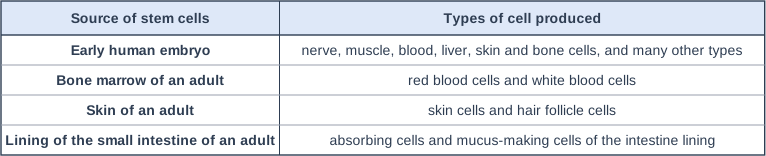
Scientists grew stem cells from four sources in a laboratory. They recorded the types of cell that each type of stem cell produced.

The table shows their results.

The scientists concluded: 'Each type of adult stem cell only makes the kinds of cell found in its own tissue, while embryonic stem cells are able to make every kind of cell.'

Evaluate how well the data support this conclusion.

Table with columns "Source of stem cells", "Types of cell produced". Source of stem cells: Early human embryo; Types of cell produced: nerve, muscle, blood, liver, skin and bone cells, and many other types | Source of stem cells: Bone marrow of an adult; Types of cell produced: red blood cells and white blood cells | Source of stem cells: Skin of an adult; Types of cell produced: skin cells and hair follicle cells | Source of stem cells: Lining of the small intestine of an adult; Types of cell produced: absorbing cells and mucus-making cells of the intestine lining.

Model answer

The data support the conclusion. Each type of adult stem cell produced only the cells of its own tissue: the bone marrow stem cells made only red and white blood cells, the skin stem cells only skin and hair follicle cells, and the intestine stem cells only the cells of the intestine lining. The stem cells from the early embryo produced many different types, including nerve, muscle, blood, liver, skin and bone cells.
However, only three adult tissues were tested, so this may not be true for all adult stem cells, and the table does not show that the embryonic stem cells produced every type of cell. The cells were also grown in a laboratory, where they may not behave as they do in the body. So the data support the conclusion but do not prove it.

Explanation

Evaluate means weighing up evidence for and against. Use the table to show the pattern (adult stem cells limited to their own tissue's cells, embryonic stem cells producing many types), then give limitations: a small number of sources, 'any type' not shown, laboratory conditions.

Mark scheme
  1. 1 mark

    support (adult): each adult source produced only cells of its own tissue, for example skin stem cells produced only skin and hair follicle cells / bone marrow stem cells produced only (red and white) blood cells

    max 3. Max 2 if no data from the table are used. Max 2 if the answer gives only one side (only support or only limitations).

  2. 1 mark

    support (embryonic): stem cells from the early embryo produced many different types of cell (nerve, muscle, blood, liver, skin and bone cells)

    ALLOW embryonic stem cells produced far more types than any adult source.

  3. 1 mark

    limitation: only three adult tissues / sources were tested, so the conclusion may not be true for all adult stem cells

    ALLOW only one type of embryo / one study, so the results need repeating.

  4. 1 mark

    limitation: the table does not show that embryonic stem cells produced every type of cell, so 'any type' is not fully supported

    ALLOW 'many other types' is not the same as all types.

  5. 1 mark

    limitation: stem cells grown in a laboratory might behave differently from stem cells in the body

    ALLOW the conditions in the laboratory might affect which cells are produced.

Question 4

4 marks

An adult man has about 2.5 × 10¹³ red blood cells. Each red blood cell lives for about 120 days and is then destroyed. Red blood cells cannot divide.

Calculate how many new red blood cells his body must make each second to keep the number of red blood cells the same.

Give your answer to 2 significant figures.

Explain how the new red blood cells are produced.

Model answer

Lifetime = 120 × 24 × 60 × 60 = 10 368 000 s
New cells needed each second = 2.5 × 10¹³ ÷ 10 368 000 = 2 411 265
= 2.4 × 10⁶ red blood cells per second (2 sf)
Adult stem cells in the bone marrow divide by mitosis, and the new cells differentiate into red blood cells, replacing the ones that are destroyed.

Explanation

If every cell is replaced once in 120 days, the whole population must be made again in that time, so divide the number of cells by the lifetime in seconds. Common errors are leaving the time in days (giving cells per day) or rounding wrongly. Red blood cells have no nucleus and cannot divide, so adult stem cells in bone marrow must replace them.

Mark scheme
  1. 1 mark

    lifetime in seconds: 120 × 24 × 60 × 60 = 10 368 000 s / 1.0368 × 10⁷ s; or a correct final answer of 2.4 × 10⁶ with no working

    An answer of 2.4 × 10⁶ (2 400 000) with no working scores marking points 1, 2 and 3. ALLOW the conversion done at the end, for example 2.5 × 10¹³ ÷ 120 = 2.08 × 10¹¹ per day, then ÷ 86 400. ALLOW 1 mark for 2.1 × 10¹¹ (cells per day: time not converted to seconds).

  2. 1 mark

    division: 2.5 × 10¹³ ÷ 1.0368 × 10⁷ = 2 411 265 / 2.41 × 10⁶; or a correct final answer of 2.4 × 10⁶ with no working

    ALLOW 2 410 000 / 2.411 × 10⁶ for this mark. ALLOW ECF from a wrong number of seconds in marking point 1.

  3. 1 mark

    evaluation: 2.4 × 10⁶ (red blood cells per second) to 2 significant figures

    ALLOW 2 400 000. ALLOW 2.4E6 or 2.4 times 10 to the power 6. ALLOW ECF for the significant-figure mark from a valid calculation.

  4. 1 mark

    (adult) stem cells in the bone marrow divide (by mitosis) and the new cells differentiate into red blood cells

    Both bone marrow (or adult) stem cells and division or differentiation are needed. DO NOT ALLOW red blood cells divide / embryonic stem cells.

Ready to try the rest? Every answer you write is marked against the mark scheme, so you can see exactly where the marks are.

Study Helper Hints first, answers after you try

Stuck on this one? Ask for a hint and I’ll point you in the right direction, without giving the answer away. Once you’ve checked your answer, I’ll show you how the marks are awarded.