
Level:
Correct: 0
Incorrect: 0
Marks: 0/0
Exam Practice
Course:
Topics:
OCR GCSE Biology (Paper 3) Smart practice A mixed round aimed at your weak spots
Avg
score:
–
Topics
done:
0/29

The endocrine system, thyroxine and adrenaline

Practise 15 exam-style questions on The endocrine system, thyroxine and adrenaline for OCR GCSE Biology (Paper 3). Write your answer as you would in the exam and get it marked in seconds against the mark scheme, point by point, with the Study Helper on hand if you get stuck.

  • 15 questions
  • 1–6 marks each
  • Instant marking
  • No sign-up needed
15 questions, marked as you go

Sample questions with model answers

Here are 4 of the questions in this topic, each with a model answer, an explanation of why it earns the marks and the mark scheme an examiner would use.

Question 1

1 mark

Thyroxine is released by the thyroid gland and carried in the blood to cells in almost every part of the body.

What is the main effect of thyroxine on these cells?

Choose your answer.

  • A It converts glucose to glycogen.
  • B It increases the metabolic rate.
  • C It narrows the air passages.
  • D It stimulates the release of TSH.

Model answer

B

Explanation

Thyroxine controls the metabolic rate: how fast the chemical reactions in cells, including respiration, take place. Option D is the reverse of what happens: thyroxine reduces the release of TSH, which is how negative feedback keeps the thyroxine concentration steady.

Mark scheme
  1. 1 mark

    B / It increases the metabolic rate.

    The only correct answer is B: thyroxine increases the metabolic rate, the rate of the chemical reactions (such as respiration) in the cells. A is not correct because converting glucose to glycogen is an effect of insulin on liver and muscle cells. C is not correct because thyroxine does not narrow the air passages (adrenaline widens them). D is not correct because a high thyroxine concentration inhibits the release of TSH by the pituitary gland (negative feedback). ALLOW the letter or the option. If more than one option is given, do not award the mark.
Question 2

2 marks

A student compares the two ways in which messages are sent around the body.

'Hormones are like a message broadcast on the radio. Nerve impulses are like a phone call to one person.'

Explain the student's comparison.

Model answer

A hormone is released into the blood and carried to almost every part of the body, like a radio broadcast that reaches every radio. But only target cells that have receptors for that hormone respond, like only the radios tuned to the station. A nerve impulse travels along particular neurones to one specific effector, like a phone call that reaches one person.

Explanation

The comparison is about targeting. Hormones reach almost every cell but act only where there are matching receptors; nerve impulses go along a fixed pathway to one destination. A common weakness is to say only that hormones are slower, which does not explain the comparison.

Mark scheme
  1. 1 mark

    hormones are released into the blood and carried to (almost) all parts of the body / all cells (like a broadcast that reaches every radio)

    max 2. ALLOW hormones are transported in the blood plasma everywhere.

  2. 1 mark

    only (target) cells that have receptors for the hormone respond (like radios tuned in to the station)

    ALLOW only target organs / cells with the right receptors are affected. IGNORE just 'hormones act on target organs' without receptors or the idea that other cells do not respond.

  3. 1 mark

    nerve impulses travel along neurones to one particular place / specific effector (like a call to one person)

    ALLOW a nerve impulse is sent along a set pathway to a specific muscle or gland. IGNORE nerve impulses are fast.

Question 3

3 marks

A driver sees a child run into the road. Within 0.7 seconds she has pressed the brake pedal and the car stops safely.

About 20 seconds later her heart is beating very fast. Her heart rate stays high for several minutes after the car has stopped.

Explain why the heart rate response starts later and lasts longer than the braking response.

Model answer

Braking is a nervous response: nerve impulses travel very quickly along neurones to the leg muscles, so it happens in under a second. The fast heart rate is caused by adrenaline, a hormone released by the adrenal glands into the blood. It takes time to be released and carried in the blood to the heart, so the response starts later. Adrenaline stays in the blood until it is broken down, so it keeps acting on the heart and the effect lasts for minutes.

Explanation

Nervous and hormonal coordination differ in speed and duration because of how the message travels: impulses along neurones are fast and short-lived, while hormones carried in the blood act more slowly and for longer. A good answer explains both the late start and the long duration, not only one of them.

Mark scheme
  1. 1 mark

    braking is controlled by the nervous system / nerve impulses travel (very) quickly along neurones (to the leg muscles)

    max 3. ALLOW electrical impulses. ALLOW it is a fast nervous response. IGNORE 'reflex' unless linked to neurones.

  2. 1 mark

    the fast heart rate is caused by adrenaline / a hormone released (by the adrenal glands) into the blood

    ALLOW endocrine system / hormonal response. DO NOT ALLOW adrenaline carried along nerves.

  3. 1 mark

    it takes time for the adrenaline to be released and carried in the blood to the heart, so the response starts later

    ALLOW transport in the blood is slower than nerve impulses.

  4. 1 mark

    adrenaline stays in the blood (until it is broken down), so it keeps acting on the heart / the effect lasts longer

    ALLOW hormones have longer-lasting effects. ALLOW nerve impulses stop as soon as the stimulus is removed / are short-lived. ORA (allow the reverse argument).

Question 4

5 marks

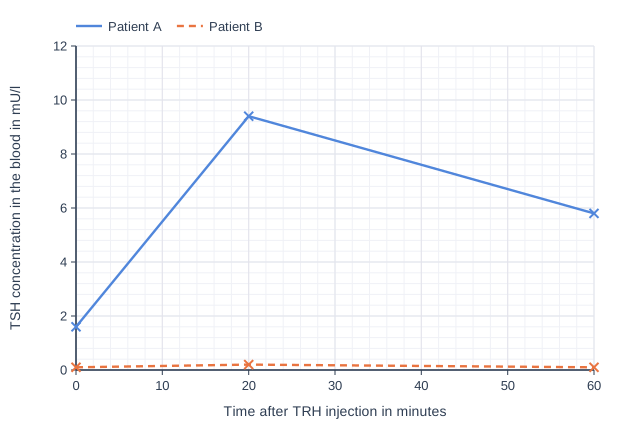
Doctors can test how the pituitary gland responds to TRH. A patient is injected with TRH at 0 minutes and the concentration of TSH in the blood is measured at 0, 20 and 60 minutes.

The graph shows the results for two patients. Patient A has a normal thyroid gland. Patient B has an overactive thyroid gland, which releases much more thyroxine than normal.

Calculate the mean rate of increase in the TSH concentration of patient A between 0 and 20 minutes. Give your answer in mU/l per minute.

Explain why the TSH concentration of patient B hardly changes after the TRH injection.

Line graph of TSH concentration in the blood in mU/l (y-axis, 0 to 12) against Time after TRH injection in minutes (x-axis, 0 to 60). "Patient A" joins the points (0, 1.6), (20, 9.4), (60, 5.8). "Patient B" (dashed) joins the points (0, 0.1), (20, 0.2), (60, 0.1).

Model answer

Mean rate of increase = (9.4 − 1.6) ÷ 20 = 7.8 ÷ 20 = 0.39 mU/l per minute.

TRH normally stimulates the pituitary gland to release TSH, which is why patient A's TSH rises. Patient B's overactive thyroid gland makes the thyroxine concentration very high. High thyroxine inhibits the release of TSH by the pituitary gland, so it hardly responds to the TRH. This is negative feedback: high thyroxine keeps TSH low so that the thyroid gland is stimulated less.

Explanation

For the rate, subtract the starting concentration from the concentration at 20 minutes and divide by the 20 minutes taken; dividing 9.4 by 20 forgets the starting value. For the explanation, link patient B's high thyroxine to inhibition of the pituitary gland. Mixing up which gland releases TRH and which releases TSH is the most common error.

Mark scheme
  1. 1 mark

    (9.4 − 1.6) ÷ 20 / 7.8 ÷ 20; or a correct final answer of 0.39 mU/l per minute (or any answer from 0.38 to 0.40 mU/l per minute) with no working

    An answer of 0.39 mU/l per minute (or any answer from 0.38 to 0.40 mU/l per minute) with no working scores marking points 1 and 2. ALLOW 0.38 to 0.40 from readings of 9.3 to 9.5 and 1.5 to 1.7. 9.4 ÷ 20 = 0.47 (no subtraction of the starting value) scores 0 for points 1 and 2.

  2. 1 mark

    evaluation: 0.39 (mU/l per minute)

    ALLOW 0.4. IGNORE units unless the question asks for them.

  3. 1 mark

    TRH (normally) stimulates the pituitary gland to release TSH (as in patient A)

    DO NOT ALLOW TRH stimulates the thyroid gland.

  4. 1 mark

    patient B has a high concentration of thyroxine (in the blood), which inhibits the release of TSH by the pituitary gland

    ALLOW thyroxine stops the pituitary gland responding to TRH. DO NOT ALLOW thyroxine inhibits the thyroid gland releasing TSH (contradiction).

  5. 1 mark

    negative feedback: with less TSH the thyroid gland is stimulated less, so (normally) less thyroxine is released / the thyroxine concentration falls back towards normal

    ALLOW the body keeps TSH low to try to bring the thyroxine concentration back down. ALLOW 1 mark for 'negative feedback' named on its own if no other explanation mark is awarded.

Ready to try the rest? Every answer you write is marked against the mark scheme, so you can see exactly where the marks are.

Study Helper Hints first, answers after you try

Stuck on this one? Ask for a hint and I’ll point you in the right direction, without giving the answer away. Once you’ve checked your answer, I’ll show you how the marks are awarded.