
Level:
Correct: 0
Incorrect: 0
Marks: 0/0
Exam Practice
Course:
Topics:
OCR GCSE Biology (Paper 3) Smart practice A mixed round aimed at your weak spots
Avg
score:
–
Topics
done:
0/29

Making and breaking down carbohydrates, proteins and lipids

Practise 16 exam-style questions on Making and breaking down carbohydrates, proteins and lipids for OCR GCSE Biology (Paper 3). Write your answer as you would in the exam and get it marked in seconds against the mark scheme, point by point, with the Study Helper on hand if you get stuck.

  • 16 questions
  • 1–6 marks each
  • Instant marking
  • No sign-up needed
16 questions, marked as you go

Sample questions with model answers

Here are 4 of the questions in this topic, each with a model answer, an explanation of why it earns the marks and the mark scheme an examiner would use.

Question 1

1 mark

A triglyceride is a type of lipid. Each triglyceride molecule is made from one glycerol molecule and three fatty acid molecules.

A sunflower seed stores about 2.0 × 10¹⁹ triglyceride molecules. When the seed germinates, all of these molecules are broken down.

How many fatty acid molecules are released?

Choose your answer.

  • A 6.7 × 10¹⁸
  • B 2.0 × 10¹⁹
  • C 6.0 × 10¹⁹
  • D 8.0 × 10¹⁹

Model answer

C

Explanation

Each triglyceride is broken down into one glycerol and three fatty acids, so the number of fatty acids is three times the number of triglycerides: 3 × 2.0 × 10¹⁹ = 6.0 × 10¹⁹. Only the fatty acids are counted, so the glycerol molecules must not be added in.

Mark scheme
  1. 1 mark

    C / 6.0 × 10¹⁹

    The only correct answer is C: each triglyceride releases three fatty acids, so 3 × 2.0 × 10¹⁹ = 6.0 × 10¹⁹. A is not correct because it divides by 3 instead of multiplying by 3; B is not correct because it is the number of triglyceride molecules (and of glycerol molecules); D is not correct because it also counts the glycerol molecules (4 molecules from each triglyceride). ALLOW the letter or the option. If more than one option is given, do not award the mark.
Question 2

2 marks

Garden warblers are small birds that breed in the UK and fly to Africa for the winter. Before they leave, they feed mainly on berries, which contain sugars but very little lipid. In a few weeks, a warbler's body mass can rise from about 17 g to about 25 g, mostly as stored lipid. Cells in the bird's liver make fatty acids and glycerol from the sugars.

In respiration, 1 g of lipid releases about 39 kJ of energy and 1 g of carbohydrate releases about 17 kJ.

Explain how the warbler builds up its store of lipid, and suggest why storing lipid rather than carbohydrate helps the warbler on its long flight.

Model answer

Enzymes in the bird's cells join fatty acids and glycerol together, three fatty acids to each glycerol, to make lipid molecules, which are stored. Each gram of lipid releases about 39 kJ in respiration, more than twice as much as a gram of carbohydrate (17 kJ), so the warbler can carry enough stored energy for its long flight with much less extra mass.

Explanation

Lipids are made by joining glycerol and fatty acids; they are not polymers, because they are not long chains of repeating monomers. The data show that lipid stores more energy per gram, which matters for an animal that has to carry its store while flying. Saying only that lipid 'gives more energy' does not use the information about mass.

Mark scheme
  1. 1 mark

    (enzymes) join fatty acids and glycerol together to make lipid (molecules) / three fatty acids are joined to one glycerol

    ALLOW triglycerides are made from glycerol and fatty acids. DO NOT ALLOW lipid is a polymer of fatty acids / fatty acids are joined into a long chain. IGNORE sugars are turned into fat (unqualified).

  2. 1 mark

    each gram of lipid releases more than twice as much energy as carbohydrate (39 ÷ 17 = about 2.3 times), so the bird carries less mass for the same amount of stored energy

    The answer must link the energy per gram to the mass the bird carries. ALLOW a lighter store holds enough energy for the flight. IGNORE lipid gives more energy (unqualified).

Question 3

3 marks

Scientists gave a volunteer a drink containing amino acids made with a heavy form of nitrogen that can be detected.

Over the next two days, the heavy nitrogen was found in proteins in the volunteer's muscle cells and in enzymes in their liver cells.

Explain these observations.

Model answer

The amino acids were absorbed into the blood and carried to the muscle and liver cells. In the cells, the amino acid monomers were joined together (at the ribosomes, by enzymes) to make new protein polymers. Enzymes are proteins, so the liver enzymes also contained the heavy nitrogen. This shows that the body is always breaking down old proteins and building new ones.

Explanation

Amino acids are the monomers of proteins, so labelled amino acids end up in any new protein the cells make, including enzymes. Finding the label so quickly shows that proteins are being made and replaced all the time. A common error is to say the amino acids are broken down to make proteins: they are joined together.

Mark scheme
  1. 1 mark

    the (labelled) amino acids are absorbed into the blood and carried to the (muscle and liver) cells

    Max 3 from the four marking points. ALLOW amino acids diffuse / are taken into the cells from the blood. IGNORE digested (amino acids are already monomers).

  2. 1 mark

    in the cells, (enzymes join) the amino acids (monomers) together to make new proteins (polymers)

    ALLOW proteins are synthesised from amino acids. ALLOW amino acids joined in chains (at the ribosomes). DO NOT ALLOW amino acids broken down to make proteins.

  3. 1 mark

    enzymes are proteins (so they are also made from the amino acids)

    ALLOW muscle proteins and enzymes are both made of amino acids.

  4. 1 mark

    (body) proteins are continually broken down and replaced / new proteins are made all the time

    ALLOW old proteins are broken down into amino acids and rebuilt. ALLOW new proteins are made for growth or repair.

Question 4

5 marks

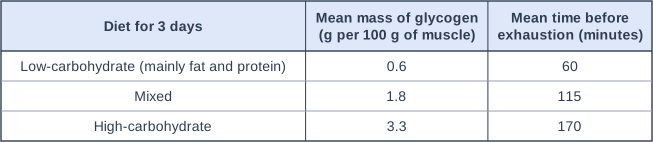
A group of trained runners followed three different diets, each for 3 days. After each diet, a scientist measured the mass of glycogen in their thigh muscles and timed how long they could run on a treadmill at a fixed fast speed before exhaustion.

The table shows the mean results.

Calculate the percentage increase in the mean time before exhaustion when the runners changed from the mixed diet to the high-carbohydrate diet. Give your answer to 2 significant figures.

Explain why the high-carbohydrate diet increased the time before exhaustion. Use data from the table and ideas about the synthesis and breakdown of carbohydrates.

Table with columns "Diet for 3 days", "Mean mass of glycogen (g per 100 g of muscle)", "Mean time before exhaustion (minutes)". Diet for 3 days: Low-carbohydrate (mainly fat and protein); Mean mass of glycogen (g per 100 g of muscle): 0.6; Mean time before exhaustion (minutes): 60 | Diet for 3 days: Mixed; Mean mass of glycogen (g per 100 g of muscle): 1.8; Mean time before exhaustion (minutes): 115 | Diet for 3 days: High-carbohydrate; Mean mass of glycogen (g per 100 g of muscle): 3.3; Mean time before exhaustion (minutes): 170.

Model answer

percentage increase = (170 − 115) ÷ 115 × 100 = 55 ÷ 115 × 100 = 47.8 % = 48 % (2 significant figures)

On the high-carbohydrate diet, more starch is eaten and digested into glucose. Enzymes in the muscle cells join the glucose monomers together to make the polymer glycogen, so the muscles stored 3.3 g of glycogen per 100 g, compared with 1.8 g after the mixed diet. During running the glycogen is broken back down into glucose, which is used in respiration to release energy for muscle contraction. With a larger glycogen store, glucose is available for longer, so the runners could keep going for 170 minutes instead of 115 minutes.

Explanation

For the percentage increase, divide the increase (55 minutes) by the starting value for the mixed diet (115 minutes), not by the final value. The explanation must link glycogen to both synthesis (glucose monomers joined into a polymer) and breakdown (glycogen back to glucose for respiration). Quote the glycogen data to show the link between the size of the store and the time to exhaustion.

Mark scheme
  1. 1 mark

    (170 − 115) ÷ 115 × 100 / 55 ÷ 115 × 100; or a correct final answer of 48 % with no working

    An answer of 48 % with no working scores marking points 1 and 2. ALLOW 1 mark for 47.8 % / 47.83 % (correct value not given to 2 significant figures). ALLOW 1 mark for 55 ÷ 115 shown. 55 ÷ 170 × 100 = 32 % (wrong base) scores 0 for the calculation. Marking points 3 to 6: 1 mark each, max 3.

  2. 1 mark

    evaluation: 48 (%)

    IGNORE units. ALLOW ECF for the significant-figure mark from a valid calculation with a slip.

  3. 1 mark

    the carbohydrate (starch) eaten is broken down / digested into sugars / glucose (which are absorbed)

    ALLOW carbohydrases / amylase break down starch into glucose.

  4. 1 mark

    glucose monomers are joined together (by enzymes) to make glycogen, a polymer, so more glycogen is stored in the muscles

    Data are not needed for this mark, but credit the point when it is made with data, for example 3.3 g of glycogen per 100 g of muscle compared with 1.8 g (mixed) or 0.6 g (low-carbohydrate). The idea of glucose being joined to make glycogen is needed; a data quote alone scores 0 for this mark.

  5. 1 mark

    during exercise the glycogen is broken down into glucose

    ALLOW glycogen converted back to glucose (in the muscle cells).

  6. 1 mark

    glucose is used in (aerobic) respiration to release energy for muscle contraction, so (with a larger store) exhaustion is delayed

    ALLOW respiration provides ATP for the muscles. DO NOT ALLOW energy is made / produced. ALLOW the glycogen store takes longer to run out.

Ready to try the rest? Every answer you write is marked against the mark scheme, so you can see exactly where the marks are.

Study Helper Hints first, answers after you try

Stuck on this one? Ask for a hint and I’ll point you in the right direction, without giving the answer away. Once you’ve checked your answer, I’ll show you how the marks are awarded.