Level:
Correct: 0
Incorrect: 0
Marks: 0/0
Exam Practice
Course:
Topics:
OCR GCSE Biology (Paper 3) Smart practice A mixed round aimed at your weak spots
Avg
score:
–
Topics
done:
0/29

Plant hormones and their uses

Practise 15 exam-style questions on Plant hormones and their uses for OCR GCSE Biology (Paper 3). Write your answer as you would in the exam and get it marked in seconds against the mark scheme, point by point, with the Study Helper on hand if you get stuck.

  • 15 questions
  • 1–6 marks each
  • Instant marking
  • No sign-up needed
15 questions, marked as you go

Sample questions with model answers

Here are 4 of the questions in this topic, each with a model answer, an explanation of why it earns the marks and the mark scheme an examiner would use.

Question 1

1 mark

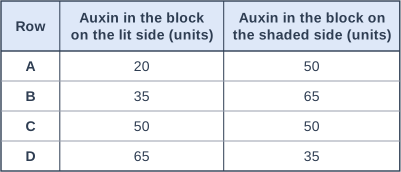
Auxin is made in the tip of a shoot. Scientists cut the tips off some shoots. They stood each tip across two small blocks of agar, separated by a thin barrier, so that auxin moving down one side of the tip collected in one block and auxin moving down the other side collected in the other block.

Tips kept in the dark gave 50 units of auxin in each block, 100 units in total. The scientists then lit some tips from one side only.

The table shows four possible results for the tips lit from one side.

Which row would support the hypothesis that light from one side makes auxin move to the shaded side, rather than destroying auxin on the lit side?

Choose your answer.

  • A row A
  • B row B
  • C row C
  • D row D
Table with columns "Row", "Auxin in the block on the lit side (units)", "Auxin in the block on the shaded side (units)". Row: A; Auxin in the block on the lit side (units): 20; Auxin in the block on the shaded side (units): 50 | Row: B; Auxin in the block on the lit side (units): 35; Auxin in the block on the shaded side (units): 65 | Row: C; Auxin in the block on the lit side (units): 50; Auxin in the block on the shaded side (units): 50 | Row: D; Auxin in the block on the lit side (units): 65; Auxin in the block on the shaded side (units): 35.

Model answer

B

Explanation

If light only moved auxin to the shaded side, the total would stay at 100 units but be shared unequally, with more on the shaded side. If light destroyed auxin, the total would fall. Results like row B are what scientists found, which is why phototropism is explained by the unequal distribution of auxin.

Mark scheme
  1. 1 mark

    B / row B

    The only correct answer is B: the total is still 100 units, the same as in the dark, so no auxin has been destroyed, but the shaded side now has more auxin (65 units) than the lit side (35 units), so auxin has moved from the lit side to the shaded side. A is not correct because the total has fallen to 70 units, with less auxin only on the lit side, which would support the idea that light destroys auxin; C is not correct because the auxin is still shared equally between the two sides; D is not correct because more auxin is on the lit side, which would make the shoot bend away from the light. ALLOW the letter or the row. If more than one option is given, do not award the mark.
Question 2

2 marks

A seedling is grown in a dark room with a lamp on each side of it. The lamp on the left is much brighter than the lamp on the right.

Predict the direction in which the shoot will bend. Explain your prediction.

Model answer

The shoot bends towards the left, towards the brighter lamp. The right side of the shoot receives less light, so more auxin moves to the right side. Auxin makes shoot cells elongate, so the cells on the right side elongate more than those on the left and the shoot curves towards the left.

Explanation

A shoot responds to the difference in light between its two sides, not just to whether light is present. Auxin moves to the less well-lit side, where it causes more cell elongation, so the shoot bends towards the brighter light. A common error is to say that auxin collects on the lit side.

Mark scheme
  1. 1 mark

    (it bends) towards the left / towards the brighter lamp

    IGNORE upwards. DO NOT ALLOW towards the right / it grows straight (the mark for the explanation can still be awarded if it is correct).

  2. 1 mark

    more auxin moves to / collects on the right side (the side that receives less light), so the cells on the right side elongate more than the cells on the left side

    Both the unequal auxin and the greater cell elongation on the right side are needed. ALLOW the less brightly lit / darker / shaded side for the right side. DO NOT ALLOW light destroys the auxin on the left side. DO NOT ALLOW auxin moves towards the light / cells on the left side grow faster.

Question 3

3 marks

A lawn weedkiller contains a synthetic auxin. It kills daisies, dandelions and other broad-leaved weeds in a lawn without harming the grass.

The label says: 'Do not use the grass cuttings from the first four mowings after treatment as a mulch around vegetable plants such as tomatoes and beans.'

Explain the reason for this instruction.

Model answer

The grass takes in some of the weedkiller, so cuttings from the first few mowings still contain the synthetic auxin. Tomatoes and beans are broad-leaved plants, so, unlike grass, they are affected by it. If the cuttings were used as mulch, the auxin would make the vegetables grow rapidly and uncontrollably, so they would be damaged or killed. After four mowings most of the weedkiller has gone, so later cuttings are safe.

Explanation

Selective weedkillers contain synthetic auxins that cause uncontrolled growth in broad-leaved plants but have little effect on grasses. The instruction protects other broad-leaved plants, such as vegetables, from the weedkiller left in the grass. Answers that only say 'the weedkiller is poisonous' miss the point about broad-leaved plants and growth.

Mark scheme
  1. 1 mark

    the grass cuttings (from the first mowings) still contain the weedkiller / synthetic auxin

    1 mark for each point, max 3. ALLOW the grass has absorbed the weedkiller and it is still in the cuttings.

  2. 1 mark

    tomatoes and beans are broad-leaved plants, so they are affected by the weedkiller (unlike the grass)

    ALLOW the vegetables are not grasses, so the auxin acts on them.

  3. 1 mark

    the auxin would cause rapid / uncontrolled growth of the vegetables, so they would be damaged or killed / give a smaller crop

    ALLOW twisted / distorted growth of their stems and leaves. IGNORE 'the weedkiller would kill them' unless the effect on their growth is described.

  4. 1 mark

    after four mowings (most of) the weedkiller has been broken down / removed, so later cuttings are safe to use

    ALLOW the amount of weedkiller in the cuttings falls with each mowing.

Question 4

4 marks

In winter, there are few pollinating insects in a courgette glasshouse, so many flowers are not pollinated and do not develop into fruit.

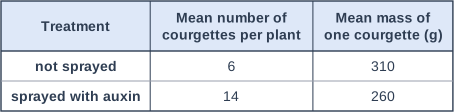
A grower sprayed the flowers of some courgette plants with an auxin solution. The table shows the results.

Calculate the percentage increase in the mean mass of courgettes produced by each plant when the flowers were sprayed. Give your answer to 2 significant figures.

The courgettes from the sprayed flowers had no seeds. Explain why.

Table with columns "Treatment", "Mean number of courgettes per plant", "Mean mass of one courgette (g)". Treatment: not sprayed; Mean number of courgettes per plant: 6; Mean mass of one courgette (g): 310 | Treatment: sprayed with auxin; Mean number of courgettes per plant: 14; Mean mass of one courgette (g): 260.

Model answer

Not sprayed: 6 × 310 = 1860 g per plant
Sprayed: 14 × 260 = 3640 g per plant
Increase = 3640 − 1860 = 1780 g
Percentage increase = 1780 ÷ 1860 × 100 = 95.70 = 96% (2 s.f.)

The flowers were not pollinated, so their egg cells were not fertilised. The auxin made the fruit develop without fertilisation, so no seeds formed inside the courgettes.

Explanation

First find the total mass per plant for each treatment (number × mean mass), then the percentage increase = increase ÷ original × 100. Comparing only the numbers of fruit ignores the smaller mass of each sprayed courgette, and dividing by the sprayed value uses the wrong starting point. Seeds form only from fertilised egg cells, so fruit made by spraying unpollinated flowers is seedless (parthenocarpic).

Mark scheme
  1. 1 mark

    mass of courgettes per plant: 6 × 310 = 1860 (g) and 14 × 260 = 3640 (g); or a correct final answer of 96% with no working

    An answer of 96% with no working scores marking points 1, 2 and 3. ALLOW 2 marks for 95.7% / 95.70% (not given to 2 significant figures). ALLOW ECF for the significant-figure mark from a valid calculation. An answer of 49% (dividing by the mass from the sprayed plants) scores marking point 1 only. An answer of 196% (the sprayed mass as a percentage of the unsprayed mass) scores marking point 1 only. An answer of 130% (comparing only the numbers of courgettes) scores 0 for the calculation.

  2. 1 mark

    (3640 − 1860) ÷ 1860 × 100 / 1780 ÷ 1860 × 100 (= 95.70); or a correct final answer of 96% with no working

    ALLOW (3640 ÷ 1860 × 100) − 100. ALLOW ECF from wrong totals if the percentage-increase method is correct.

  3. 1 mark

    96 (%) (to 2 significant figures)

    IGNORE units.

  4. 1 mark

    the egg cells / ovules in the flowers were not fertilised (the auxin made the fruit develop without pollination and fertilisation), so no seeds formed

    ALLOW no fertilisation took place, so no seeds developed. ALLOW the fruit developed without fertilisation / parthenocarpic fruit. DO NOT ALLOW the auxin killed / destroyed the seeds.

Ready to try the rest? Every answer you write is marked against the mark scheme, so you can see exactly where the marks are.

Study Helper Hints first, answers after you try

Stuck on this one? Ask for a hint and I’ll point you in the right direction, without giving the answer away. Once you’ve checked your answer, I’ll show you how the marks are awarded.