
Level:
Correct: 0
Incorrect: 0
Marks: 0/0
Exam Practice
Course:
Topics:
OCR GCSE Biology (Paper 3) Smart practice A mixed round aimed at your weak spots
Avg
score:
–
Topics
done:
0/29

Contraception and infertility treatment

Practise 16 exam-style questions on Contraception and infertility treatment for OCR GCSE Biology (Paper 3). Write your answer as you would in the exam and get it marked in seconds against the mark scheme, point by point, with the Study Helper on hand if you get stuck.

  • 16 questions
  • 1–6 marks each
  • Instant marking
  • No sign-up needed
16 questions, marked as you go

Sample questions with model answers

Here are 4 of the questions in this topic, each with a model answer, an explanation of why it earns the marks and the mark scheme an examiner would use.

Question 1

1 mark

Estimates for women in the USA (Trussell, Contraceptive Technology, 2011) show that 85 out of every 100 women who use no contraception become pregnant within one year.

With typical use of male condoms, 18 out of every 100 women become pregnant within one year.

By what percentage does using condoms reduce the number of pregnancies, compared with using no contraception?

Choose your answer.

  • A 18 %
  • B 67 %
  • C 79 %
  • D 82 %

Model answer

C

Explanation

A percentage reduction compares the change with the starting value: (85 − 18) ÷ 85 × 100 = 79 %. The common errors are to give the change itself (67) or to use the effectiveness figure (82 %), which compares with 100 women, not with 85 pregnancies.

Mark scheme
  1. 1 mark

    C / 79 %

    The only correct answer is C: (85 − 18) ÷ 85 × 100 = 78.8 %, which is 79 %. A is not correct because 18 % is the percentage of condom users who became pregnant. B is not correct because 67 is the difference in the number of pregnancies (85 − 18), not a percentage of 85. D is not correct because 82 % (100 − 18) is the percentage of condom users who did not become pregnant. ALLOW the letter or the option. If more than one option is given, do not award the mark.
Question 2

2 marks

Some medicines used to treat epilepsy make liver cells produce more of the enzymes that break down the hormones in the combined contraceptive pill.

A woman who takes one of these medicines is advised to use a copper IUD instead of the combined pill. A copper IUD is a small device placed in the uterus. It contains no hormones.

Explain why the combined pill may not protect her from pregnancy, and why a copper IUD is suitable for her.

Model answer

The extra liver enzymes break down the oestrogen and progesterone from the pill faster, so their concentration in her blood may be too low to inhibit the release of FSH and LH. An egg could then mature and be released, so she could become pregnant. A copper IUD contains no hormones and works inside the uterus, so the liver enzymes do not affect it and it keeps working.

Explanation

Hormonal contraceptives only work while the hormone concentration in the blood stays high enough to stop FSH and LH being released. Anything that removes the hormones faster, such as extra liver enzymes, makes the pill less reliable, so a method that does not depend on hormones is a safer choice. Answers need to link the lower concentration to the effect on FSH, LH and ovulation.

Mark scheme
  1. 1 mark

    the hormones (oestrogen and progesterone) from the pill are broken down faster, so their concentration in the blood may be too low to inhibit FSH and LH / to stop eggs maturing and being released (ovulation)

    ALLOW the hormone concentration may be too low to keep the mucus in the cervix thick. DO NOT ALLOW the medicine breaks down the FSH and LH. IGNORE the pill does not work (unqualified).

  2. 1 mark

    the copper IUD does not depend on hormones (it works in the uterus), so the extra liver enzymes do not change how well it works

    ALLOW there are no hormones for the liver enzymes to break down.

Question 3

3 marks

Some women use their body temperature as a natural method of family planning. After ovulation, progesterone causes the body temperature measured each morning to rise by about 0.3 °C. It stays higher until the next period. Sperm can survive for up to 5 days inside a woman's body.

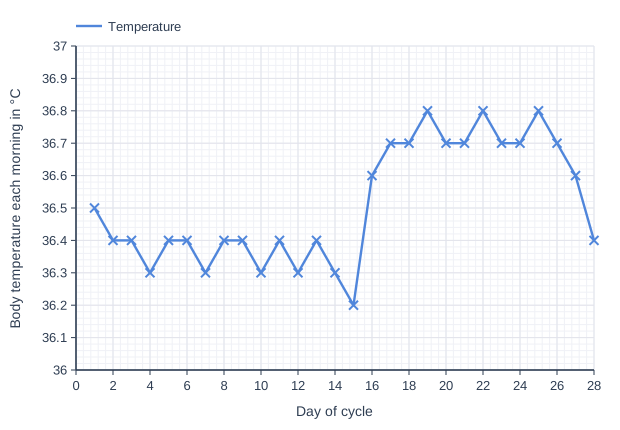
The graph shows one woman's temperature, measured each morning, during one cycle. Day 1 is the first day of her period.

Suggest the day on which she ovulated.

Explain why this method can show that ovulation has happened, but cannot be used on its own to find the days early in the cycle when intercourse could lead to pregnancy.

Line graph of body temperature each morning in °C (y-axis, 36 to 37) against day of cycle (x-axis, 0 to 28). "Temperature" joins the points (1, 36.5), (2, 36.4), (3, 36.4), (4, 36.3), (5, 36.4), (6, 36.4), (7, 36.3), (8, 36.4), (9, 36.4), (10, 36.3), (11, 36.4), (12, 36.3), (13, 36.4), (14, 36.3), (15, 36.2), (16, 36.6), (17, 36.7), (18, 36.7), (19, 36.8), (20, 36.7), (21, 36.7), (22, 36.8), (23, 36.7), (24, 36.7), (25, 36.8), (26, 36.7), (27, 36.6), (28, 36.4).

Model answer

She probably ovulated on day 15, because her temperature rose on day 16 and stayed about 0.3 °C higher. Progesterone is released after ovulation and raises the temperature, so a lasting rise shows that ovulation has already happened. But the rise comes only after ovulation, so it cannot warn her in advance. Sperm can live for up to 5 days, so intercourse in the days before ovulation, when her temperature is still low, could lead to pregnancy.

Explanation

This non-hormonal method relies on the woman's own progesterone. Its weakness is timing: it confirms ovulation after the event, while the fertile window starts days earlier because sperm survive for several days. This is one reason natural methods are much less effective with typical use than hormonal methods.

Mark scheme
  1. 1 mark

    day 15 (just before the temperature rise that lasts from day 16)

    max 3. Max 2 if no day of ovulation is given. ALLOW day 14 to day 16.

  2. 1 mark

    the rise is caused by progesterone, which is released after ovulation, so a lasting rise shows that ovulation has (already) happened

    ALLOW progesterone is only high after an egg has been released.

  3. 1 mark

    the temperature rises only after ovulation, so it cannot predict in advance when ovulation will happen

    ALLOW by the time the temperature rises, the fertile days have already passed.

  4. 1 mark

    sperm can survive for up to 5 days, so intercourse several days before ovulation (before the rise) can lead to pregnancy

    ALLOW the fertile time starts about 5 days before ovulation.

  5. 1 mark

    the day of ovulation can vary from cycle to cycle / temperature can change for other reasons (such as illness), so past charts are not a reliable guide

    ALLOW cycles can be irregular.

Question 4

4 marks

In some IVF treatments, spare embryos are frozen and stored. Later, an embryo is thawed and placed in the woman's uterus.

To prepare for this, the woman takes oestrogen tablets for about two weeks. She then takes progesterone as well, and the embryo is placed in her uterus a few days later. She is not given FSH.

Explain why the woman is given oestrogen and then progesterone, but is not given FSH.

Model answer

Oestrogen causes the lining of the uterus to be repaired and become thick. Progesterone then maintains the thick lining, so when the embryo is placed in the uterus the lining is ready for it to implant; this copies the order of the natural cycle. FSH is not needed because the embryo already exists, so no eggs need to mature or be collected. The high oestrogen also inhibits her own FSH, so she does not ovulate and the doctors control the timing.

Explanation

Each hormone is chosen for its role in the menstrual cycle: oestrogen builds the lining, progesterone keeps it. FSH is used only when eggs are needed. The best answers also notice that high oestrogen switches off the woman's own FSH, which keeps the timing under control.

Mark scheme
  1. 1 mark

    oestrogen causes the lining of the uterus to be repaired / to thicken

    max 4. DO NOT ALLOW oestrogen maintains the lining (as the only role of oestrogen).

  2. 1 mark

    progesterone maintains the (thick) lining (and stops it breaking down)

    ALLOW progesterone keeps the lining thick / ready.

  3. 1 mark

    so the lining is ready for the embryo to implant (at the time the embryo is placed in the uterus)

    ALLOW the hormones copy the natural order of the menstrual cycle, so the embryo can attach and develop.

  4. 1 mark

    FSH is not needed because the embryo already exists / no eggs need to mature or be collected

    ALLOW FSH makes eggs mature and no eggs are needed.

  5. 1 mark

    the (high) oestrogen inhibits her own FSH, so her own eggs do not mature / she does not ovulate (so the doctors control the timing)

    ALLOW her own cycle is switched off.

Ready to try the rest? Every answer you write is marked against the mark scheme, so you can see exactly where the marks are.

Study Helper Hints first, answers after you try

Stuck on this one? Ask for a hint and I’ll point you in the right direction, without giving the answer away. Once you’ve checked your answer, I’ll show you how the marks are awarded.