
Level:
Correct: 0
Incorrect: 0
Marks: 0/0
Exam Practice
Course:
Topics:
OCR GCSE Biology (Paper 3) Smart practice A mixed round aimed at your weak spots
Avg
score:
–
Topics
done:
0/29

The circulatory system, the heart and the blood

Practise 19 exam-style questions on The circulatory system, the heart and the blood for OCR GCSE Biology (Paper 3). Write your answer as you would in the exam and get it marked in seconds against the mark scheme, point by point, with the Study Helper on hand if you get stuck.

  • 19 questions
  • 1–6 marks each
  • Instant marking
  • No sign-up needed
19 questions, marked as you go

Sample questions with model answers

Here are 4 of the questions in this topic, each with a model answer, an explanation of why it earns the marks and the mark scheme an examiner would use.

Question 1

1 mark

Blood pressure changes as blood flows around the body.

Which blood vessel carries blood at the lowest pressure?

Choose your answer.

  • A aorta
  • B capillary in a leg muscle
  • C pulmonary artery
  • D vena cava

Model answer

D

Explanation

Pressure is highest where the ventricles push blood into the arteries and falls all the way round the circuit, especially as the blood passes through the arterioles and capillaries. This is why veins have thin walls, a wide lumen and valves: the blood in them is at low pressure. A common error is to choose the capillary because it is the narrowest vessel.

Mark scheme
  1. 1 mark

    D / vena cava

    The only correct answer is D: the pressure of the blood falls as it flows away from the heart through the arteries and capillaries, so the blood in the veins, and in the vena cava just before it enters the right atrium, is at the lowest pressure. A is not correct because the aorta receives blood straight from the left ventricle, at the highest pressure; B is not correct because blood in a capillary has not yet reached the veins, so its pressure is higher than in the vena cava; C is not correct because the pulmonary artery receives blood straight from the right ventricle as it contracts. ALLOW the letter or the option. If more than one option is given, do not award the mark.
Question 2

2 marks

When a giraffe stands upright, its head is about 2 m above its heart. When it lowers its head to drink, its head is about 2 m below its heart.

The jugular vein carries blood from the head back to the heart. It contains several valves.

Suggest how these valves help the giraffe when it lowers its head to drink.

Model answer

When the head is below the heart, gravity tends to pull the blood in the jugular vein back down towards the head. The blood in veins is at low pressure, so it could easily flow the wrong way. The valves close if the blood starts to flow backwards, so they stop blood collecting in the head and keep it flowing towards the heart.

Explanation

Veins carry blood at low pressure, so they need valves to keep the blood moving in one direction, towards the heart. The giraffe is an unfamiliar example of the same idea: the valves close when blood starts to flow backwards. A common error is to say that valves pump blood; they only prevent backflow.

Mark scheme
  1. 1 mark

    the valves stop blood flowing backwards / down into the head (when the head is below the heart)

    ALLOW the valves prevent backflow (of blood towards the head). ALLOW stop too much blood collecting in the head / brain. ALLOW the valves make sure blood flows in one direction, towards the heart.

  2. 1 mark

    (because) the blood in the (jugular) vein is at low pressure / gravity pulls the blood back down towards the head (when the head is below the heart)

    ALLOW the blood in veins is far from the pumping of the heart / is not pushed strongly by the heart. DO NOT ALLOW for this mark the valves keep blood flowing in one direction / towards the heart (this repeats marking point 1). IGNORE the valves pump the blood.

Question 3

3 marks

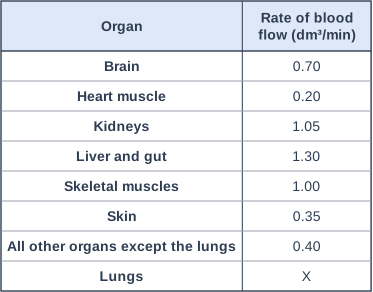
A scientist estimated the rate of blood flow through the organs of a resting adult. The table shows the results.

X is the rate of blood flow through the lungs.

Deduce the value of X. Explain your answer using your knowledge of the human circulatory system.

Table with columns "Organ", "Rate of blood flow (dm³/min)". Organ: Brain; Rate of blood flow (dm³/min): 0.70 | Organ: Heart muscle; Rate of blood flow (dm³/min): 0.20 | Organ: Kidneys; Rate of blood flow (dm³/min): 1.05 | Organ: Liver and gut; Rate of blood flow (dm³/min): 1.30 | Organ: Skeletal muscles; Rate of blood flow (dm³/min): 1.00 | Organ: Skin; Rate of blood flow (dm³/min): 0.35 | Organ: All other organs except the lungs; Rate of blood flow (dm³/min): 0.40 | Organ: Lungs; Rate of blood flow (dm³/min): X.

Model answer

X = 0.70 + 0.20 + 1.05 + 1.30 + 1.00 + 0.35 + 0.40 = 5.0 dm³/min

The blood flow through the lungs is equal to the total blood flow through all the other organs, because humans have a double circulation. Blood from every other organ returns in the veins and the vena cava to the right atrium, and the right ventricle pumps all of it through the pulmonary artery to the lungs. All the blood leaving the lungs returns in the pulmonary veins to the left side of the heart, and the left ventricle pumps it into the aorta, which supplies the other organs. So in each complete circuit the blood passes through the lungs once, and the same volume flows through the lungs each minute as through all the other organs together.

Explanation

The circuit through the lungs and the circuit through the body are joined end to end through the two sides of the heart, so all the blood that leaves the left ventricle for the body organs must pass through the lungs before it can be pumped out again. The lungs therefore receive the whole output of the right ventricle, equal to the total for all the other organs. A common error is to treat the lungs as one more organ that gets a small share of the blood; another is to double the total because blood passes through the heart twice.

Mark scheme
  1. 1 mark

    X = 5.0 (dm³/min) / the total of the blood flows through all the other organs

    An answer of 5.0 dm³/min with no working or explanation scores marking point 1 only. ALLOW 5 / 5.00 (dm³/min) / 5000 cm³/min. DO NOT ALLOW 10 (dm³/min) (the blood does not pass through the lungs twice in each circuit). DO NOT ALLOW a value smaller than 5.0 (the lungs do not receive only a share of the blood).

  2. 2 marks

    explanation, 1 mark for each of the following, max 2:
    • the blood from all the other organs returns (in the veins / vena cava) to the right side of the heart, and the right ventricle pumps all of it to the lungs (in the pulmonary artery)
    • all the blood leaving the lungs returns (in the pulmonary veins) to the left side of the heart, and the left ventricle pumps all of it into the aorta, which supplies the other organs
    • humans have a double circulation: in each complete circuit the blood passes through the lungs once / the two ventricles pump the same volume of blood each minute

    1 mark for each point, max 2. ALLOW the lungs receive all the blood pumped by the right ventricle. IGNORE the lungs need a large blood supply for gas exchange unless linked to the route of the blood. DO NOT ALLOW the blood is shared between the lungs and the other organs. DO NOT ALLOW blood passes through the lungs twice in each circuit.

Question 4

4 marks

A resting adult's heart pumps 5.4 dm³ of blood into the aorta every minute. All of this blood then flows through the capillaries of the body.

The total cross-sectional area of all the capillaries in the body is 3000 cm².

Use the equation:
mean speed of blood = volume of blood flowing per second ÷ total cross-sectional area

Calculate the mean speed of the blood in the capillaries in mm/s.
(1 dm³ = 1000 cm³ and 1 cm = 10 mm)

Suggest why it is an advantage that blood flows slowly through the capillaries.

Model answer

Volume per second = 5.4 × 1000 ÷ 60 = 90 cm³/s
Mean speed = 90 ÷ 3000 = 0.03 cm/s
0.03 × 10 = 0.30 mm/s

The slow flow gives more time for oxygen and glucose to diffuse out of the blood into the body cells, and for carbon dioxide to diffuse from the cells into the blood.

Explanation

Convert the volume to cm³ and the time to seconds first, so the units match the area in cm², then convert cm/s to mm/s. Blood is slow in the capillaries because their total cross-sectional area is about a thousand times that of the aorta, not because each capillary is narrow. The slow flow gives time for exchange by diffusion.

Mark scheme
  1. 1 mark

    volume per second: 5.4 × 1000 ÷ 60 = 90 (cm³/s); or a correct final answer of 0.30 mm/s with no working

    An answer of 0.30 mm/s (ALLOW 0.3 mm/s) with no working scores marking points 1, 2 and 3. ALLOW the per-minute route: 5400 ÷ 3000 = 1.8 (cm/min) for marking point 1. ALLOW 2 marks for 0.03 (the speed in cm/s, not converted to mm/s) or for 18 (mm/min) or 1.8 (cm/min) given as the final answer.

  2. 1 mark

    speed: 90 ÷ 3000 = 0.03 (cm/s); or a correct final answer of 0.30 mm/s with no working

    ALLOW 1.8 ÷ 60 = 0.03 (cm/s). ALLOW ECF from an incorrect volume per second.

  3. 1 mark

    evaluation: 0.3 (mm/s) / 0.30 (mm/s)

    ALLOW 3 × 10⁻¹ (mm/s). IGNORE units unless they contradict the answer.

  4. 1 mark

    more time for substances (oxygen, glucose, carbon dioxide) to diffuse between the blood and the body cells / more time for exchange

    IGNORE so the capillaries do not burst. IGNORE so blood can get through the narrow capillaries.

Ready to try the rest? Every answer you write is marked against the mark scheme, so you can see exactly where the marks are.

Study Helper Hints first, answers after you try

Stuck on this one? Ask for a hint and I’ll point you in the right direction, without giving the answer away. Once you’ve checked your answer, I’ll show you how the marks are awarded.