Level:
Correct: 0
Incorrect: 0
Marks: 0/0
Exam Practice
Course:
Topics:
OCR GCSE Biology (Paper 3) Smart practice A mixed round aimed at your weak spots
Avg
score:
–
Topics
done:
0/29

DNA nucleotides and protein synthesis

Practise 14 exam-style questions on DNA nucleotides and protein synthesis for OCR GCSE Biology (Paper 3). Write your answer as you would in the exam and get it marked in seconds against the mark scheme, point by point, with the Study Helper on hand if you get stuck.

  • 14 questions
  • 1–4 marks each
  • Instant marking
  • No sign-up needed
14 questions, marked as you go

Sample questions with model answers

Here are 4 of the questions in this topic, each with a model answer, an explanation of why it earns the marks and the mark scheme an examiner would use.

Question 1

1 mark

Protein synthesis happens in two main stages, transcription and translation.

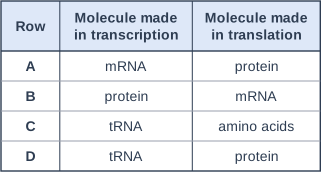
The table shows four suggestions for the molecule made in each stage.

Which row is correct?

Choose your answer.

  • A row A
  • B row B
  • C row C
  • D row D
Table with columns "Row", "Molecule made in transcription", "Molecule made in translation". Row: A; Molecule made in transcription: mRNA; Molecule made in translation: protein | Row: B; Molecule made in transcription: protein; Molecule made in translation: mRNA | Row: C; Molecule made in transcription: tRNA; Molecule made in translation: amino acids | Row: D; Molecule made in transcription: tRNA; Molecule made in translation: protein.

Model answer

A

Explanation

Transcription copies the base sequence of a gene into a molecule of mRNA in the nucleus. Translation uses that sequence, in the cytoplasm, to join amino acids together into a protein. Two common errors are mixing up the names of the two stages and thinking that translation makes amino acids: the amino acids already exist and tRNA brings them to the ribosome.

Mark scheme
  1. 1 mark

    A / row A

    The only correct answer is A: in transcription a gene is copied to make mRNA in the nucleus, and in translation amino acids are joined together in the cytoplasm, in the order set by the mRNA, to make a protein. B is not correct because it gives the two stages the wrong way round; C is not correct because amino acids are not made in translation (tRNA carries them to the ribosome, where they are joined together) and transcription makes mRNA, not tRNA; D is not correct because transcription makes mRNA, not tRNA. ALLOW the letter or the row. If more than one option is given, do not award the mark.

Question 2

2 marks

A student wrote this description of protein synthesis.

'When a cell makes a protein, the whole DNA molecule in the chromosome unzips. One strand of the gene is copied to make a molecule of mRNA. This is called translation. The mRNA moves out of the nucleus to a ribosome, where tRNA molecules bring amino acids that are joined together.'

The student has made two mistakes.

Write down the two mistakes and correct them.

Model answer

Mistake 1: the whole DNA molecule does not unzip; only the part of the DNA around the gene unzips.
Mistake 2: copying the gene to make mRNA is transcription, not translation. Translation is joining the amino acids at the ribosome.

Explanation

Only the gene being used unzips, so the rest of the chromosome stays as a double helix. The gene is copied into mRNA in the nucleus by transcription; the mRNA's base sequence is then used to join amino acids in the cytoplasm by translation. Mixing up the names of the two stages, and saying that a whole chromosome unzips, are both common errors.

Mark scheme
  1. 1 mark

    not the whole DNA molecule: only the part of the DNA around the gene unzips

    max 2. ALLOW only the gene / section of DNA that codes for the protein unzips. If more than two mistakes are given, each wrong one (a correct part of the description called a mistake) cancels a correct one.

  2. 1 mark

    copying the gene to make mRNA is called transcription, not translation

    ALLOW 'translation' should be 'transcription'. ALLOW translation is joining amino acids at the ribosome, not making mRNA. The word 'transcription' must be used, or the correct meaning of translation given.

Question 3

2 marks

A teacher uses this model to explain protein synthesis.

• A company keeps the master plans for all its products in a locked office. The plans are never taken out of the office. The office is the nucleus and each plan is a gene.
• When a product is needed, a worker makes a tracing of one plan and takes the tracing to the factory floor.
• On the factory floor, machines follow the tracing to put the product together from parts.

Evaluate the model by giving one way in which it represents protein synthesis well and one way in which it does not.

Model answer

The model represents protein synthesis well because the DNA stays in the nucleus, just as the master plans never leave the office, and only a copy of one gene (the mRNA) goes to the ribosomes in the cytoplasm, like the tracing taken to the factory floor. However, a tracing is identical to the plan, whereas mRNA is complementary to the DNA strand it is copied from, and the model does not show tRNA carrying the amino acids to the ribosome.

Explanation

To evaluate a model, match each part of the model to the real process, then say what it shows correctly and what it leaves out or gets wrong. This model shows well why a copy of the gene is needed, but it misses complementary base pairing, the triplet code and the role of tRNA. Giving two strengths and no limitation scores only 1 mark.

Mark scheme
  1. 1 mark

    strength: DNA / genes stay in the nucleus, like plans that are never taken out of the office

    Max 1 for strengths and max 1 for limitations. Max 1 if the answer gives only one side (only strengths or only limitations).

  2. 1 mark

    strength: only one gene is copied (into mRNA), like tracing one plan rather than all of them

    ALLOW only the part of the DNA that is needed is copied.

  3. 1 mark

    strength: the copy (mRNA), not the original, leaves the nucleus and goes to where the protein is made (the ribosome in the cytoplasm), like the tracing taken to the factory floor

    ALLOW the machines represent ribosomes and the parts represent amino acids. ALLOW the original gene is not used up / can be copied again, like the master plan staying in the office.

  4. 1 mark

    limitation: a tracing is identical to the plan, but mRNA is complementary to the template strand (with U in place of T) / is made by base pairing

    ALLOW mRNA is not an exact copy of the DNA.

  5. 1 mark

    limitation: the model does not show tRNA carrying the amino acids (the parts) to the ribosome

    ALLOW the model does not show how the parts reach the machines.

  6. 1 mark

    limitation: the model does not show the triplet code / that groups of three bases set the order in which amino acids are joined

    ALLOW the model does not show the DNA unzipping around the gene.

Question 4

4 marks

Herpes simplex virus causes cold sores. When the virus infects a human cell, its DNA enters the nucleus of the cell. The cell then makes the proteins that form the coats of new viruses.

Explain how the cell makes a virus coat protein, and not one of its own proteins, from the virus's DNA.

In your answer, state which of the molecules and structures used come from the virus and which come from the human cell.

Model answer

In the nucleus, the virus's DNA unzips around the gene for the coat protein, and the cell's RNA nucleotides pair with its bases to make mRNA (transcription), so the mRNA carries the virus's base sequence. The mRNA moves out of the nucleus to the cell's ribosomes in the cytoplasm, where the cell's tRNA molecules bring amino acids (translation). Each triplet of bases codes for one amino acid, so the amino acids are joined in the order set by the virus's gene, and the protein made is the virus's coat protein, not a human protein. The virus provides only the DNA (the instructions); the human cell provides the RNA nucleotides, the ribosomes, the tRNA and the amino acids.

Explanation

The cell's protein-synthesis machinery uses whichever gene is transcribed: the base sequence of the gene sets the base sequence of the mRNA, and the triplets of the mRNA set the order of the amino acids. So a virus needs to bring only its genetic material. A description of protein synthesis that never says why the protein made is a virus protein, or where the parts come from, scores at most 3 marks; saying that the virus makes the protein itself is a common error.

Mark scheme
  1. 1 mark

    the virus's gene (for the coat protein) is copied into mRNA in the nucleus (transcription), so the mRNA has the virus's base sequence

    1 mark for each point, max 4. ALLOW the virus's DNA unzips around the gene and RNA nucleotides pair with its bases to make mRNA. DO NOT ALLOW translation for this step.

  2. 1 mark

    the mRNA moves out of the nucleus to the (cell's) ribosomes in the cytoplasm, where tRNA brings amino acids (translation)

    ALLOW the mRNA goes to a ribosome and tRNA carries the amino acids to it. DO NOT ALLOW mRNA carries amino acids.

  3. 1 mark

    each triplet of bases (in the mRNA) codes for one amino acid, so the amino acids are joined in the order set by the virus's gene, giving the virus's protein (not a human protein)

    ALLOW the order of bases in the virus's gene determines the order of amino acids in the protein. ALLOW codon for triplet. DO NOT ALLOW the triplets make / produce amino acids.

  4. 1 mark

    from the virus: only the DNA / the gene (the base sequence / instructions)

    ALLOW the virus provides only the genetic information. DO NOT ALLOW the virus provides the ribosomes, tRNA or amino acids (contradiction).

  5. 1 mark

    from the human cell: at least two of RNA nucleotides, ribosomes, tRNA and amino acids

    Two correct items are needed for this mark. ALLOW enzymes / energy (ATP) as one of the two items. A wrong item (for example the virus's ribosomes) cancels a correct one.

Ready to try the rest? Every answer you write is marked against the mark scheme, so you can see exactly where the marks are.

Study Helper Hints first, answers after you try

Stuck on this one? Ask for a hint and I’ll point you in the right direction, without giving the answer away. Once you’ve checked your answer, I’ll show you how the marks are awarded.