
Level:
Correct: 0
Incorrect: 0
Marks: 0/0
Exam Practice
Course:
Topics:
OCR GCSE Biology (Paper 3) Smart practice A mixed round aimed at your weak spots
Avg
score:
–
Topics
done:
0/29

Hormones in human reproduction and the menstrual cycle

Practise 16 exam-style questions on Hormones in human reproduction and the menstrual cycle for OCR GCSE Biology (Paper 3). Write your answer as you would in the exam and get it marked in seconds against the mark scheme, point by point, with the Study Helper on hand if you get stuck.

  • 16 questions
  • 1–6 marks each
  • Instant marking
  • No sign-up needed
16 questions, marked as you go

Sample questions with model answers

Here are 4 of the questions in this topic, each with a model answer, an explanation of why it earns the marks and the mark scheme an examiner would use.

Question 1

1 mark

Near the middle of the menstrual cycle, the concentration of oestrogen in the blood reaches its highest level.

What effect does this high concentration of oestrogen have?

Choose your answer.

  • A An egg starts to mature in the ovary.
  • B Ovulation is prevented.
  • C The lining of the uterus breaks down.
  • D The pituitary gland releases more LH.

Model answer

D

Explanation

This is one of the key interactions in the cycle: the rising oestrogen released by the developing follicle triggers the pituitary gland to release a surge of LH, and LH causes the egg to be released. Option B is the reverse of what happens.

Mark scheme
  1. 1 mark

    D / The pituitary gland releases more LH.

    The only correct answer is D: a high concentration of oestrogen stimulates the pituitary gland to release a surge of LH, which causes ovulation. A is not correct because eggs begin to mature earlier in the cycle in response to FSH. B is not correct because the high oestrogen leads to ovulation (through the LH surge) rather than preventing it. C is not correct because oestrogen causes the lining to be repaired and thicken; the lining breaks down when progesterone (and oestrogen) fall at the end of the cycle. ALLOW the letter or the option. If more than one option is given, do not award the mark.
Question 2

2 marks

During pregnancy, the concentration of progesterone in a woman's blood stays high.

Explain why a pregnant woman does not release any more eggs.

Model answer

The high progesterone concentration inhibits the release of FSH and LH by the pituitary gland. Without FSH no more eggs mature, and without an LH surge no egg is released, so there is no ovulation during pregnancy.

Explanation

Progesterone has two jobs here: it maintains the lining of the uterus, and it inhibits FSH and LH. The question asks about eggs, so the answer must use the second role. A common error is to explain only why periods stop.

Mark scheme
  1. 1 mark

    progesterone inhibits the release of FSH / LH (by the pituitary gland)

    ALLOW progesterone stops FSH and LH being made. DO NOT ALLOW progesterone inhibits oestrogen (as the only idea).

  2. 1 mark

    so no (more) eggs / follicles mature / there is no LH surge, so no ovulation

    ALLOW without FSH no egg develops; without LH no egg is released. IGNORE 'the lining stays thick' (it does not explain why no eggs are released).

Question 3

3 marks

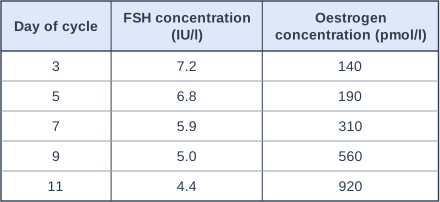
The table shows the concentrations of FSH and oestrogen in a woman's blood during the first part of one menstrual cycle.

Explain the change in the FSH concentration shown in the table, and suggest why this change is important.

Use data from the table in your answer.

Table with columns "Day of cycle", "FSH concentration (IU/l)", "Oestrogen concentration (pmol/l)". Day of cycle: 3; FSH concentration (IU/l): 7.2; Oestrogen concentration (pmol/l): 140 | Day of cycle: 5; FSH concentration (IU/l): 6.8; Oestrogen concentration (pmol/l): 190 | Day of cycle: 7; FSH concentration (IU/l): 5.9; Oestrogen concentration (pmol/l): 310 | Day of cycle: 9; FSH concentration (IU/l): 5.0; Oestrogen concentration (pmol/l): 560 | Day of cycle: 11; FSH concentration (IU/l): 4.4; Oestrogen concentration (pmol/l): 920.

Model answer

FSH stimulates the developing follicle in the ovary to release oestrogen, so the oestrogen concentration rises from 140 to 920 pmol/l between day 3 and day 11. Oestrogen inhibits the release of FSH by the pituitary gland, so the FSH concentration falls from 7.2 to 4.4 IU/l. This is important because with less FSH no more eggs start to mature, so usually only one egg is released in the cycle.

Explanation

The two hormones interact: FSH stimulates oestrogen release, and rising oestrogen then inhibits FSH. Use the figures from both columns to support the explanation. A common error is to state the pattern without explaining which hormone causes the change.

Mark scheme
  1. 1 mark

    the oestrogen concentration rises (from 140 to 920 pmol/l) / oestrogen is released by the (developing follicle in the) ovary

    Max 2 if no data from the table are used. ALLOW FSH stimulates the ovary to release oestrogen. ALLOW figures quoted for FSH (7.2 to 4.4 IU/l) as the data.

  2. 1 mark

    oestrogen inhibits the release of FSH (by the pituitary gland), so the FSH concentration falls

    ALLOW oestrogen stops / reduces FSH production. DO NOT ALLOW oestrogen inhibits LH (as the only idea). DO NOT ALLOW the ovary releases FSH (contradiction).

  3. 1 mark

    so no more eggs / follicles mature / usually only one egg is released in the cycle

    ALLOW prevents several eggs developing at the same time. IGNORE 'stops the cycle'.

Question 4

4 marks

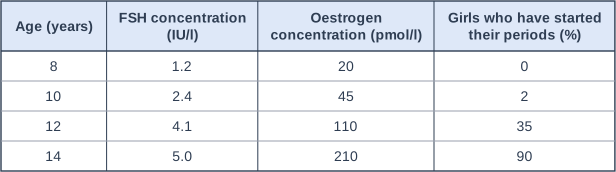
Scientists measured hormone concentrations in the blood of girls of different ages. They also recorded the percentage of girls in each age group who had started their periods.

The table shows the scientists' results (mean values).

Use the data to explain why periods start at puberty.

Table with columns "Age (years)", "FSH concentration (IU/l)", "Oestrogen concentration (pmol/l)", "Girls who have started their periods (%)". Age (years): 8; FSH concentration (IU/l): 1.2; Oestrogen concentration (pmol/l): 20; Girls who have started their periods (%): 0 | Age (years): 10; FSH concentration (IU/l): 2.4; Oestrogen concentration (pmol/l): 45; Girls who have started their periods (%): 2 | Age (years): 12; FSH concentration (IU/l): 4.1; Oestrogen concentration (pmol/l): 110; Girls who have started their periods (%): 35 | Age (years): 14; FSH concentration (IU/l): 5.0; Oestrogen concentration (pmol/l): 210; Girls who have started their periods (%): 90.

Model answer

At puberty the pituitary gland releases more FSH: the mean FSH concentration rises from 1.2 IU/l at age 8 to 5.0 IU/l at age 14. FSH causes follicles in the ovaries to mature and stimulates the ovaries to release oestrogen, so oestrogen rises from 20 to 210 pmol/l. Oestrogen makes the lining of the uterus build up; when hormone levels then fall, the lining breaks down and is lost as a period. This is why the percentage of girls who have started their periods rises from 0 % at age 8 to 90 % at age 14 as the hormone concentrations rise.

Explanation

Link the data in a chain: more FSH, then more oestrogen, then a thicker lining that can break down as a period. Quote figures from the table at each step. The data show a correlation; the explanation comes from knowing what each hormone does.

Mark scheme
  1. 1 mark

    the FSH concentration increases with age / at puberty (from 1.2 to 5.0 IU/l)

    max 4. Max 3 if no data from the table are used.

  2. 1 mark

    FSH causes eggs / follicles to mature (in the ovaries)

    ALLOW FSH starts the development of follicles.

  3. 1 mark

    FSH stimulates the ovaries to release oestrogen, so the oestrogen concentration rises (from 20 to 210 pmol/l)

    DO NOT ALLOW the pituitary gland releases oestrogen.

  4. 1 mark

    oestrogen causes the lining of the uterus to build up / thicken, and (when hormone levels fall) the lining breaks down, which is a period

    ALLOW once the lining builds up, menstrual cycles (and periods) begin.

  5. 1 mark

    the percentage of girls who have started periods rises (from 0 to 90 %) as the FSH and oestrogen concentrations rise

    ALLOW a correct link between the hormone data and the percentage with periods at any one age, for example most girls start their periods between 12 and 14, when oestrogen rises from 110 to 210 pmol/l.

Ready to try the rest? Every answer you write is marked against the mark scheme, so you can see exactly where the marks are.

Study Helper Hints first, answers after you try

Stuck on this one? Ask for a hint and I’ll point you in the right direction, without giving the answer away. Once you’ve checked your answer, I’ll show you how the marks are awarded.