
Level:
Correct: 0
Incorrect: 0
Marks: 0/0
Exam Practice
Course:
Topics:
OCR GCSE Biology (Paper 3) Smart practice A mixed round aimed at your weak spots
Avg
score:
–
Topics
done:
0/29

The eye: structure, function and defects

Practise 15 exam-style questions on The eye: structure, function and defects for OCR GCSE Biology (Paper 3). Write your answer as you would in the exam and get it marked in seconds against the mark scheme, point by point, with the Study Helper on hand if you get stuck.

  • 15 questions
  • 1–6 marks each
  • Instant marking
  • No sign-up needed
15 questions, marked as you go

Sample questions with model answers

Here are 4 of the questions in this topic, each with a model answer, an explanation of why it earns the marks and the mark scheme an examiner would use.

Question 1

1 mark

The optic nerve leaves the back of each eye. It contains about one million neurones.

Which option describes the optic nerve?

Choose your answer.

  • A a bundle of motor neurones that carry impulses from the brain to the iris
  • B a bundle of relay neurones that carry impulses from the lens to the retina
  • C a bundle of sensory neurones that carry impulses from the retina to the brain
  • D a bundle of sensory neurones that carry impulses from the retina to the spinal cord

Model answer

C (a bundle of sensory neurones that carry impulses from the retina to the brain)

Explanation

Receptor cells in the retina detect light and start impulses, which travel along the sensory neurones of the optic nerve to the brain. The brain interprets these impulses to give the image we see. Students sometimes confuse the direction: the optic nerve only carries impulses away from the eye.

Mark scheme
  1. 1 mark

    C / a bundle of sensory neurones that carry impulses from the retina to the brain

    The only correct answer is C: the optic nerve is a bundle of sensory neurones that carry impulses from the receptor cells in the retina to the brain, where the information is interpreted. A is not correct because the optic nerve carries impulses towards the brain, not away from it; the impulses that control the iris muscles travel along other neurones. B is not correct because relay neurones are found inside the CNS, and the lens does not produce impulses. D is not correct because the optic nerve goes directly to the brain, not to the spinal cord. ALLOW the letter or the option. If more than one option is given, do not award the mark.
Question 2

2 marks

A student looks up from reading a message on her phone to watch a bird in a distant tree.

The statements describe what happens in her eye so that she sees the bird clearly.

J The lens is pulled into a thinner, flatter shape.
K The suspensory ligaments are pulled tight.
L The ciliary muscles relax.
M Light from the bird is refracted less and is focused on the retina.

Write the letters J, K, L and M in the correct order, starting with what happens first.

Model answer

L, K, J, M

Explanation

To focus on a distant object the ciliary muscles relax. The ring of ciliary muscle becomes wider, so it pulls the suspensory ligaments tight; they pull on the edge of the lens and make it thinner, so it refracts light less and light from the distant bird is focused on the retina. Many students wrongly think that the ciliary muscles contract to stretch the lens: in fact they contract when focusing on near objects, which lets the ligaments go slack so the lens becomes fatter.

Mark scheme
  1. 2 marks

    L, K, J, M

    2 marks for L, K, J, M (ciliary muscles relax → suspensory ligaments pulled tight → lens pulled thinner → light refracted less and focused on the retina). 1 mark for an order in which only two neighbouring letters are swapped (K, L, J, M or L, J, K, M or L, K, M, J). 0 marks for any other order. ALLOW the letters separated by arrows, commas or spaces. ALLOW the statements written out in full in the correct order.

Question 3

3 marks

The cornea is the transparent layer at the front of the eye. It is about 0.5 mm thick in the centre and has a curved surface. It has no blood vessels: its cells get oxygen by diffusion from the air, through the thin layer of tears that covers the eye.

Explain how these features of the cornea are related to its function.

Model answer

The cornea lets light into the eye and refracts it. It is transparent, with no blood vessels to absorb or block the light, so light can pass through it to the lens and retina. Its curved surface bends (refracts) the light towards the pupil and lens, helping to focus it on the retina. Because it has no blood supply, its cells get oxygen by diffusion from the tears; being thin means the oxygen only has a short distance to diffuse to reach all the cells, which need it for aerobic respiration.

Explanation

Link each feature to what the cornea does: transparency lets light in, the curve refracts light, and thinness gives a short diffusion distance for the oxygen its cells need for respiration. A common mistake is to say the cornea 'reflects' light or 'controls the amount of light' (that is the iris).

Mark scheme
  1. 1 mark

    transparent / no blood vessels, so light can pass through it (to the lens and retina)

    Max 3. ALLOW blood (vessels) would absorb / block / scatter light. IGNORE so the person can see, unless linked to light passing through.

  2. 1 mark

    curved surface refracts / bends light (towards the pupil and lens) / helps to focus light on the retina

    ALLOW focuses light. DO NOT ALLOW reflects light.

  3. 1 mark

    thin, so oxygen only has a short distance to diffuse to all of its cells / so oxygen diffuses quickly to its cells

    The link to oxygen or diffusion is needed. ALLOW short diffusion distance.

  4. 1 mark

    (its cells need oxygen) for (aerobic) respiration, to release energy (to stay alive)

    IGNORE to make energy / to breathe. DO NOT ALLOW anaerobic respiration.

Question 4

5 marks

The near point is the shortest distance from the eye at which an object can be seen clearly.

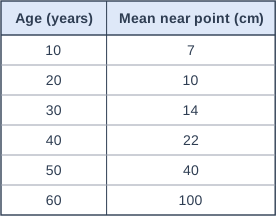
A scientist measured the near point of volunteers in six age groups. The table shows the mean near point for each age group.

Calculate the percentage increase in the mean near point from age 40 to age 60.

Explain why the near point changes with age, and why many people over the age of 50 need glasses with convex lenses to read.

Table with columns "Age (years)", "Mean near point (cm)". Age (years): 10; Mean near point (cm): 7 | Age (years): 20; Mean near point (cm): 10 | Age (years): 30; Mean near point (cm): 14 | Age (years): 40; Mean near point (cm): 22 | Age (years): 50; Mean near point (cm): 40 | Age (years): 60; Mean near point (cm): 100.

Model answer

Percentage increase = (100 − 22) ÷ 22 × 100 = 78 ÷ 22 × 100 = 355%
The near point gets further away with age, slowly at first and then quickly after 40. This is because the lens becomes less elastic (stiffer) as a person gets older. To focus on a near object the ciliary muscles contract and the suspensory ligaments go slack, but a stiff lens cannot become as fat and rounded, so it cannot refract light from near objects enough and the light is focused behind the retina. Reading glasses with convex (converging) lenses bend the light inwards before it enters the eye, so light from the page is focused on the retina.

Explanation

Percentage increase = change ÷ original value × 100, so divide the increase (78 cm) by the value at age 40 (22 cm), not by the value at age 60. For the explanation, link the loss of elasticity of the lens to its failure to become rounded for near objects, so light is focused behind the retina - a type of long-sightedness - which a converging (convex) lens corrects. A common error is to say the lens cannot become thinner, which would affect distant vision instead.

Mark scheme
  1. 1 mark

    (100 − 22) ÷ 22 × 100 / 78 ÷ 22 × 100; or a correct final answer of 355% (ALLOW 354.5% or 350%) with no working

    An answer of 355% (ALLOW 354.5% or 350%) with no working scores marking points 1 and 2. ALLOW 1 mark for 78 ÷ 22 = 3.5(5) not multiplied by 100. Marking points 3 to 6: max 3.

  2. 1 mark

    355 (%)

    ALLOW 354.5, 354.55 or 350 (2 significant figures). DO NOT ALLOW 78 (%) (the increase in cm divided by 100) or 455 (%) (100 ÷ 22 × 100). IGNORE units.

  3. 1 mark

    the lens becomes less elastic / stiffer / harder with age

    ALLOW the lens loses its elasticity. ALLOW the ciliary muscles become weaker.

  4. 1 mark

    so (when the ciliary muscles contract and the suspensory ligaments go slack) the lens cannot become as fat / rounded / thick

    ALLOW the lens cannot change shape as much. DO NOT ALLOW the lens cannot become thinner.

  5. 1 mark

    so light from near objects is not refracted enough / is focused behind the retina

    ALLOW they become long-sighted. DO NOT ALLOW focused in front of the retina.

  6. 1 mark

    convex / converging lenses refract / bend the light (inwards) before it enters the eye, so light from the page is focused on the retina

    The idea of converging the light AND focusing it on the retina is needed. DO NOT ALLOW the lenses magnify the words, unless linked to focusing on the retina.

Ready to try the rest? Every answer you write is marked against the mark scheme, so you can see exactly where the marks are.

Study Helper Hints first, answers after you try

Stuck on this one? Ask for a hint and I’ll point you in the right direction, without giving the answer away. Once you’ve checked your answer, I’ll show you how the marks are awarded.