
Level:
Correct: 0
Incorrect: 0
Marks: 0/0
Exam Practice
Course:
Topics:
OCR GCSE Physics (Paper 2) Smart practice A mixed round aimed at your weak spots
Avg
score:
–
Topics
done:
0/30

The Sun and the solar system

Practise 15 exam-style questions on The Sun and the solar system for OCR GCSE Physics (Paper 2). Write your answer as you would in the exam and get it marked in seconds against the mark scheme, point by point, with the Study Helper on hand if you get stuck.

  • 15 questions
  • 1–6 marks each
  • Instant marking
  • No sign-up needed
15 questions, marked as you go

Sample questions with model answers

Here are 4 of the questions in this topic, each with a model answer, an explanation of why it earns the marks and the mark scheme an examiner would use.

Question 1

1 mark

Astronomers estimate that the Sun formed about 4.6 billion years ago. Their model of the Sun predicts that it will be a main sequence star for about 10 billion years in total. After this stage, the Sun will become a red giant.

About how long will it be until the Sun becomes a red giant?

Choose your answer.

  • A 14.6 billion years
  • B 10 billion years
  • C 5.4 billion years
  • D 4.6 billion years

Model answer

C (5.4 billion years)

Explanation

The Sun is about 4.6 billion years old, and its main sequence stage lasts about 10 billion years, so the time left is 10 − 4.6 = 5.4 billion years. The Sun is therefore a little less than halfway through its life as a main sequence star.

Mark scheme
  1. 1 mark

    C / 5.4 billion years

    The only correct answer is C: the Sun has already spent about 4.6 billion years of its 10 billion years as a main sequence star, so about 10 − 4.6 = 5.4 billion years are left. A is not correct because it adds the two times (10 + 4.6) instead of subtracting; B is not correct because 10 billion years is the total time on the main sequence, not the time that is left; D is not correct because 4.6 billion years is the time that has already passed. ALLOW the letter or the option. If more than one option is given, do not award the mark.
Question 2

2 marks

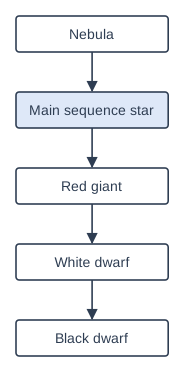
The flow chart shows the stages in the life cycle of the Sun. The shaded box shows the stage that the Sun is in now.

A student says:

'At the end of its life, the Sun will explode as a supernova and leave behind a black hole.'

Explain why the student is wrong.

Flow chart of 5 boxes joined by arrows, read from top to bottom. The first box is "Nebula", which leads to "Main sequence star" (shaded), which leads to "Red giant", which leads to "White dwarf", which leads to "Black dwarf".

Model answer

The Sun does not have enough mass to explode as a supernova: only stars with a much greater mass than the Sun do this, and only they leave behind neutron stars or black holes. The flow chart shows that the Sun will become a red giant and then a white dwarf, which slowly cools to become a black dwarf. A black dwarf is a cold, dead star, not a black hole.

Explanation

How a star ends its life depends on its mass. A star like the Sun swells into a red giant, loses its outer layers and leaves a white dwarf, which cools to a black dwarf. Only stars with much more mass than the Sun become red supergiants, explode as supernovae and leave a neutron star or a black hole. Take care not to mix up a black dwarf with a black hole.

Mark scheme
  1. 1 mark

    the Sun does not have enough mass to explode as a supernova / only stars with a much greater mass than the Sun explode as supernovae (and leave behind neutron stars or black holes)

    1 mark for each of points 1 and 2. ALLOW the Sun is not massive enough / is too small to become a supernova or a black hole (as meaning its mass is too small). IGNORE the Sun is too young / is not hot enough.

  2. 1 mark

    (the flow chart shows that) the Sun will become a red giant and then a white dwarf, which cools to become a black dwarf: a black dwarf is not a black hole

    ALLOW the Sun's life ends as a white dwarf / as a black dwarf (not a black hole). ALLOW the red giant will lose its outer layers (as a planetary nebula) and leave a white dwarf. DO NOT ALLOW the Sun will become a neutron star.

Question 3

2 marks

The Moon and the Hubble Space Telescope both move round the Earth. The Hubble Space Telescope was launched into its orbit in 1990.

Give two differences between the Moon and the Hubble Space Telescope.

Model answer

The Moon is a natural satellite, but the Hubble Space Telescope is an artificial satellite that was made by people and launched by a rocket. The Moon is also much further from the Earth: the telescope is in a low orbit a few hundred kilometres up.

Explanation

A satellite is any object that orbits a planet. The Moon is the Earth's natural satellite and the Hubble Space Telescope is an artificial one. They differ in many ways: the Moon is far bigger, it is about 384 000 km away rather than a few hundred kilometres, and it takes about 27 days to go round the Earth, while the telescope goes round in about an hour and a half.

Mark scheme
  1. 1 mark

    the Moon is a natural satellite, but the Hubble Space Telescope is an artificial satellite (made by people and launched by a rocket)

    1 mark for each of points 1 to 4, max 2. If more than two answers are given, a wrong one cancels a right one. Each answer must make the difference clear, or describe one of them so that the comparison is clear. IGNORE 'both orbit the Earth' or 'both are satellites of the Earth' (similarities given in the question). ALLOW one is natural and one is artificial / man-made.

  2. 1 mark

    the Moon is much larger / has a much greater mass

    ORA (allow the reverse argument).

  3. 1 mark

    the Moon is much further from the Earth (the telescope is in a low orbit, a few hundred kilometres up)

    ORA (allow the reverse argument).

  4. 1 mark

    the Moon takes much longer to go round the Earth once (about 27 days, compared with about an hour and a half)

    ORA (allow the reverse argument). ALLOW the Moon takes about a month to orbit the Earth.

Question 4

4 marks

A TV company sends live pictures from a football match in the UK to its studio, also in the UK. The signal travels from a dish near the stadium up to a satellite in a geostationary orbit, and then back down to a dish at the studio.

Each dish is about 39 000 km from the satellite.

The signal is carried by microwaves, which travel at 3.0 × 10⁸ m/s.

Calculate the time it takes for the signal to travel from the dish near the stadium to the dish at the studio.

Model answer

total distance = 39 000 km up + 39 000 km down = 78 000 km = 78 000 000 m
distance travelled = speed × time, so time = distance ÷ speed
time = 78 000 000 ÷ 300 000 000 = 0.26 s

Explanation

The signal goes up to the satellite and back down, so the distance is twice 39 000 km. Change kilometres into metres before dividing by the speed in m/s. The common slips are using only one way (0.13 s) and forgetting to change km into m. The delay of about a quarter of a second is why there is a short pause in live interviews sent by satellite.

Mark scheme
  1. 1 mark

    total distance = 2 × 39 000 = 78 000 km; or a correct final answer of 0.26 s with no working

    An answer of 0.26 s with no working scores 4 marks. ALLOW 0.13 s for 3 marks (only the distance from one dish to the satellite used). ALLOW 0.00026 s / 2.6 × 10⁻⁴ s for 3 marks (kilometres not changed into metres). ALLOW 0.00013 s / 1.3 × 10⁻⁴ s for 2 marks (both slips).

  2. 1 mark

    unit conversion: 78 000 km = 78 000 000 m / 7.8 × 10⁷ m; or a correct final answer of 0.26 s with no working

    ALLOW ECF: 39 000 km = 39 000 000 m / 3.9 × 10⁷ m when the distance was not doubled.

  3. 1 mark

    recall and substitution: time = distance ÷ speed = 7.8 × 10⁷ ÷ 3.0 × 10⁸; or a correct final answer of 0.26 s with no working

    ALLOW distance = speed × time, rearranged. ALLOW ECF from a wrong distance. DO NOT ALLOW distance × speed.

  4. 1 mark

    evaluation: 0.26 (s)

    ALLOW 260 ms. ALLOW ECF from a wrong distance correctly divided by 3.0 × 10⁸ (see point 1). IGNORE units.

Ready to try the rest? Every answer you write is marked against the mark scheme, so you can see exactly where the marks are.

Study Helper Hints first, answers after you try

Stuck on this one? Ask for a hint and I’ll point you in the right direction, without giving the answer away. Once you’ve checked your answer, I’ll show you how the marks are awarded.