
Level:
Correct: 0
Incorrect: 0
Marks: 0/0
Exam Practice
Course:
Topics:
OCR GCSE Physics (Paper 2) Smart practice A mixed round aimed at your weak spots
Avg
score:
–
Topics
done:
0/30

Ray diagrams, lenses and colour

Practise 16 exam-style questions on Ray diagrams, lenses and colour for OCR GCSE Physics (Paper 2). Write your answer as you would in the exam and get it marked in seconds against the mark scheme, point by point, with the Study Helper on hand if you get stuck.

  • 16 questions
  • 1–6 marks each
  • Instant marking
  • No sign-up needed
16 questions, marked as you go

Sample questions with model answers

Here are 4 of the questions in this topic, each with a model answer, an explanation of why it earns the marks and the mark scheme an examiner would use.

Question 1

1 mark

A ray of light from a laser pointer hits a plane mirror along the normal, at 90° to the surface of the mirror.

What happens to the ray of light?

Choose your answer.

  • A It is absorbed by the mirror.
  • B It is reflected back along its own path.
  • C It is reflected sideways along the surface of the mirror.
  • D It passes straight through the glass of the mirror.

Model answer

B (it is reflected back along its own path)

Explanation

Angles in ray diagrams are measured from the normal. A ray travelling along the normal has an angle of incidence of 0°, and because the angle of reflection equals the angle of incidence, the reflected ray also travels along the normal: straight back the way it came. This is why you see your own eye looking straight back at you when you look straight into a mirror.

Mark scheme
  1. 1 mark

    B / it is reflected back along its own path

    The only correct answer is B: the ray travels along the normal, so the angle of incidence is 0°; the angle of reflection equals the angle of incidence, so it is also 0° and the ray is reflected straight back along the normal, the way it came. A is not correct because a mirror reflects almost all the light that hits it; C is not correct because a ray reflected along the surface would have an angle of reflection of 90°, not 0°; D is not correct because the shiny back of the mirror reflects the light, so it does not pass through. ALLOW the letter or the option. If more than one option is given, do not award the mark.
Question 2

2 marks

On a sunny day, a student holds a convex lens above a sheet of black paper. She moves the lens up and down until the sunlight passing through it makes a very small, bright spot on the paper. After a few seconds, the paper under the spot starts to scorch.

She repeats this with a concave lens. She cannot make a bright spot, and the paper does not scorch.

Explain these observations. Use ideas about what each lens does to the rays of light from the Sun.

Model answer

The convex lens refracts the parallel rays of sunlight so that they converge and meet at its principal focus. All the light passing through the lens is concentrated onto a tiny spot, so a lot of energy is absorbed by a very small area of the black paper, which gets hot enough to scorch. The concave lens refracts the rays so that they diverge. The light is spread out over a larger area instead of being concentrated, so there is no bright spot and the paper does not get hot.

Explanation

Rays of light from the Sun arrive almost parallel. A convex (converging) lens brings them together at its principal focus, concentrating the energy of all the light that passes through the lens onto a small area. A concave (diverging) lens spreads the rays out, so it can never concentrate the light. This is the main difference between the two lenses, and it decides their uses: convex lenses bring light to a focus, for example in cameras, and concave lenses spread it out.

Mark scheme
  1. 1 mark

    the convex lens makes the (parallel) rays of sunlight converge / meet at a point (its principal focus), so the light (and its energy) is concentrated on a very small area of the paper, which gets very hot

    1 mark for each of points 1 and 2. ALLOW the convex lens focuses the sunlight / brings the rays together at the focal point. The idea of the light (or its energy) being concentrated on a small area is needed for this mark: DO NOT ALLOW 'the lens magnifies the heat' or 'the lens makes the light hotter'. IGNORE 'the black paper absorbs the light' on its own.

  2. 1 mark

    the concave lens makes the rays diverge / spread out, so the light (and its energy) is spread over a larger area and does not heat the paper much

    ALLOW the concave lens spreads the light out / does not bring the rays to a focus. DO NOT ALLOW 'the concave lens blocks / absorbs / reflects the sunlight'.

Question 3

2 marks

In a theatre, two identical lamps give out white light. A sheet of clear, colourless plastic is placed in front of one lamp. A red filter, made of the same plastic coloured red, is placed in front of the other lamp.

After an hour, the red filter is much hotter than the clear plastic.

Explain why.

Model answer

The clear plastic transmits almost all the colours of the white light, so it absorbs very little of the light. The red filter transmits only red light and absorbs all the other colours, so it absorbs much more of the light. The energy of the absorbed light is transferred to the thermal energy store of the filter, so its temperature rises much more than the temperature of the clear plastic.

Explanation

A coloured filter does not add colour to light: it transmits light of its own colour and absorbs the other colours. The energy of the light that is absorbed is not lost; it heats the filter, increasing the energy in its thermal store and raising its temperature. Clear plastic transmits nearly all the light, so it absorbs little energy and stays cooler.

Mark scheme
  1. 1 mark

    the red filter absorbs all the colours of the light except red (it transmits only red light), but the clear plastic transmits (almost) all the colours, so the red filter absorbs much more of the light

    ALLOW the red filter absorbs more (of the energy) of the light than the clear plastic. ORA (allow the reverse argument). DO NOT ALLOW 'the red filter absorbs red light'.

  2. 1 mark

    the energy of the absorbed light is transferred to the thermal (internal) energy store of the filter, so its temperature rises

    ALLOW the absorbed light heats the filter / makes the particles of the filter vibrate faster. DO NOT ALLOW 'the filter traps the heat' with no reference to absorbing the light or its energy.

Question 4

4 marks

Two identical ice cubes are at their melting point, 0 °C. A student places one of them in a shallow metal dish painted black, and the other in an identical dish painted white.

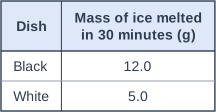
She leaves the dishes side by side in bright sunshine. After 30 minutes, she pours the water from the melted ice out of each dish and measures its mass. The table shows her results.

Specific latent heat of fusion of ice = 334 000 J/kg

Use the equation: thermal energy for a change in state = mass × specific latent heat

Calculate the energy that was needed to melt the ice in the black dish during the 30 minutes.

Suggest why more ice melted in the black dish. Use ideas about what happens to the light that hits each dish.

Table with columns "Dish", "Mass of ice melted in 30 minutes (g)". Dish: Black; Mass of ice melted in 30 minutes (g): 12.0 | Dish: White; Mass of ice melted in 30 minutes (g): 5.0.

Model answer

mass of ice melted in the black dish = 12.0 g = 0.012 kg
thermal energy for a change in state = mass × specific latent heat
thermal energy = 0.012 × 334 000 = 4008 J (about 4000 J)
The black dish absorbs almost all the colours of the sunlight that hits it, but the white dish reflects almost all of them. So the black dish absorbs more energy from the sunlight and transfers more of it to the ice, and more of the ice melts.

Explanation

Change the mass of ice melted into kilograms before using the equation: 12.0 g = 0.012 kg, so the energy needed is 0.012 × 334 000 = 4008 J. Using 12.0 without converting it gives 4 008 000 J, a thousand times too big. The difference between the dishes comes from their colour: a black surface absorbs all the colours of light, but a white surface reflects them, so much less energy from the sunlight reaches the ice in the white dish.

Mark scheme
  1. 1 mark

    unit conversion: 12.0 g = 0.012 kg; or a correct final answer of 4008 J, 4010 J or 4000 J with no working

    An answer of 4008 J, 4010 J or 4000 J (or 4.0 kJ) with no working scores marking points 1 to 3 only. ALLOW 4 008 000 J for 2 marks (grams not converted to kilograms: 12.0 × 334 000). DO NOT ALLOW the mass melted in the white dish (5.0 g) for this point.

  2. 1 mark

    substitution: 0.012 × 334 000; or a correct final answer of 4008 J, 4010 J or 4000 J with no working

    ALLOW ECF from a wrong conversion in point 1, for example 0.12 × 334 000.

  3. 1 mark

    evaluation: 4008 (J) / 4010 (J) / 4000 (J)

    ALLOW 4.008 kJ / 4.01 kJ / 4.0 kJ. ALLOW ECF from point 2. IGNORE units, as the question does not ask for them.

  4. 1 mark

    the black dish absorbs (almost) all the colours of the light that hits it, but the white dish reflects (almost) all of them, so more energy is transferred to the black dish and from it to the ice

    ORA (allow the reverse argument). ALLOW black absorbs more light / white reflects more light, so more energy reaches the ice in the black dish. The idea of light being absorbed or reflected is needed: DO NOT ALLOW 'black attracts heat' or 'black absorbs heat' with no reference to light.

Ready to try the rest? Every answer you write is marked against the mark scheme, so you can see exactly where the marks are.

Study Helper Hints first, answers after you try

Stuck on this one? Ask for a hint and I’ll point you in the right direction, without giving the answer away. Once you’ve checked your answer, I’ll show you how the marks are awarded.