
Level:
Correct: 0
Incorrect: 0
Marks: 0/0
Exam Practice
Course:
Topics:
OCR GCSE Physics (Paper 2) Smart practice A mixed round aimed at your weak spots
Avg
score:
–
Topics
done:
0/30

The electromagnetic spectrum

Practise 15 exam-style questions on The electromagnetic spectrum for OCR GCSE Physics (Paper 2). Write your answer as you would in the exam and get it marked in seconds against the mark scheme, point by point, with the Study Helper on hand if you get stuck.

  • 15 questions
  • 1–6 marks each
  • Instant marking
  • No sign-up needed
15 questions, marked as you go

Sample questions with model answers

Here are 4 of the questions in this topic, each with a model answer, an explanation of why it earns the marks and the mark scheme an examiner would use.

Question 1

1 mark

Bees can detect some ultraviolet. Some snakes can detect the infrared given out by warm animals.

Which statement is correct?

Choose your answer.

  • A Bees detect ultraviolet, which has a longer wavelength than visible light.
  • B Humans can detect every wavelength that bees and these snakes can detect.
  • C Humans, bees and these snakes each detect a limited range of wavelengths.
  • D Snakes detect infrared, which has a higher frequency than visible light.

Model answer

C

Explanation

Our eyes detect only a limited range of the electromagnetic spectrum: visible light, from red to violet. Bees can also detect some ultraviolet, just beyond violet, and these snakes can detect infrared, just beyond red, but each of them still detects only part of the spectrum. Remember the order: ultraviolet has a shorter wavelength and a higher frequency than visible light, and infrared has a longer wavelength and a lower frequency.

Mark scheme
  1. 1 mark

    C / Humans, bees and these snakes each detect a limited range of wavelengths.

    The only correct answer is C: human eyes detect only a limited range of the electromagnetic spectrum (visible light), and bees and these snakes also detect only a limited range, although their ranges include some ultraviolet or infrared that humans cannot detect. A is not correct because ultraviolet has a shorter wavelength than visible light, not a longer one; B is not correct because humans cannot detect ultraviolet or infrared, which bees and these snakes can; D is not correct because infrared has a lower frequency than visible light, not a higher one. ALLOW the letter or the option. If more than one option is given, do not award the mark.
Question 2

2 marks

A student says:

'Light cannot be part of the electromagnetic spectrum, because we can see light but we cannot see electromagnetic waves.'

Explain why the student is wrong.

Model answer

Light is an electromagnetic wave: visible light is one of the groups of the electromagnetic spectrum. Our eyes can detect only this limited range of the spectrum, so we can see light but not the other groups, such as radio waves or ultraviolet.

Explanation

We can see one part of the electromagnetic spectrum, so the student's reason does not work. Visible light is an electromagnetic wave like all the others; the other groups are invisible only because our eyes detect a limited range of wavelengths. Answers that say the other waves are 'too weak' or 'too fast' to see do not score.

Mark scheme
  1. 1 mark

    light is an electromagnetic wave / visible light is one of the groups of the electromagnetic spectrum

    ALLOW light is part of the electromagnetic spectrum, between infrared and ultraviolet. IGNORE repeats of the student's statement.

  2. 1 mark

    our eyes can detect only a limited range of the electromagnetic spectrum (visible light), so the other groups cannot be seen

    ALLOW our eyes detect only some wavelengths / frequencies of electromagnetic waves. ALLOW we cannot see radio waves / microwaves / infrared / ultraviolet / X-rays / gamma rays because they are outside the range our eyes detect. DO NOT ALLOW we cannot see the other waves because they are too weak / too fast.

Question 3

2 marks

A student has a bracelet made of 'UV beads'. The beads are white indoors, but they turn purple when ultraviolet reaches them.

The student wears the bracelet outside on a sunny day. The beads turn purple, but the student cannot see any ultraviolet.

Explain these observations.

Model answer

Sunlight contains ultraviolet as well as visible light. The ultraviolet reaches the beads and makes them turn purple. The student cannot see the ultraviolet because our eyes can only detect a limited range of the electromagnetic spectrum, visible light, and ultraviolet has a higher frequency than violet light, outside that range.

Explanation

The beads act as a detector for ultraviolet, so their colour change shows that ultraviolet is present in sunlight. Our eyes detect only visible light, from red to violet, so ultraviolet is invisible to us even when it is there. Saying that ultraviolet is 'too weak' to see is not correct: on a sunny day there is plenty of it.

Mark scheme
  1. 1 mark

    sunlight contains ultraviolet, which reaches the beads (and makes them change colour)

    ALLOW the Sun gives out ultraviolet (as well as visible light). IGNORE the beads absorb light, unless ultraviolet is stated.

  2. 1 mark

    our eyes can detect only a limited range of the electromagnetic spectrum / only visible light, and ultraviolet is outside this range

    ALLOW ultraviolet has a higher frequency / shorter wavelength than violet light, so the eye cannot detect it. DO NOT ALLOW ultraviolet is too weak / too bright / too fast to see.

Question 4

4 marks

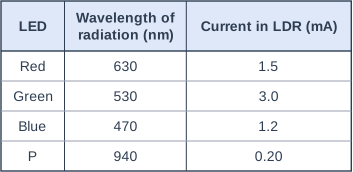
A student investigates how an LDR (light-dependent resistor) responds to the radiation from four LEDs. Each LED gives out the same power of radiation, and she shines each one on the LDR from the same distance.

The potential difference across the LDR is kept at 6.0 V.

The table shows her results. When LED P is switched on, the student cannot see any light from it.

Calculate the resistance of the LDR when LED P shines on it.
Name the group of the electromagnetic spectrum that LED P gives out.

Table with columns "LED", "Wavelength of radiation (nm)", "Current in LDR (mA)". LED: Red; Wavelength of radiation (nm): 630; Current in LDR (mA): 1.5 | LED: Green; Wavelength of radiation (nm): 530; Current in LDR (mA): 3.0 | LED: Blue; Wavelength of radiation (nm): 470; Current in LDR (mA): 1.2 | LED: P; Wavelength of radiation (nm): 940; Current in LDR (mA): 0.20.

Model answer

V = I × R, so R = V ÷ I
I = 0.20 mA = 0.000 20 A
R = 6.0 ÷ 0.000 20 = 30 000 Ω
LED P gives out infrared: its wavelength (940 nm) is longer than that of red light (630 nm), and the student cannot see it.

Explanation

Rearrange potential difference = current × resistance to give resistance = potential difference ÷ current, and change the current from milliamps to amps first (divide by 1000). Forgetting the conversion gives 30 Ω, which loses one mark. LED P's wavelength, 940 nm, is longer than that of red light and it cannot be seen, so it is infrared, which is outside the limited range our eyes detect.

Mark scheme
  1. 1 mark

    recall: potential difference = current × resistance, so resistance = potential difference ÷ current (R = V ÷ I); or a correct final answer of 30 000 Ω with no working

    An answer of 30 000 Ω (or 30 kΩ) with no working scores marking points 1 to 3 only; point 4 (the group) is marked separately. ALLOW V = I × R in symbols or words, or 6.0 ÷ 0.000 20 seen. ALLOW an answer of 30 Ω (milliamps not converted to amps: 6.0 ÷ 0.20) for 2 marks (points 1 and 3).

  2. 1 mark

    unit conversion: 0.20 mA = 0.000 20 A (2.0 × 10⁻⁴ A); or a correct final answer of 30 000 Ω with no working

    ALLOW 0.0002 A. ALLOW typed forms such as 2E-4 A.

  3. 1 mark

    evaluation: 30 000 (Ω)

    ALLOW 30 kΩ / 3 × 10⁴ Ω / typed forms such as 3E4 Ω. ALLOW ECF from a wrong conversion of the current: for example 30 (Ω) from 0.20 A scores this point. IGNORE units unless they are wrong for the value given (for example 30 000 kΩ).

  4. 1 mark

    infrared

    ALLOW IR / infra-red. Award this point on its own, whatever the calculation scores. DO NOT ALLOW ultraviolet, microwaves or more than one group.

Ready to try the rest? Every answer you write is marked against the mark scheme, so you can see exactly where the marks are.

Study Helper Hints first, answers after you try

Stuck on this one? Ask for a hint and I’ll point you in the right direction, without giving the answer away. Once you’ve checked your answer, I’ll show you how the marks are awarded.