
Level:
Correct: 0
Incorrect: 0
Marks: 0/0
Exam Practice
Course:
Topics:
OCR GCSE Physics (Paper 2) Smart practice A mixed round aimed at your weak spots
Avg
score:
–
Topics
done:
0/30

Red-shift and the Big Bang

Practise 10 exam-style questions on Red-shift and the Big Bang for OCR GCSE Physics (Paper 2). Write your answer as you would in the exam and get it marked in seconds against the mark scheme, point by point, with the Study Helper on hand if you get stuck.

  • 10 questions
  • 1–6 marks each
  • Instant marking
  • No sign-up needed
10 questions, marked as you go

Sample questions with model answers

Here are 4 of the questions in this topic, each with a model answer, an explanation of why it earns the marks and the mark scheme an examiner would use.

Question 1

1 mark

Astronomers say that the universe is expanding.

What does this mean?

Choose your answer.

  • A Galaxies are moving closer together.
  • B The distances between galaxies are increasing.
  • C The stars in each galaxy are moving further apart.
  • D The universe is getting hotter.

Model answer

B (The distances between galaxies are increasing.)

Explanation

An expanding universe is one in which the distances between galaxies are getting larger, so distant galaxies are moving away from us and from each other. The galaxies themselves, and the stars inside them, are held together by gravity, so they do not spread out. As the universe expands, it cools.

Mark scheme
  1. 1 mark

    B / the distances between galaxies are increasing

    The only correct answer is B: in an expanding universe, space stretches, so the distances between galaxies (other than very close neighbours) keep increasing. A is not correct because galaxies moving closer together would describe a universe that is getting smaller; C is not correct because the stars in a galaxy are held together by gravity, so the expansion is of the distances between galaxies, not between the stars in one galaxy; D is not correct because the universe has been cooling as it expands (it was very much hotter just after the Big Bang). ALLOW the letter or the option. If more than one option is given, do not award the mark.
Question 2

2 marks

A student writes this sentence in her notes:

'Red-shift means that all of the light from a distant galaxy has been changed into red light.'

Explain what red-shift means, and why the student's sentence is wrong.

Model answer

Red-shift is an increase in the wavelength (and a decrease in the frequency) of the light from a galaxy that is moving away from us. Every wavelength in the light is increased, so the whole spectrum, with all its lines, moves towards the red end. The light is not all turned into red light: blue light, for example, only becomes a longer wavelength, such as green, and the light still contains a range of wavelengths. 'Red' just tells us the direction in which the wavelengths change.

Explanation

Red-shift does not turn all the light red. It increases every wavelength in the light, so the whole spectrum moves towards the longer-wavelength (red) end, and the light still contains a range of colours. Remember that the speed of the light does not change: only its wavelength and frequency change.

Mark scheme
  1. 1 mark

    red-shift is an increase in the wavelength (and a decrease in the frequency) of the light from a galaxy that is moving away (from the Earth)

    1 mark for each of points 1 and 2. ALLOW the light waves are stretched / the lines in the spectrum move to longer wavelengths / towards the red end of the spectrum. A change in the light (wavelength, frequency or position of the lines) is needed: 'the galaxy is moving away' on its own does not score. DO NOT ALLOW the light slows down / the speed of the light changes.

  2. 1 mark

    every wavelength (colour) in the light is increased / the whole spectrum moves towards the red end, so the light still contains a range of different wavelengths (blue light becomes a longer wavelength, such as green, not red light); 'red' only describes the direction of the shift

    ALLOW the colours are not all changed into red, because each wavelength is only shifted along the spectrum. ALLOW all the lines move towards the red end but stay in different places / keep the same pattern. IGNORE 'the galaxy does not look red' with no reason.

Question 3

3 marks

Astronomers use a simple computer model of two galaxies, X and Y. In the model, each galaxy moves away from the Milky Way (our galaxy) at a steady speed.

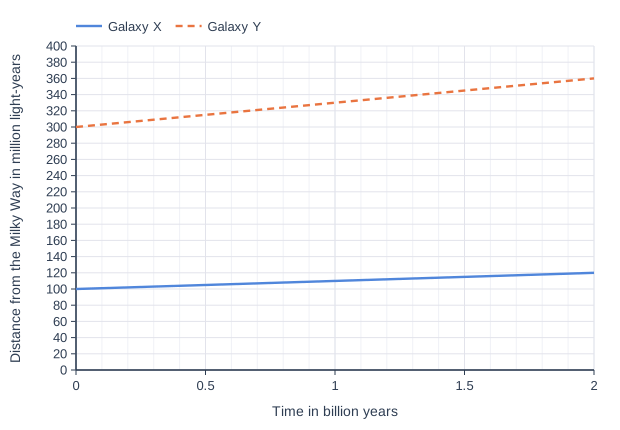
The graph shows how the distance of each galaxy from the Milky Way changes over 2 billion years in the model.

Which galaxy is moving away from the Milky Way faster? Explain how you can tell from the graph.

Use data from the graph to explain why the model supports the idea that the universe is expanding.

Line graph of Distance from the Milky Way in million light-years (y-axis, 0 to 400) against time in billion years (x-axis, 0 to 2). "Galaxy X" joins the points (0, 100), (2, 120). "Galaxy Y" (dashed) joins the points (0, 300), (2, 360).

Model answer

Galaxy Y is moving away faster, because its line on the graph is steeper.

In the 2 billion years, Y's distance increases from 300 to 360 million light-years, an increase of 60 million light-years. X's distance increases from 100 to 120 million light-years, an increase of only 20 million light-years. So both galaxies move away from the Milky Way, and Y, which is 3 times as far away, moves away 3 times as fast. More distant galaxies moving away faster is the pattern that astronomers find for real galaxies, and it is evidence that the universe is expanding.

Explanation

On a distance-time graph, the gradient (steepness) of the line shows the speed, so Y, with the steeper line, is faster. The changes in distance show that the galaxy which is further away moves away faster, in proportion to its distance. Astronomers find this same pattern for real galaxies from the red-shift of their light, and it is the evidence that the universe is expanding.

Mark scheme
  1. 1 mark

    galaxy Y, because its line is steeper / has a greater gradient (slope)

    1 mark for each of points 1 to 3. Both Y and the reason are needed. ALLOW Y's distance increases more in the same time. DO NOT ALLOW 'Y, because it is further away' with no reference to the steepness of the line or the change in distance.

  2. 1 mark

    use of data: in the 2 billion years, Y's distance increases by 60 million light-years (from 300 to 360 million light-years), but X's distance increases by only 20 million light-years (from 100 to 120 million light-years)

    Both increases are needed, or a correct comparison of them: ALLOW Y moves 3 times as far as X in the same time / Y moves away 3 times as fast as X. ALLOW speeds of 30 and 10 million light-years per billion years. IGNORE units.

  3. 1 mark

    both galaxies are moving away from the Milky Way (their distances increase), and the galaxy that is further away (Y) is moving away faster: this is the pattern found for real galaxies in an expanding universe

    The idea that the more distant galaxy moves away faster is needed. ALLOW Y is 3 times as far away and moves 3 times as fast / speed is proportional to distance, as in an expanding universe. IGNORE 'the galaxies are moving apart' with no link to their distances.

Question 4

4 marks

A teacher uses a 'Doppler ball' to model red-shift. The ball has a buzzer inside it that gives out a sound with a steady frequency. The teacher swings the ball round in a large circle on a string. The students listen to the sound as the ball moves towards them and then away from them.

Describe how the frequency and the wavelength of the sound waves reaching the students change while the ball is moving away from them.

Explain how this models what happens to the light from a distant galaxy.

Model answer

While the ball moves away from the students, the sound waves reaching them are stretched out. The wavelength is longer and the frequency is lower, so they hear a lower note.

A distant galaxy that is moving away from the Earth is like the ball moving away. Its light waves are stretched in the same way, so the light reaching the Earth has a longer wavelength and a lower frequency than the light it gave out. The light is shifted towards the red end of the spectrum: this is called red-shift.

Explanation

When a source of waves moves away from you, each wave is sent out from a little further away than the one before, so the waves reaching you are stretched: the wavelength is longer and the frequency is lower. With sound you hear a lower note; with light the spectrum moves towards the red end. The speed of the waves does not change, only their wavelength and frequency.

Mark scheme
  1. 1 mark

    the frequency of the sound reaching the students is lower (than the frequency given out by the buzzer) / the pitch (note) is lower

    1 mark for each of points 1 to 4. ALLOW the frequency decreases. IGNORE the sound is quieter / louder.

  2. 1 mark

    the wavelength of the sound reaching the students is longer / the waves are stretched out / the compressions are further apart

    ALLOW the wavelength increases. IGNORE references to the speed of the sound.

  3. 1 mark

    a distant galaxy moving away from the Earth is like the ball moving away: the light reaching the Earth from it has a longer wavelength and a lower frequency than the light it gives out

    Both the idea of the galaxy (source) moving away and a change in the wavelength or frequency of its light are needed. ALLOW the light waves from the galaxy are stretched in the same way. DO NOT ALLOW the light from the galaxy slows down.

  4. 1 mark

    the light is shifted towards the red end of the spectrum / this is called red-shift

    The word 'red-shift', or a shift towards the red end of the spectrum, must be given. ALLOW the lines in the galaxy's spectrum move towards the red end.

Ready to try the rest? Every answer you write is marked against the mark scheme, so you can see exactly where the marks are.

Study Helper Hints first, answers after you try

Stuck on this one? Ask for a hint and I’ll point you in the right direction, without giving the answer away. Once you’ve checked your answer, I’ll show you how the marks are awarded.